
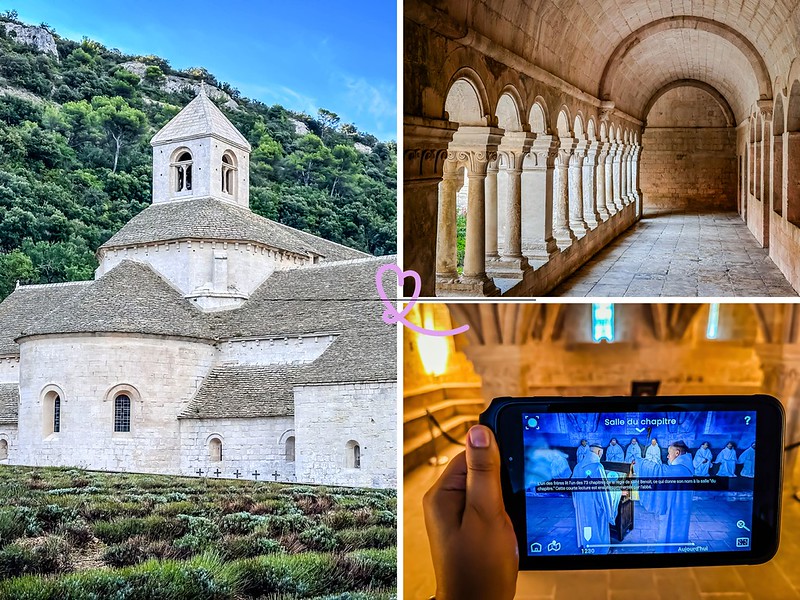
Are you a fan of Romanesque architecture? The Abbey of Notre-Dame de Sénanque awaits you in a secluded valley, a few kilometers from Gordes, in the Luberon. We were struck by the simplicity of this 12th-century Cistercian monastery, which is still home to a community of monks today. A visit that feels like stepping back in time, far from the hustle and bustle of the neighboring villages.
In this article, discover our helpful tips—illustrated with photos —to help you best prepare for your visit to Sénanque Abbey and have a wonderful time!
This guide is completely independent, based on our experiences. We visited the region anonymously, making our own choices and paying our bills in full.
Why visit Sénanque Abbey?
Is Sénanque Abbey worth the trip? Our opinion:
Yes, Sénanque Abbey is worth a visit. This Romanesque monastery, which is still inhabited, offers a rare glimpse into Cistercian life. We enjoyed the HistoPad, which helps explain how the monks used each space. The setting, nestled in its little valley, invites silence and contemplation.
It’s one of the best things to do in the Luberon and in Gordes.
Discover tours in the Luberon that include Sénanque Abbey here

Why is Sénanque Abbey famous?
The abbey owes its international fame to an image that has become emblematic of Provence: its stone facade and small slate-roofed bell tower, which stand out against rows of blooming lavender. When we visited, the flowers had already been picked, but we found that the site was still just as interesting.
Considered one of the purest examples of Romanesque Cistercian architecture, Sénanque is also the fourth Cistercian abbey founded in Provence, after Aiguebelle, Silvacane, and Le Thoronet. Finally, what struck us most was that a community of monks still lives and prays there.

Our favorite moments
Here are the three moments that made the biggest impression on us during our visit:
- The tranquility of the first visit of the morning, when the abbey is almost empty of visitors.
- The HistoPad, which brings to life the monks’ daily routines and the purpose of each room.
- A stroll through the cloister, open to the sky and perfect for contemplation.
- Book your tour of the Luberon here

WHERE TO STAY IN Lubéron
Our favorites:
In Gordes, a truly exceptional village:
Mas des Romarins Hotel – check photos and availability
Around Mane and Forcalquier:
Couvent des Minimes Hotel – check photos and availability
Around Menerbes, in the heart of the villages:
Bastine de Marie Hotel – check photos and availability

See our selection: Where to Stay in the Luberon
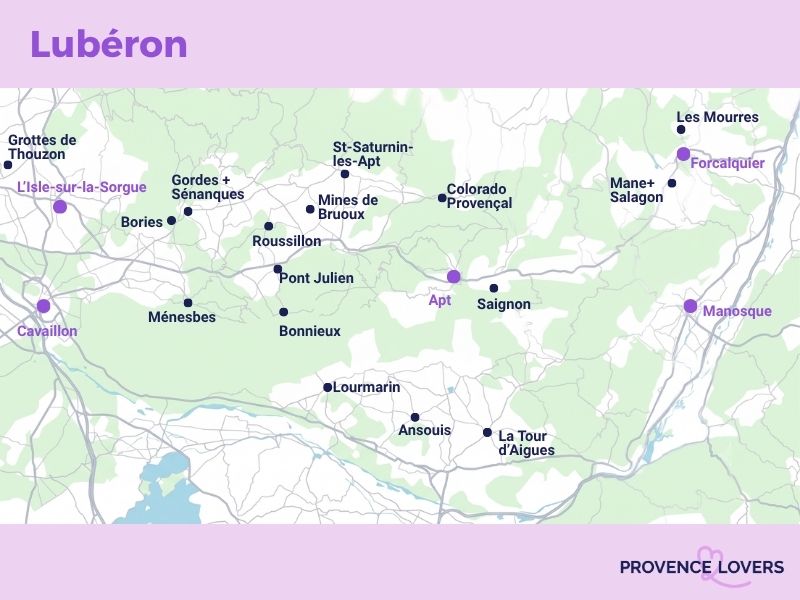
Directions and Map: Sénanque Abbey, Gordes
Where is Sénanque Abbey located?
- In the municipality of Gordes, 5 km north of the village, in the Vaucluse department,
- Travel time from Gordes: 10 min,
- Travel time from L’Isle-sur-la-Sorgue: 30 min,
- Travel time from Avignon: 1 hour.
- Here is a map to help you find your way:
How to get there?
There are several ways to get to the abbey:
- The car: it’s the simplest solution. From Coustellet, follow the D900 toward Gordes, then take the D177 on your left shortly after entering the village, toward Venasque. Please note: From March 15 to September 30, the D177 is one-way on the return trip: you must turn left toward Venasque, then turn right onto the D244 after 4 km to head back toward Gordes. This one-way street is permanent for buses, RVs, and trucks.
- On foot: It’s a 30-minute walk from the village of Gordes.
- By train: The nearest train stations are Cavaillon (21 km), L’Isle-sur-la-Sorgue (22 km), Carpentras (23 km), and Avignon (40 km). You’ll then need to take a taxi the rest of the way, since no bus line goes directly to the abbey (to be confirmed). The official website lists several local taxi companies.
- Organized tours: Many excursions in the Luberon include a stop at the abbey. See the options here.

Parking
A large, free parking lot is available for visitors. From there, it’s just a few minutes’ walk (about 5 minutes) to the abbey. Please note that overnight parking and camping are prohibited there.
From the parking lot, you have to walk along a wooded path to reach the abbey.

OUR TPS FOR RENTING YOUR CAR IN Provence
- Compare prices on our preferred platform: DiscoverCars – one of the best rated sites.
- Choose a car that is powerful enough (the roads are steep) but compact (some passages are narrow).
- Remember to take outcomprehensive insurance (some roads are winding and narrow).
- There is a lot of demand, book it early.

Useful tips: duration, schedules, eating…
Best time to visit
We recommend visiting first thing in the morning, when you can enjoy the peaceful atmosphere. Reservations are required: be sure to buy your ticket online before you leave. Another important point is that there is no cell phone reception in the valley. So be sure to book your ticket and itinerary in advance!
If you’re dreaming of that famous photo of lavender in bloom, aim for the blooming season, which is usually from mid-June to mid-July. As for us, we arrived after the harvest: the fields had already been cut. Keep in mind that this is also the busiest time of the year.

Length of visit and main difficulties
Allow between 30 and 45 minutes for a self-guided tour, and 1 hour for a guided tour. Allow a little extra time if you’d like to browse the monastery shop.
The medieval abbey has several staircases and many steps. As a result, access is very difficult for people with limited mobility and impossible for wheelchair users. It’s also worth noting that Sénanque remains a place of monastic life: appropriate attire is required, and silence must be observed. Pets are not allowed, with the exception of guide dogs.

Advice on how to visit
The tour includes access to the abbey church, the former dormitory, the cloister, the heating room, and the chapter house. We suggest that you first take some time to look at the facade from the outside, and then follow the tour suggested by the HistoPad or the guide. We ended our visit at the gift shop, located near the exit.

Visiting with children
We find the prices family-friendly: admission is free for children under 6, and costs €4 for ages 6 to 17. Good news for large families: free admission applies starting with the third child under the age of 18.
The HistoPad, which interactively recreates the rooms, can, in our opinion, capture the attention of young children. However, please prepare them for the silence required in this place of worship, as well as for the many stairs, which are not well-suited for strollers.

Schedules and rates
Self-guided tours are available at the following times:
- Monday through Saturday: 9:45 a.m. to 11:00 a.m. and 1:00 p.m. to 5:00 p.m. (last admission),
- Sundays: 1:00 p.m. to 5:00 p.m. (last admission).
Here are the rates for individual tours:
- Guided tour: 8€,
- Self-guided tour with HistoPad: €8,
- Students (ages 18–25, with student ID): €6,
- Children ages 6 to under 18: €4; free for the third child and any additional children,
- Free: children under 6, tour guides (upon presentation of their ID), priests, and members of religious orders.
- Reservations are required. You can book your time slot here. Visit the official website for more info here.

Guided tours
The abbey strongly recommends taking a guided tour. The tour lasts 1 hour and is conducted in French by a tour guide at the following times:
- Monday through Saturday: 10:00 a.m., 10:30 a.m., 1:30 p.m., 2:30 p.m., 3:30 p.m., 4:30 p.m., and 5:00 p.m.,
- Sundays: 1:30 p.m., 2:30 p.m., 3:30 p.m., 4:30 p.m., and 5:00 p.m.
If you don’t speak French, opt for the self-guided tour with HistoPad, available in 11 languages (French, English, German, Italian, Spanish, Dutch, Chinese, Japanese, Polish, Korean, and Portuguese). We found it well designed to give a sense of the monks’ daily lives in each space.

Lodging
The abbey has a monastic guesthouse that welcomes people wishing to go on a spiritual retreat. Please note that this is not a traditional tourist accommodation: your stay is arranged through the hotelier, who is happy to assist you.
Catering
There is no restaurant on the premises. The monastery shop, on the other hand, offers local products that are perfect for a quick gourmet treat. For a proper meal, the easiest option is to head to the village of Gordes, located 5 km away, where you’ll find several restaurants.

A LITTLE MORE patience
All the photos, maps, information, good addresses to make your stay in Provence a success, will soon be gathered in a single ebook!
A Cistercian abbey nestled in the valley
Even before you walk through the doors, the site reveals itself in all its simplicity. The location was by no means chosen at random: it complies with the Cistercian Order’s requirements, which stipulated that its monasteries be located away from towns.
The facade and the lavender fields
As we walked down from the parking lot, we came upon the abbey nestled at the bottom of a narrow valley about 1 km long and 300 m wide. The founding monks found everything they needed there: stone, wood, arable land, pastures, and, above all, a stream—the Sénancole.

In front of the building stand the famous rows of lavender, cultivated by the community. Did you know that in the Middle Ages, this site was the monks’ cemetery? Enjoy the view from the path, as access to the fields is prohibited to protect the crops. We were surprised by how peaceful the place was, even without the flowers.
The Abbey Church
Built first, on the highest point of the site, the abbey church defines the layout of the entire monastery. We were struck by its simplicity: no paintings, no stained-glass windows depicting historical scenes—just clean lines and harmonious proportions. This simplicity, mandated by the Cistercian Rule, ensures that nothing distracts the monk from his prayer.

Take a close look at the Latin cross plan, the steps leading up to the sanctuary, and the dome of the transept, adorned with the symbols of the four evangelists. The transept also houses the tomb of Geoffroy de Venasque, a lord and benefactor of the abbey. Even today, we have learned that the monks gather there seven times a day and once at night.


In the Footsteps of the Monks
The tour then continues into the convent buildings, where the community went about its daily life. Each room has a specific purpose, which the HistoPad and the guides bring to life.
The Old Dormitory
More than 30 meters long, the former dormitory could accommodate about 30 monks. In the 12th century, everyone simply had a straw mat, a pillow, and a blanket, and slept fully clothed so they could quickly make their way to church for the midnight service.

Look up at the twelve-lobed rose window, which lets in the light of the setting sun, and at the twelve semicircular arches. We have learned that Sénanque was a pioneer in the area of comfort: as early as the late 14th century, the king authorized the creation of individual alcoves. For our part, we smiled when we discovered the supposed origin of the nursery rhyme “Frère Jacques.”

The cloister
The cloister, the heart of monastic life, connects the various buildings without requiring one to leave the grounds. We loved the soft light that fills its galleries, which open onto a small central garden.

Each gallery had its own purpose: the eastern one, adjoining the church, was used for spiritual activities; the northern one, for reading; while the western one was used for personal hygiene, such as washing hands before a meal. Take a moment to pause in this place of meditation. There, we felt the calm that still reigns here, since the Rule requires silence at all times.

The Chapter House
Completed in 1202, the chapter house is reached by descending three steps—a symbolic gesture that recalls the humility required before speaking. Stone benches run along the walls and flank the abbot’s seat.

We were impressed by its acoustics: thanks to the six rib vaults, the voice carries effortlessly. Listen closely and imagine the meetings that take place there every evening. Because the hall is still in use: the monks read the Rule there, make decisions for the community, and elect their abbot there. We found this unbroken connection between medieval customs and modern life to be touching.

The Heater
Built between 1185 and 1200, the monks’ hall, or “chauffoir,” was the only heated room in the abbey besides the kitchen. People would meditate there, read there, and mend their clothes there. In the northeast corner, a scriptorium was used to draft charters and copy books.

We spent a long time looking at the 12th-century chimney and its conical hood, as well as the single central pillar that supports the vaults. Take a closer look at its capital: the inverted fleurs-de-lis there symbolize the founders’ devotion to the Virgin Mary. We also learned that a staircase led to the outhouses, which were built over a stream.

It’s time to book!
Compare everything: companies, prices, schedules and availability.
An Abbey That’s Still Alive Today
Sénanque is not a static museum. A Cistercian community has lived there since 1988 and opens part of its home to visitors, which is still rare for a religious site.
The HistoPad: A Journey Back in Time
During our self-guided tour, we used the HistoPad, a digital tablet included with the ticket. This tool has helped us better understand how monks lived in the Middle Ages and how they used each area of the abbey.

Available in 11 languages, it is particularly well-suited for non-French-speaking visitors who are unable to follow the guided tour in French. This will give you the opportunity to see the rooms as they used to be. For our part, we found it well thought out, without taking the focus away from the actual architecture.
The Community and the Monastery Shop
During visits, the monks withdraw into seclusion to continue their life of prayer, guided by the Rule of St. Benedict. They make their living from their work: growing lavandin, tending an olive grove, running an apiary, and operating a monastic inn. We understand that admission fees and the gift shop provide a large part of the funding for the monastery’s maintenance and restoration.

There, you’ll discover products from Sénanque as well as those from more than fifty abbeys and monasteries. You’ll also find the scents of Provence and a large bookstore section. We had a nice time there before hitting the road again.
History in brief
Nearly 900 years of history are etched into the stones of Sénanque. Here are the key steps to keep in mind before your visit:
- 1148: Cistercian monks from Mazan Abbey in the Ardèche founded the abbey in the Sénancole Valley. The name of the place is said to come from the Latin ” Sana Aqua,” meaning “healthy water.”
- 1160–1220: Construction spanned 60 years and took place in several phases: first the choir and transept of the church, then the monks’ wing, the refectory, the cloister, and finally the lay brothers’ quarters.
- 13th–14th centuries: this was the golden age. Thanks to donations from local lords, the abbey owns mills, barns, and houses from Marseille to Carpentras. About 40 brothers live there.
- 15th century: The Hundred Years’ War, food shortages, and epidemics struck the region. By 1439, only three monks remained.
- 1544: An armed band of Waldensians (a dissident religious movement) attacked the abbey and set fire to its southern section.
- 1791: During the French Revolution, the abbey was sold as national property.
- 1854–1903: A community resettled there and restored the site, before being driven out several times by laws against religious congregations.
- 1921: Part of the abbey was designated a Historic Monument. In 1926, Sénanque became a priory of Lérins Abbey.
- 1969–1988: The abbey was leased to Paul Berliet, an industrialist who restored it and established a cultural center there.
- 1988: Cistercian monks from Lérins returned to Sénanque. They still live there according to the Rule of St. Benedict.

EXPLORE the Luberon
- Top Attractions in the Luberon
- Best Villages
- Where to stay
- Gordes: Attractions – Hotels
- Roussillon
- Provençal Colorado

Frequently asked questions
When is the best time to see the lavender in bloom at Sénanque Abbey?
Lavender typically blooms from mid-June to mid-July, before being harvested by the community. When we were there, the harvest had already taken place. If the photo of the purple fields is important to you, be sure to check for details before planning your visit.
Can we attend Mass at Sénanque Abbey?
Yes, the Masses and services celebrated by the monks are open to the public. However, it is important to respect the peaceful atmosphere there: photography and recording are prohibited. The schedule of services is posted on the abbey’s official website.
PLAN YOUR TRIP TO provence
- Inspiration
Best things to do in Provence
Provence’s most beautiful towns
Most beautiful villages
Most beautiful castles
Best destinations

- Practical advice
Rent a car in Provence – in Nice – in Cannes – in Marseille – in Aix-en-Provence.
Itineraries: 5 days – 1 week – 10 days
Weekend Ideas: Best of – Romantic – Luxury – Unique

- Where to stay
Where to stay in Provence
Best luxury hotels

- The must-dos
Best things to do in Marseille
What to do in Aix-en-Provence
Best things to do in Avignon
Best things to do in Arles
Best things to do in Nice
Best things to do in Cannes
Best things to do in Antibes
Best things to do in Monaco
Best things to do in Saint-Tropez
Best things to do in Cassis
Things to Do in the Luberon
Things to Do in the Alpilles



 nos vidéos sur Youtube
 nos photos sur Instagram
 nos actualités sur Linkedin
 formulaire de contact


