
Gordes is a hilltop village in the Luberon, ranked among the most beautiful villages in France. With its Renaissance castle, cobblestone streets, and views of the Monts de Vaucluse, we found it to be a remarkable place, even if the large number of tourists means you need to plan your visit carefully.
Check out our ideas for things to do in Gordes, illustrated with photos that will make you want to go there.
This guide is completely independent, based on our experiences. We visited the region anonymously, making our own choices and paying our bills in full.
Is the village of Gordes worth a visit?
Yes, the village of Gordes is worth a visit. Perched on a rocky outcrop in the Monts de Vaucluse, it overlooks the plain and the Calavon Valley. We enjoyed its Renaissance castle, its cobblestone streets, and its views of the Luberon. It is one of the most beautiful villages in the Luberon—and in all of Provence.
If you don’t have a car, organized tours also allow you to explore Gordes from neighboring cities (Avignon, Aix-en-Provence, Marseille), in combination with other destinations in the Luberon— see the options
1. View from the Gordes lookout point (D15)

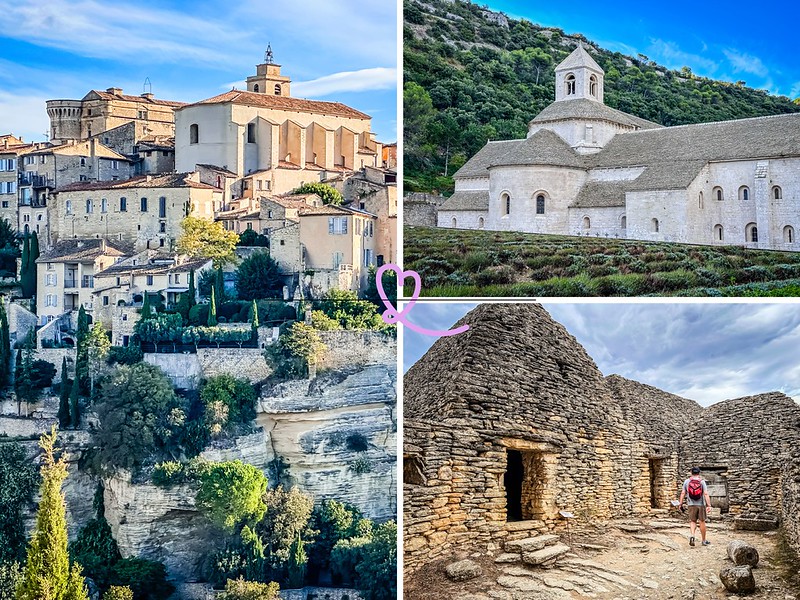
Along Route D15, a lookout point offers a panoramic view of Gordes. It was from this vantage point that we first saw the village, built in an amphitheater-like layout around its castle. You’ll probably recognize this image, which appears frequently on postcards and in guidebooks about the region. It’s easy to pull over by car on the side of the road, either before or after passing through the village.
- Free and open access, directly from Route D15
- Limited on-street parking spaces
2. Place du Château and its fountain

Place du Château is located in the heart of the village, right in front of the building that gives the square its name. We stopped there to look at its fountain, around which several shops and outdoor cafes are clustered. It’s a must-see spot, whether you’re coming from the parking lot or heading back down from the upper alleys. The square also offers a good view of the proportions of the castle that overlooks it.
3. Cellars of the Palais Saint-Firmin

Beneath the Palais Saint-Firmin, we discovered a vast semi-troglodytic underground network, carved into the limestone between the 11th and 18th centuries. The rooms once housed an oil mill, cisterns, and silos, providing a concrete glimpse into the village’s artisanal way of life before the modern era.
The tour—which can be taken on your own or with an audio guide—lasts about 30 minutes and ends with a small museum dedicated to life underground. The entrance is located between the church and the lookout point.

- Hours: Open from early April to early November, daily from 10:30 a.m. to 1:00 p.m. and then from 2:30 p.m. to 6:00 p.m. (1:30 p.m. in July and August)
- Price: €6 (full price), €5 (reduced price)
- Closed from early November through early April
- See the latest news on the official website here
OUR TPS FOR RENTING YOUR CAR IN Provence
- Compare prices on our preferred platform: DiscoverCars – one of the best rated sites.
- Choose a car that is powerful enough (the roads are steep) but compact (some passages are narrow).
- Remember to take outcomprehensive insurance (some roads are winding and narrow).
- There is a lot of demand, book it early.

4. Saint-Firmin Church

The Church of Saint-Firmin stands on the site of an earlier Romanesque church dedicated to Our Lady, built in the 11th and 12th centuries. Severely damaged, it was rebuilt in the 18th century and dedicated to Saint Firmin. Its square tower, which now serves as a bell tower, is believed to have originated from an old belfry. We liked its location, at the intersection of several shopping streets, and its striking interior colors.
- Open year-round, with extended hours in the summer
- Free admission
5. The cobblestone streets

In Provençal, “calades” refers to narrow streets paved with stones laid on their edges. We came across them at every turn in the village, lined with pale stone houses. This type of paving, typical of the Luberon, makes walking quite challenging in some places, especially when the ground is wet. Take a moment to look up at the facades: you’ll notice arched passageways and small squares dotted along the route.
- Free admission throughout the historic district
- Shoes with non-slip soles are recommended
6. Spend a night in Gordes

Most people visit Gordes for just a day, which means visitors are concentrated within a few hours. We recommend staying overnight so you can enjoy the village once the tour groups have left. The narrow streets empty out, and the village’s stone takes on different hues depending on the time of day. It’s also a chance to find parking more easily, since the parking lots near downtown fill up quickly during the day.
We recommend..:
- Mas des Romarins Hotel with beautiful views of the village – Check photos and availability
- Le Gordos Hotel and its beautiful, relaxing pool – Check photos and availability
- Ferme de la Huppe Hotel and its gourmet restaurant – Check photos and availability
- See our selection of the best hotels in Gordes
WHERE TO STAY IN Lubéron
Our favorites:
In Gordes, a truly exceptional village:
Mas des Romarins Hotel – check photos and availability
Around Mane and Forcalquier:
Couvent des Minimes Hotel – check photos and availability
Around Menerbes, in the heart of the villages:
Bastine de Marie Hotel – check photos and availability

See our selection: Where to Stay in the Luberon
7. Gordes Castle and the Pol Mara Museum

The Gordes Castle has overlooked the village for a thousand years. Rebuilt in 1525 by Bertrand Rambaud de Simiane, it combines a northern facade that still retains its defensive character with a southern facade typical of the Renaissance, featuring a monumental fireplace dating from 1541. We were impressed by its size.
Inside, the Pol Mara Museum features several hundred works by the Flemish painter, who settled in Gordes in 1972 and personally oversaw the installation of the exhibits in his museum, which opened in 1996. The castle also houses the tourist office today.

- Stairs leading to the upper floors
- Hours: Daily, from 10 a.m. to 1 p.m. and then from 2 p.m. to 6 p.m. in June, July, August, and September; from 10 a.m. to 1 p.m. and then from 1:30 p.m. to 5:30 p.m. the rest of the year
- Price: €6 (full price), €4 (reduced price and students), free for children under 12
- See the latest news on the official website here
8. Remains of the medieval ramparts and views

Gordes was surrounded by ramparts in the mid-14th century, amid the unrest caused by the Hundred Years’ War. At that time, these fortifications protected a town that was already organized around the castle.
We followed some of their ruins, which in places offer beautiful views of the farmland and the surrounding hills. The town eventually outgrew these walls in the 17th and 18th centuries, when the village’s population grew significantly.

9. Chapel of the White Penitents

The Chapel of the White Penitents has been mentioned in the archives only since the 17th century, under the authority of the brotherhood of the same name. It served as a fire station for many years before becoming an exhibition hall.
- Opening hours vary depending on the exhibition schedule, during the season
- Free admission
10. Washhouse and Rocher Bel-Air Trail

In the Fontaine Basse neighborhood, at the very bottom of the village, a washhouse fed by springs flowing from beneath the cliff has long been the beating heart of Gordes. It was already known in the 15th century. The trail is very steep and can become slippery after it rains: we recommend wearing sturdy shoes. But we really enjoyed the atmosphere away from the tourists.

From the washhouse, you can head uphill across the street toward the Rocher Bel-Air overlook (the first on this list) instead of returning to the village, enjoying beautiful views all along the way. Please note: Once you reach the top, you’ll need to take the bike path back toward the village, since there is no sidewalk along this stretch.
11. Village of Les Bories

Located about 1.5 km from the center of Gordes, the Village des Bories consists of about twenty dry-stone huts, built without mortar using the false vault technique. This complex was once used as seasonal farm outbuildings. We enjoyed the self-guided tour, which helped us understand the various uses of these structures: homes, sheepfolds, or sheds. The site is now organized as a museum of rural life.

- Soil made of dirt and pebbles
- Hours: Open daily year-round, except January 1 and December 25; hours vary widely depending on the month, but are at least from 10 a.m. to 5 p.m. in winter and at least from 8 a.m. to 6:30 p.m. in summer.
- Price: €8 (full price), €4 (reduced price and children), free for children under 12
- Free parking near the site (but the access road is narrow, so RVs must park near the main road)
- See the latest news on the official website here

It’s time to book!
Compare everything: companies, prices, schedules and availability.
12. Notre-Dame de Sénanque Abbey

The Abbey of Notre-Dame de Sénanque was founded in 1148 by Cistercian monks from Mazan, in the Ardèche region. It is the fourth Cistercian abbey to be founded in Provence. We found its simple Romanesque architecture to be particularly well-suited to the monastic way of life that continues there to this day.
Surrounded by lavender fields (which aren’t always in bloom…), it is home to an active community: as a result, tours take place outside of service times, and the site is closed on certain mornings.

- Hours: Vary throughout the year; closed on certain mornings
Monday through Saturday: 9:30 a.m. to 11:00 a.m. and 1:00 p.m. to 5:00 p.m. — Sunday: 1:00 p.m. to 5:00 p.m. - You can choose between a guided tour in French or a self-guided tour with an audio guide available in several languages.
- Price: €8 (full price), €4 (reduced price and children ages 6–17), €6 (students), free for children under 6
- About 4 km from the center of Gordes, or a 10-minute drive
- On-site parking
- See the latest news on the official website here
13. Nearby museums: Lavender, stained glass, olive oil…

And very close to Gordes in the valley—just a 10-minute drive away—you can round out your visit with museums that highlight specific aspects of the region:
- The Moulin des Bouillons is an old olive oil mill known as a “blood mill,” meaning it was powered by animals or human labor. Located on a Gallo-Roman site that has been inhabited for two thousand years, it preserves all of its winemaking tools, from vats carved into the rock to wine presses dating from the 1st to the 16th century. Located in the same park as the Moulin des Bouillons, the Museum of Glass and Stained Glass traces the history of glass from antiquity through stained-glass windows and everyday or scientific objects.

- The Lavender Museum in Coustelle: Discover Provence’s fine lavender and the distillation process
- Visit the Olive Oil Museum at the Domaine de La Royère in Oppède, about 15 km from Gordes, to follow the journey of the fruit from olive to oil
14. Provençal Market
Every Tuesday morning, the village center of Gordes hosts its Provençal market. There, you’ll find stalls run by local producers, offering everything from fruit and cheese to handmade crafts. It’s also the day when the village is at its liveliest, which has both its advantages and its drawbacks: the atmosphere is lively, but traffic and parking become more difficult. If you’re coming that day, you’d better arrive early.
A LITTLE MORE patience
All the photos, maps, information, good addresses to make your stay in Provence a success, will soon be gathered in a single ebook!
15. Exploring the Surroundings by Bike

The region is also very popular for cycling. The roads wind up and down through fascinating landscapes.
Things to Do Around Gordes
We also took advantage of the area around Gordes to extend our stay in the Luberon:
Roussillon and the Ochre Trail

Located about 13 km from Gordes—a 20-minute drive—the village of Roussillon is known for its ochre-colored facades. You’ll also find the Sentier des Ocres there, which offers a trail through old quarries that have shaped the colorful landscape.
Learn more.
The Other Villages of the Luberon

Other villages in the Luberon are worth a visit and can easily be combined with a day trip to Gordes.
See the most beautiful villages in the Luberon.
L’Isle-sur-la-Sorgue

About 18 km from Gordes—a 20- to 25-minute drive—L’Isle-sur-la-Sorgue is known for its canals and waterwheels.
How to Get to Gordes + Parking
Where is Gordes?
- In the heart of the Luberon Regional Nature Park
- From Avignon: a 40-minute drive
- From Aix-en-Provence: 1 hour and 10 minutes
- From Arles: 1 hour and 20 minutes

How to get there
By car, from the A7 highway, take Exit 25 (Cavaillon), then follow the D15 toward Gordes. By public transportation, the 907 bus connects Cavaillon to Coustellet, from where the 917 bus on the ZOU! network continues on to Gordes. As part of organized tours, several tour operators offer day trips to the Luberon that include a stop in Gordes.

If you don’t have a car, organized tours also allow you to explore Gordes from neighboring cities (Avignon, Aix-en-Provence, Marseille), in combination with other destinations in the Luberon— see the options
Parking in Gordes

There are several parking lots around the village where you can pay by the half-day. We recommend that you arrive early, as the spots closest to the center fill up quickly. Parking is metered every day from 8 a.m. to 7 p.m., with about 30 minutes of free parking depending on the zone.
Expect to pay around €8 for 4 hours and up to €30 for a full day in the most central areas. Buses are not allowed to enter the village and must park at the entrance.
EXPLORE the Luberon
- Top Attractions in the Luberon
- Best Villages
- Where to stay
- Gordes: Attractions – Hotels
- Roussillon
- Provençal Colorado

Helpful Tips for Visiting Gordes
How long and when?
Plan on spending 1 hour strolling through the village center. Plan on spending a full day if you include the museums, the abbey, and a walk in the surrounding area. Gordes remains a very popular tourist destination: we recommend visiting early in the morning or late in the day to avoid the largest crowds.
Tour directions, map and difficulty

The village is very hilly, with cobblestone streets that can be difficult to navigate at times. Be sure to wear sturdy shoes, especially if you plan to walk down to the washhouse or toward Rocher Bel-Air. There are public restrooms across from the post office—a useful landmark to keep in mind before heading out for a walk.

Visiting with children
Gordes is a great place to visit with the family. Children generally enjoy the Caves du Palais Saint-Firmin, with its combination of a video presentation and an underground tour. The Village des Bories also offers a fun way to explore traditional housing in an outdoor setting.
Restaurants

You’ll find a variety of restaurants in the villages: grocery stores that make great sandwiches, traditional diners, and the delicious fine-dining restaurant L’Orangerie.
Visiting Gordes in Winter
In winter, Gordes is less crowded than during the peak season. The village is located at a high elevation in the Monts de Vaucluse: we recommend that you bring warm clothing, as temperatures may be cooler than in Avignon or the surrounding plains. Some sites reduce their hours or close during this time.
PLAN YOUR TRIP TO provence
- Inspiration
Best things to do in Provence
Provence’s most beautiful towns
Most beautiful villages
Most beautiful castles
Best destinations

- Practical advice
Rent a car in Provence – in Nice – in Cannes – in Marseille – in Aix-en-Provence.
Itineraries: 5 days – 1 week – 10 days
Weekend Ideas: Best of – Romantic – Luxury – Unique

- Where to stay
Where to stay in Provence
Best luxury hotels

- The must-dos
Best things to do in Marseille
What to do in Aix-en-Provence
Best things to do in Avignon
Best things to do in Arles
Best things to do in Nice
Best things to do in Cannes
Best things to do in Antibes
Best things to do in Monaco
Best things to do in Saint-Tropez
Best things to do in Cassis
Things to Do in the Luberon
Things to Do in the Alpilles



 nos vidéos sur Youtube
 nos photos sur Instagram
 nos actualités sur Linkedin
 formulaire de contact


