
The Alpilles are a small limestone mountain range located between Avignon, Arles, and Salon-de-Provence. Hilltop villages, ancient sites, oil mills, and landscapes that inspired Van Gogh all come together in this small area.
In this article, we highlight ten must-see attractions in the Alpilles, from the hilltop village of Les Baux-de-Provence to the small roads lined with olive trees.
This guide is completely independent, based on our experiences. We visited the region anonymously, making our own choices and paying our bills in full.
Are the Alpilles worth a visit?
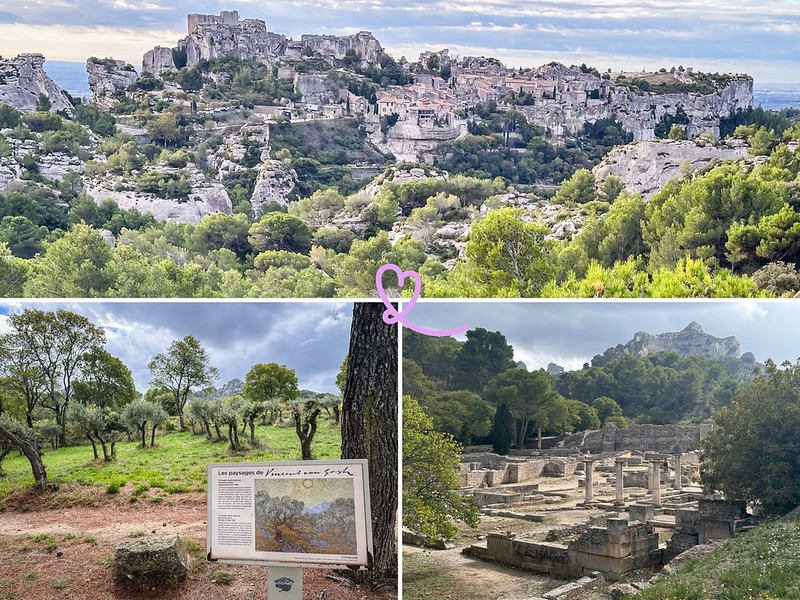
Yes, the Alpilles are definitely worth spending some extra time exploring during a trip to Provence. We loved the combination: a medieval castle, a Gallo-Roman settlement, a monastery associated with Van Gogh, and the rock formations of the mountain range!
It is one of the most beautiful destinations in Provence.
We recommend setting aside at least two days to enjoy the region at a leisurely pace, whether you’re more into hiking, fine dining, or exploring historical sites.

Must-See Places in the Alpilles
If you only have a very limited amount of time to spend in the Alpilles—just one day—we recommend the following places to experience the region’s various attractions:
- The Village and Castle of Les Baux-de-Provence
- The Glanum Archaeological Site
- The narrow streets of Saint-Rémy-de-Provence and a walk in Van Gogh’s footsteps
- And here’s a map of all our favorite attractions:
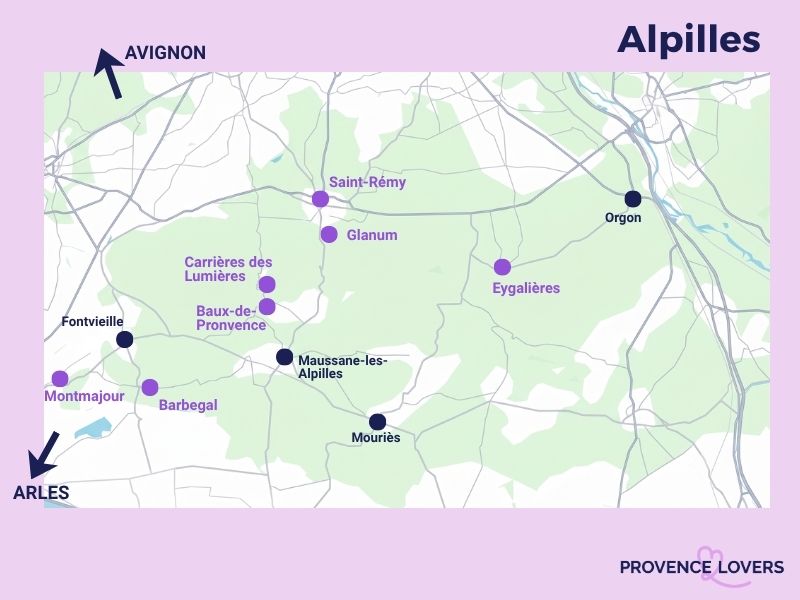
How to get there
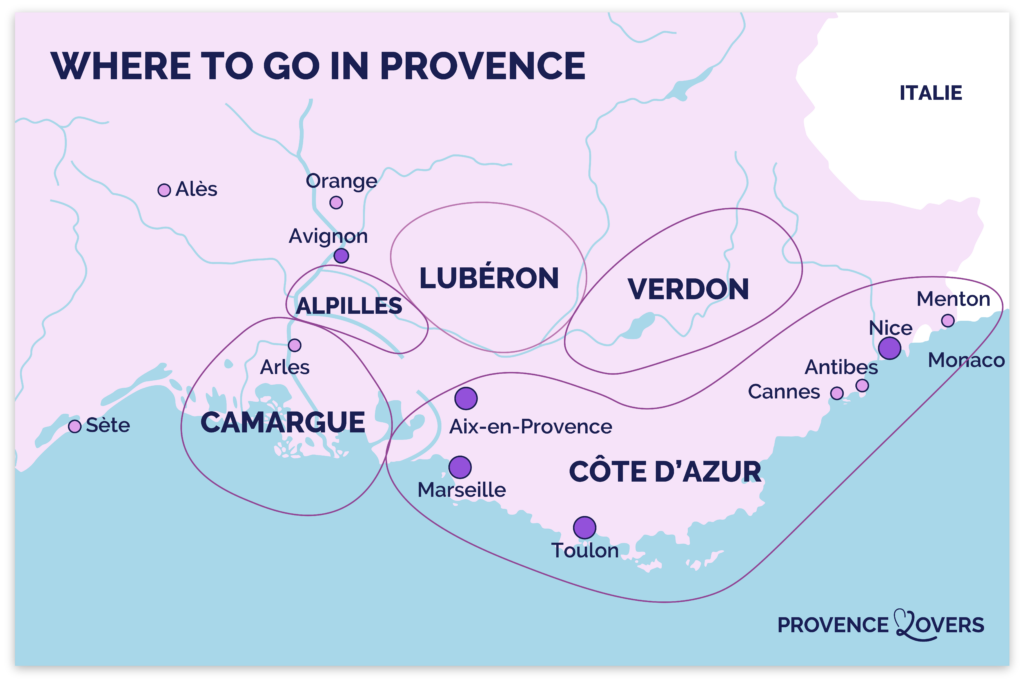
Tours are organized from the major cities of Provence (Arles, Aix-en-Provence, Nice, Marseille: see options), but we recommend renting a car so you can enjoy the many scenic viewpoints along the route and take your time.
Here’s a map to help you find your way:
- Arles to Saint-Rémy-de-Provence = 40 min
- Aix-en-Provence to Saint-Rémy-de-Provence = 1 hour
- Marseille to Saint-Rémy-de-Provence = 1 hour 15 minutes
- Nice to Saint-Rémy-de-Provence = 2 hours 30 minutes
- Saint-Rémy to Les Baux-de-Provence = 20 min
Where to Stay in the Alpilles
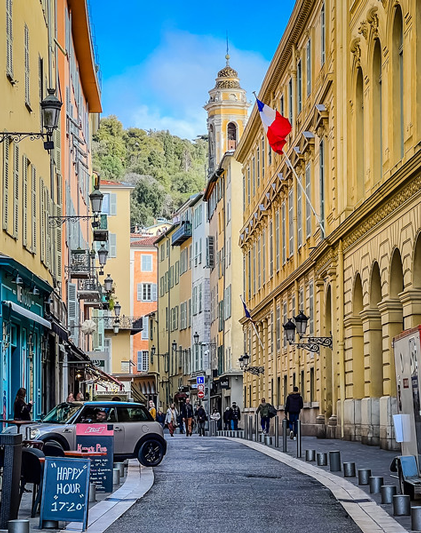
WHERE TO STAY IN Saint-Rémy-de-Provence
Our favorites:
- In the city:
Sous les Figuiers Hotel – check photos and availability
Mas des Carassins Hotel – Check photos and availability
- In the surrounding countryside:
Château des Alpilles Hotel – check photos and availability

1. The Village and Castle of Les Baux-de-Provence

Why it’s a must
Perched on a rocky outcrop, the village of Les Baux-de-Provence is undoubtedly the most spectacular site in the Alpilles. Ranked among the Most Beautiful Villages of France, it retains a maze of cobblestone streets lined with Renaissance mansions, such as the Hôtel de Manville, which now serves as the town hall.
We enjoyed climbing up to the Château plateau, which covers 5 hectares and offers a 360-degree panoramic view of the Alpilles and the Camargue. The site also features the remains of the fortress dismantled by Richelieu in 1632: the keep, Saracen towers, cave dwellings, and reconstructed siege engines such as the trebuchet.

As you make your way back down toward the village, take a moment to admire the Church of Saint-Vincent, which is partially carved into the rock, as well as the Chapel of the White Penitents and its frescoes by Yves Brayer. The Renaissance window known as “Post Tenebras Lux,” on Rue du Trencat, bears the Calvinist motto inherited from the Wars of Religion.

Practical advice
- We recommend allowing at least 1 hour and 30 minutes for the full tour.
- Castle Hours: Open year-round, every day, generally from 9 a.m. to 6 p.m. – Admission: €10 (full adult price) – Official website here
- A village open exclusively to pedestrians, with slippery cobblestone streets: be sure to wear sturdy shoes
See the latest news - Paid parking is required in the village (about €6 per hour)
- Learn more in our article about the castle
OUR TPS FOR RENTING YOUR CAR IN Provence
- Compare prices on our preferred platform: DiscoverCars – one of the best rated sites.
- Choose a car that is powerful enough (the roads are steep) but compact (some passages are narrow).
- Remember to take outcomprehensive insurance (some roads are winding and narrow).
- There is a lot of demand, book it early.

2. Glanum Archaeological Site

Why it’s a must
At the southern edge of Saint-Rémy-de-Provence, the Glanum site offers a glimpse into two thousand years of history. This city, founded by the Gauls and later expanded by the Romans, has yielded remarkably well-preserved ruins since excavations began in 1921: thermal baths, a forum, temples dedicated to the gods, and the sanctuary of the sacred spring that led to the city’s founding.
We strolled along the original cobblestone streets at the foot of the Alpilles, in a small valley that makes the visit as scenic as it is historic. We fell in love with the combination of archaeological ruins and majestic rock formations.

Practical advice
- We recommend setting aside at least 1 hour and 30 minutes to explore the entire site at a leisurely pace.
- Glanum Hours: 9:30 a.m. to 6:00 p.m. from April through September, 10:00 a.m. to 5:00 p.m. from October through March (closed on Mondays)
- Price: €9 (full adult price)
- Accessibility: The lower section is accessible, but getting to the lookout points may be difficult for wheelchair users due to the rocky and uneven terrain
- The Ancient Monuments (Triumphal Arch and Mausoleum of the Julii): Free and open to the public from Route D5; visible both day and night since they are illuminated
- Glanum’s official website: here
3. Narrow Streets of Saint-Rémy-de-Provence

Why it’s a must
Just a few minutes from Glanum, the historic center of Saint-Rémy-de-Provence offers a more urban and sophisticated atmosphere than Les Baux. The narrow streets are lined with art galleries, designer boutiques, and 17th- and 18th-century mansions, such as the Hôtel de Lagoy and the Hôtel Mistral de Mondragon.
We enjoyed Place Favier for its tranquility, as well as the fountain dedicated to Nostradamus, who was born in this house in the city center in the 16th century.

On Wednesday mornings, the town comes alive with its Provençal market: stalls selling lavender, goat cheese, local olives, and fruit line the streets of the town center from 8 a.m. to 1 p.m. Arrive early to avoid the crowds, especially in the summer.
Practical advice
- We recommend visiting in the morning, as many shops close between 12:30 p.m. and 3:00 p.m.
- The center is within walking distance of the surrounding parking lots
- Provençal Market: Wednesday mornings, from 8 a.m. to about 1 p.m.
- Find out more in our dedicated article
A LITTLE MORE patience
All the photos, maps, information, good addresses to make your stay in Provence a success, will soon be gathered in a single ebook!
4. Hiking in the Alpilles Regional Nature Park

Why it’s a must
The Alpilles Regional Nature Park is crisscrossed by a network of marked trails, winding through garrigue, centuries-old olive trees, and white limestone cliffs.
From Saint-Rémy-de-Provence, Lake Peïroou—an artificial reservoir built in the late 19th century—serves as a convenient starting point for several hiking trails. The hike to the Rocher des Deux Trous follows a trail that passes through a natural arch with two distinctive openings, before reaching vantage points offering unobstructed views of the plain.
You can also explore the Val d’Enfer, at the foot of the village of Les Baux, where erosion has carved out rocks with jagged shapes that are said to have inspired Dante’s “Inferno” in *The Divine Comedy*.

Practical advice
- We recommend setting out early in the morning during the summer, as the mountain range is very exposed to the sun and offers little shade.
- Trail maps are available at the Saint-Rémy-de-Provence Tourist Office and on the park’s website
- Be sure to bring plenty of water, a hat, and sunscreen, as the scrubland offers little shade
- Allow about 2 hours and 30 minutes for the Val d’Enfer loop, starting from Les Baux-de-Provence
- We recommend wearing good walking shoes, as the terrain is rocky
- For more information, visit the Alpilles Regional Nature Park website and the Chemins des Parcs website
5. Carrières de Lumières

Why it’s a must
Located in former limestone quarries at the foot of the village of Les Baux, the Carrières de Lumières project works by the great masters onto 14-meter-high walls. The programs change every year, featuring artists such as Cézanne, Kandinsky, and Van Gogh, depending on the edition.
We found the experience particularly refreshing in the midst of the summer heat, as the indoor temperature stays around 14°C all year round. We recommend that you book your tickets online in advance, as it can get very crowded in the summer.

Practical advice
- Hours: 9:30 a.m. to 7:30 p.m. in the summer, 10:00 a.m. to 6:00 p.m. in the winter
- Price: €16.50 – Latest news on the official website here
- Bring a warm garment even in the summer, when the temperature is around 14°C
- Book ahead to avoid the line
- Find out more in our dedicated article

It’s time to book!
Compare everything: companies, prices, schedules and availability.
6. Walk in Van Gogh’s footsteps

Why it’s a must
Vincent van Gogh voluntarily stayed at the Monastery of Saint-Paul de Mausole in Saint-Rémy-de-Provence from May 1889 to May 1890. This former 12th-century monastery, which has been converted into a nursing home, features a reconstructed room where the artist painted some of his most famous works.
We found the Romanesque cloister particularly soothing, with its carved columns and inner garden. We recommend extending your visit with a stroll along the Van Gogh Trail, a 1.5-kilometer walking path that connects the monastery to downtown, winding through the olive groves and wheat fields that inspired the painter.

Practical advice
- Saint-Paul de Mausole Monastery: Open daily from 9:30 a.m. to 7:00 p.m. from April through September, and from 10:15 a.m. to 5:00 p.m. from October through March
- Price: €10 (full adult price)
- Official website: here
- Van Gogh Walk: about 1.5 km; allow 30 to 40 minutes for an easy walk; free and open to the public year-round
- Choose the late afternoon for lighting similar to that in the painter’s works
7. Discover the local cuisine

The Baux-de-Provence Valley produces an olive oil protected by a Protected Designation of Origin, renowned far beyond the region. You can visit several mills around the mountain range, such as the Moulin Castelas near Les Baux, where you can taste and compare oils with varying degrees of fruitiness. Maussane-les-Alpilles, known as the “olive capital,” is home to several traditional olive mills that are open to visitors. The harvest takes place from November through January, which is the best time to visit a working mill

At the Alpilles Museum in Saint-Rémy, you can also learn more about the local terroir, the region’s seeds, and farming techniques.
The markets let you discover lots of local specialties.
Or you can simply enjoy the great restaurants in the area
8. Eygalières, an authentic Provençal village

About fifteen minutes from Saint-Rémy, Eygalières retains a more intimate atmosphere than its neighboring towns. The village is centered around a 17th-century belfry and steep alleyways lined with contemporary art galleries and fine-dining restaurants.
We enjoyed the hike up to the Saint-Sixte Chapel, which stands alone on a hill away from the village and offers an unobstructed view of the plain and the Alpilles. We also recommend the Sunday morning market, which is quieter than the one in Saint-Rémy, as a chance to experience the Provençal way of life away from the tourist hustle and bustle.
9. The Roman Aqueduct at Barbegal

Why it’s a must
The ruins of the Barbegal aqueduct and mill complex are among the least well-known archaeological sites in the Alpilles, even though they are a testament to a remarkable technical feat. The complex once powered sixteen waterwheels arranged in two rows along a slope, considered one of the greatest concentrations of mechanical power in antiquity. We found the site surprisingly peaceful, partly overgrown with vegetation, far from the crowds flocking to Glanum or Les Baux.
Practical advice
- Free access all year round
- Outdoor site with no on-site facilities: Be sure to bring water
- Located about 10 minutes from Fontvieille and 20 minutes from Arles
10. Montmajour Abbey

Why it’s a must
Built on a former rocky islet surrounded by marshes, Montmajour Abbey now overlooks the plain between Arles and Fontvieille. Founded in the 10th century by Benedictine monks, it still features a Romanesque abbey church, a cloister, and a crypt carved directly into the rock.
We climbed up to the Abbé Tower, which was added in the 14th century, to enjoy an unobstructed view of the Alpilles and the Camargue. We also spotted, a few hundred meters away, the small Sainte-Croix Chapel, standing alone in the middle of an ancient rock cemetery. The abbey is also known for having inspired several of Van Gogh’s paintings; he enjoyed taking walks there from Arles.

Practical advice
- Open year-round, closed on some Mondays during the off-season: check the hours before you go
- Allow about 1 hour for the tour
- A remarkable view from the Tour de l’Abbé, accessible via a narrow staircase
- Price: 7 euros
- Hours: 9:00 a.m. to 6:15 p.m., June through September—see all hours here


Other villages and attractions to explore in the Alpilles
In addition to the ten must-see destinations, there are several villages worth stopping at if you have more time to spend in the area.
- Maussane-les-Alpilles: a quiet village known for its olive oil mills and its Provençal market
- Fontvieille: the birthplace of Daudet’s “Moulin de Daudet,” which inspired *Letters from My Mill*, and the starting point for the Barbegal Aqueduct
- Mouriès: the capital of the Vallée des Baux-de-Provence AOC, known for its Green Olive Festival in September
- Orgon: a village at the northern tip of the Alpilles, overlooked by the Notre-Dame de Beauregard Chapel and its panoramic view of the Durance Valley
- Servanes Golf Course: an 18-hole course nestled near Mouriès, among pine and olive trees
- The vineyards of the Baux-de-Provence AOC: estates such as Mas de la Dame, a pioneer in organic viticulture, and Mas Sainte-Berthe, known for its hand-harvested grapes, offer tours and tastings

Visit the Alpilles
How to Get Around
A car is still the most convenient way to explore the Alpilles, as the villages are 10 to 20 minutes apart. The nearest TGV stations are Avignon and Arles.
In the summer, buses from the ZOU! network serve certain villages, such as Les Baux-de-Provence, but service is limited during the off-season. We recommend checking the schedules before you leave if you plan to use public transportation.
Tours are also organized from the major cities of Provence (Arles, Aix-en-Provence, Nice, Marseille): see the options
For our part, we’ve always preferred traveling by car, which lets us visit several villages in a single day.

Parking
Parking varies greatly from one village to another. In Les Baux-de-Provence, parking is paid and mandatory within the village. In Saint-Rémy-de-Provence, there are several free parking lots surrounding the historic center, including those on Boulevard Marceau, Place de la République, and Avenue Frédéric Mistral. The pedestrian-friendly center of Saint-Rémy makes for a pleasant stroll once you’ve parked your car. We recommend arriving before 9 a.m. in the summer and on market days to find a parking spot easily.

Helpful Tips for Visiting the Alpilles
How much time to allow and the best season to visit
One day is enough to see the must-see sights in a single village, but we recommend setting aside three to four days to explore the entire mountain range at a leisurely pace. Spring and the off-season—between April and June, and then in September and October—offer pleasant temperatures and fewer visitors than in the summer.
Visiting the Alpilles with the Family
Children especially enjoy the Château des Baux, where the reconstructed siege engines and medieval activities in the spring and summer easily capture their attention. The Glanum site, with its ruins at child height, also sparks the imagination. We also tried out the Van Gogh Trail, which is accessible to young children thanks to its flat terrain and illustrated signs. Finally, we recommend the Carrières de Lumières, whose immersive show captivates visitors of all ages.
Things to do when it rains
If it rains, the Carrières de Lumières is still a safe bet, since the show takes place entirely indoors. The museums in Saint-Rémy-de-Provence and Les Baux—such as the Musée des Alpilles, the Hôtel de Sade, and the Musée des Santons—also offer a pleasant place to visit. However, we avoid visiting the Château des Baux in bad weather, since the site is outdoors and windy. We also recommend caution on the cobblestones in the narrow streets, which can be slippery when it rains.
Frequently asked questions
Which is the most beautiful village in the Alpilles?
The choice depends on your priorities. Les Baux-de-Provence offers the most spectacular setting, with its hilltop castle; Saint-Rémy-de-Provence charms visitors with its ancient heritage and more urban atmosphere; while Eygalières attracts those seeking tranquility and fine dining.
Can you visit the Alpilles without a car?
It’s difficult to explore the entire mountain range. From the TGV stations in Avignon and Arles, you can reach certain villages by bus, but service is limited, especially outside the summer season.
PLAN YOUR TRIP TO provence
- Inspiration
Best things to do in Provence
Provence’s most beautiful towns
Most beautiful villages
Most beautiful castles
Best destinations

- Practical advice
Rent a car in Provence – in Nice – in Cannes – in Marseille – in Aix-en-Provence.
Itineraries: 5 days – 1 week – 10 days
Weekend Ideas: Best of – Romantic – Luxury – Unique

- Where to stay
Where to stay in Provence
Best luxury hotels

- The must-dos
Best things to do in Marseille
What to do in Aix-en-Provence
Best things to do in Avignon
Best things to do in Arles
Best things to do in Nice
Best things to do in Cannes
Best things to do in Antibes
Best things to do in Monaco
Best things to do in Saint-Tropez
Best things to do in Cassis
Things to Do in the Luberon
Things to Do in the Alpilles



 nos vidéos sur Youtube
 nos photos sur Instagram
 nos actualités sur Linkedin
 formulaire de contact


