
The Luberon is a region in Provence known for its hilltop villages, ochre fields, and rolling hills covered with vineyards and olive groves.
But beyond this postcard-perfect scene, there are many other places and activities to discover in the region: archaeological sites, caves, museums, Provençal markets…
In this article, we’ll share with you the must-see spots in the Luberon and the best activities you won’t want to miss.
This guide is completely independent, based on our experiences. We visited the region anonymously, making our own choices and paying our bills in full.
Things to Do in the Luberon: Must-See Places
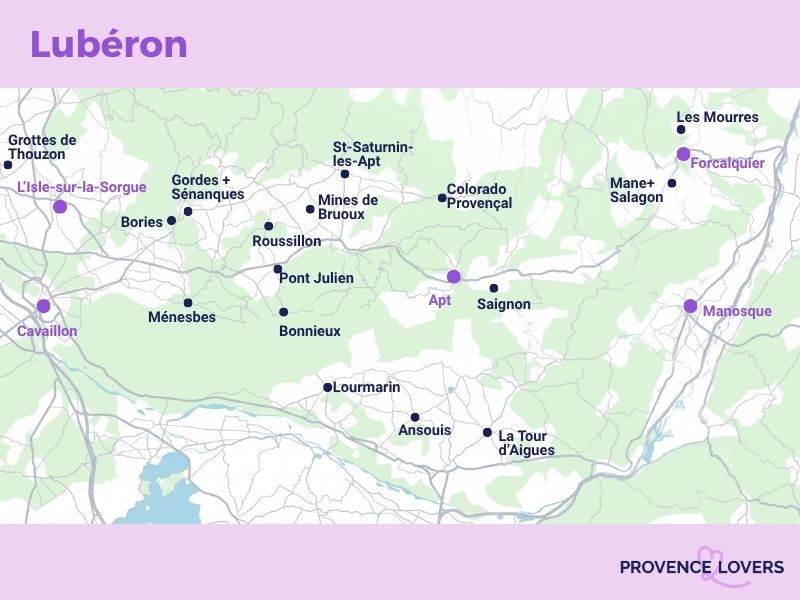
Must-see places: list and map
A brief geographical note: we are referring to the entire territory of the Luberon Regional Nature Park and its municipalities, and not just to the mountain range of the same name.
Here’s a map to help you find these must-see spots:
It’s a very rich region, a great place to spend several weeks. And it’s one of the most beautiful destinations in Provence. If you’d like to narrow down your choices even further, here are our top picks—the places that best represent the Luberon.
- The Village of Gordes
- Les Bories Site
- The Village of Roussillon and its Ochre Trail
- Provençal Colorado
- The Village of Saignon
- Lourmarin Castle
- The Village of Ménerbes
- Bruoux Mines
- The Village of Ansouis and Its Castle
- Sénanque Abbey

Where to Stay in the Luberon
WHERE TO STAY IN Lubéron
Our favorites:
In Gordes, a truly exceptional village:
Mas des Romarins Hotel – check photos and availability
Around Mane and Forcalquier:
Couvent des Minimes Hotel – check photos and availability
Around Menerbes, in the heart of the villages:
Bastine de Marie Hotel – check photos and availability

See our selection: Where to Stay in the Luberon
1. Famous villages in the Luberon (Gordes, Roussillon…)

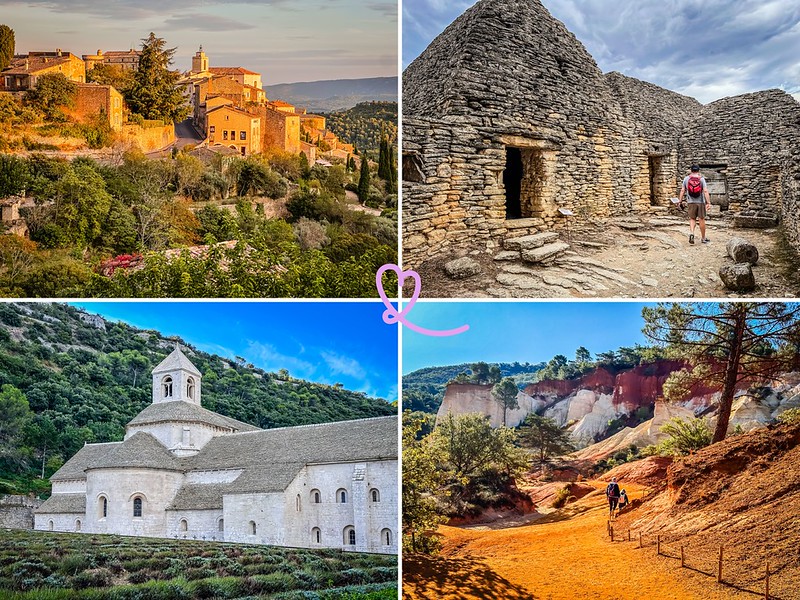
The Luberon owes much of its reputation to its hilltop villages, built of limestone and clinging to the hillsides. We were surprised by the diversity of these towns, which range from medieval fortified villages to more contemporary artists’ towns. Each one retains its own unique character, even though they all share these narrow alleys and shaded squares where it’s nice to stop and rest. We recommend taking a walk there early in the morning or late in the day, after the tour buses have left.
Many of them are among the most beautiful villages in Provence.

- Gordes, for its dry-stone houses terraced along the hillside
- Roussillon, for its facades in seventeen shades of ochre
- Lourmarin, known for its market and its Renaissance castle
- Ménerbes, for its quiet streets and its view of the plain
- Ansouis, for its castle and its designation as one of the most beautiful villages in France
2. Less-known villages (Saignon, Bonnieux…)

In addition to the names that appear in every guidebook, the Luberon is also home to some more low-key villages. We found them just as interesting, often less crowded, and therefore better suited for a leisurely visit. They offer a glimpse into local life away from the souvenir shops, while still retaining that same Provençal charm.

- Saignon, perched on a rock above Apt and its town square, which transports you back in time
- Saint-Saturnin-lès-Apt, nestled among vineyards and lavender fields, stretching out in a long, narrow strip
- Bonnieux, with its 86 steps leading up to the upper church
- …
OUR TPS FOR RENTING YOUR CAR IN Provence
- Compare prices on our preferred platform: DiscoverCars – one of the best rated sites.
- Choose a car that is powerful enough (the roads are steep) but compact (some passages are narrow).
- Remember to take outcomprehensive insurance (some roads are winding and narrow).
- There is a lot of demand, book it early.

3. Ochre sites (Provençal Colorado, Bruoux mines, etc.)

Ochre has shaped the landscape and economy of part of the Luberon for over a century. We were struck by the range of colors revealed by these old farms: yellow, red, orange, and sometimes almost purple. Depending on the site you choose, the tour takes place on foot in direct sunlight along a loop trail, or underground in a former mining tunnel. It’s one of the signature color palettes of Provence.

- The “Provençal Colorado” in Rustrel, which looks like a miniature version of an American canyon, takes between 1 hour and 30 minutes and 3 hours to hike, depending on the route you choose
- The Ochre Trail in Roussillon, a loop around the village, with two routes lasting 35 minutes or 50 minutes
- The Bruoux Mines in Gargas: a guided tour lasting about 1 hour through the old mining tunnels
- We recommend that you wear sturdy, closed-toe shoes, as dust tends to stick to the soles as well as to Claire-colored clothing.
4. Abbeys and priories (Sénanques, Salagon, etc.)

The region is home to several religious buildings that bear witness to the presence of monastic orders dating back to the Middle Ages. We appreciated the simplicity of their Romanesque architecture, which often contrasts with the surrounding landscapes—lavender fields or scrubland, depending on the season. Some of these sites are still inhabited by a community and are only partially open to visitors, while others have been converted into museums or gardens.

- Sénanque Abbey, near Gordes, was founded in the 12th century and is still home to a Cistercian community; reservations are required for tours of the interior.
- Saint-Hilaire Abbey, located between Ménerbes and Oppède, is more modest but just as steeped in history
- The Salagon Priory in Mane, with its ethnobotanical gardens
A LITTLE MORE patience
All the photos, maps, information, good addresses to make your stay in Provence a success, will soon be gathered in a single ebook!

5. Archaeological sites (Bories, Pont Julien, etc.)

The Luberon bears traces of human settlement dating back in some cases to antiquity, or even earlier. There are both dry-stone dwellings and Roman structures that are still standing. We were surprised by how well-preserved some of the ruins were—some of which are over 2,000 years old. These sites can generally be visited at your own pace and in a relatively short amount of time, making it easy to combine a visit with another activity on the same day.

- Le Village des Bories, near Gordes, features about thirty huts built of dry-stacked stone without mortar
- The Julien Bridge, between Bonnieux and Apt, built by the Romans in the 1st century BCE on the ancient Via Domitia
- The ruins of Apta Julia in Apt, an ancient Roman city visible in the town center
- The Small Roman Bridge in Mane
6. Thrilling activities (hot air balloon rides, etc.)

The Luberon isn’t just about leisurely sightseeing. There are several activities that let you explore the region from a more active perspective—or even from the air. They often offer a rather different perspective on landscapes we think we already know.
- Cavaillon via ferrata, on Saint-Jacques Hill; participants must be equipped with a climbing harness and carabiners; several routes available depending on skill level— check availability and make a reservation
- Sunrise hot-air balloon ride over Forcalquier, flying over fields and villages— check availability and book
- Mountain biking, horseback riding…
7. Towns in the Luberon (Apt, Manosque, L’Isle-sur-la-Sorgue, etc.)

Around the Regional Nature Park, several towns serve as convenient starting points for exploring the region. Some are located within the park’s boundaries, while others are right on its doorstep but still serve as convenient starting points for exploring the surrounding villages. We recommend that you choose your place to stay based on what you’re looking for: a lively market, a variety of shops, or simply a quiet evening.

- L’Isle-sur-la-Sorgue, which is technically outside the Luberon Regional Nature Park but serves as a natural gateway to it, thanks to its canals lined with waterwheels and its antique market
- Apt, the historic capital of the Luberon, is a great base from which to explore the entire region
- Cavaillon, a more urban town, known for its melons
- Manosque, the birthplace of the writer Jean Giono
- Forcalquier, with its old cathedral and Monday market, marks the transition to Haute-Provence
8. Castles (Lourmarin, Tour d’Aigues, Ansouis…)

Although it isn’t the region of France with the most castles, the Luberon still has several, dating from quite different periods. Some are still inhabited or belong to private families, while others have been restored and now house exhibitions or a museum. We’ve noticed that each one retains its own distinct character, whether it’s a romantic ruin, a Renaissance mansion, or an 18th-century extravagance.

- Lourmarin Castle, for its blend of medieval and Renaissance architecture and its art exhibitions
- Ansouis Castle, which had been inhabited by the same family since the Middle Ages until recently
- Château de la Tour d’Aigues, known for its ruins following a fire during the Revolution and its ceramics museum
- Château Sauvan, in Mane, nicknamed the “Little Trianon of Provence” for its 18th-century architecture
9. Geological Attractions (Mourres, Thouzon Cave, etc.)

Beyond the ochre, the Luberon offers other rather surprising natural formations, shaped by erosion or water over millions of years. We enjoyed this contrast with the region’s more traditional landscapes—between the oddly shaped rocks out in the open and the underground gallery adorned with stalactites and stalagmites.

- Les Mourres, on the Forcalquier Plateau, is a field of mushroom-shaped rocks sculpted by erosion; admission is free and open to the public. Allow about 1 hour for the walk.
- The Thouzon Caves in Le Thor, the only natural cave open to the public in Vaucluse, discovered by chance in 1902

10. Museums of the Luberon

Local themes—ochre, lavender, olive oil, writing, and painting—each have their own dedicated museum in the region. We found these places helpful in better understanding what we would later observe in the field, whether it was a field of flowers or a former mining site. Most of them can be toured in about an hour and are suitable for both adults and curious children.

- The Lavender Museum in Coustellet, featuring a still that is still in operation
- The Ochre Museum in Roussillon, to learn about extraction techniques
- Olive Oil Museum: From Harvest to Pressing, in La Royère
- The Corkscrew Muse in Ménerbes
- The Jean Giono Center in Manosque, named in honor of the writer who was born in the city
- The Artemisia Museum in Forcalquier, Amid the Scents of Haute-Provence
11. Hiking Trails in the Luberon Regional Nature Park

Designated a biosphere reserve by UNESCO, the Luberon Regional Nature Park protects a diverse array of flora and fauna, which is quite rich for a mountain range of modest size. There are holm oaks, junipers, and, on the higher ground, a few beech groves that are reminiscent of cooler climates.
In terms of wildlife, the park is home to Bonelli’s eagles, reintroduced Egyptian vultures, and numerous reptiles adapted to the summer drought. The trails, which are often well-marked, lead to viewpoints overlooking the valley or the plateau, depending on which side of the mountain range you choose.

- The GR9 long-distance hiking trail, which crosses the mountain range from east to west
- The ascent to Mourre Nègre, the highest point of the mountain range at an elevation of 1,125 meters
- The trails around Buoux and its fort
- …
12. Luberon Vineyards

The Luberon AOC designation covers a significant portion of the region, between south-facing hillsides and varied soils ranging from limestone to clay terraces. We tasted mostly whites and rosés, which are known for their freshness, though we didn’t neglect the more full-bodied reds either. Many wineries offer tours of their cellars followed by a tasting, often with a view of the vineyards and sometimes of a hilltop village in the background.
View options for winery tours and tastings in the Luberon – view options
13. Cuisine of the Luberon

Unsurprisingly, the Luberon is one of the most active truffle-growing regions in Provence. During the season, from November through March, several estates organize truffle-hunting excursions led by a trained dog, usually followed by a tasting. When it comes to dining, we have fond memories of restaurants that highlight local ingredients—sometimes in a setting steeped in history, sometimes with a view that rivals the food on the plate.
- Guided truffle hunt in the Luberon— see options
- Restaurant du Couvent des Minimes, in Mane, offering a setting steeped in history and featuring local specialties from Haute-Provence
- The Grand Hôtel Restaurant in Gordes, offering refined cuisine with a view of the valley
14. Local crafts (oil, vinegar, soaps, etc.)

The Luberon is home to artisanal craftsmanship that’s well worth a visit—far beyond the run-of-the-mill souvenir shops. We enjoy meeting producers in person, especially during harvest or production seasons. Many local raw materials are thus transformed into products that serve as a reminder of the region once you return home.

- Olive oil and wine vinegar from local producers, whose facilities are often open to visitors during the harvest
- Ochre processed into pigments, soaps, and ceramics
- Mane’s artisanal caramels, made according to a local recipe passed down through several generations
- The vinegar maker from Roussillon—be sure to give it a try!
15. Browsing the markets of Provence

Markets still set the pace of life in the villages of the Luberon, one day a week depending on the town. We always enjoy stopping by, both for the local products and for the lively atmosphere that fills the streets, which are usually quieter. They’re also a great way to meet locals, away from the tourist-oriented shops.
- The Apt market on Saturday mornings, renowned for its stalls selling fruit, cheese, and Provençal products throughout the city center
- The Lourmarin market on Friday mornings: lively and friendly
- The market in L’Isle-sur-la-Sorgue on Sunday mornings, better known for its antique dealers than for its food market
- The Forcalquier Market, Thursday Morning
- …
Lavender fields, in season

If you’re traveling between mid-June and early August, the lavender fields are a great addition to a visit to the Luberon. However, the blooming period varies from year to year depending on the weather, so it’s best to check the condition of the fields before heading out.
We don’t have any photos because we avoid this time of year due to our allergies.
Below is a famous photo of Sénanques Abbey with its lavender in bloom…
Some of the most photographed rows can be found, for example:
- The Claparèdes Plateau, between Bonnieux and Saignon
- The area surrounding Sénanque Abbey, near Gordes
- The Sault Plateau, a little further north and technically outside the park, is a must-see for lovers of this landscape
Visiting the Luberon: Practical Tips
Where is the Luberon?
The mountain range stretches for about 60 kilometers, bordered to the south by the Durance Valley and to the north by the Calavon Valley, between the towns of Apt and Cavaillon.
The territory of the Luberon Regional Nature Park extends beyond the mountain range itself: it also encompasses the Claparèdes Plateau, the Vaucluse Plateau to the north, and a large part of the Calavon Valley, for a total of nearly 77 municipalities.
- From Avignon: about 40 minutes by car
- From Marseille: about 1 hour and 15 minutes by car
- From Aix-en-Provence: about 50 minutes by car
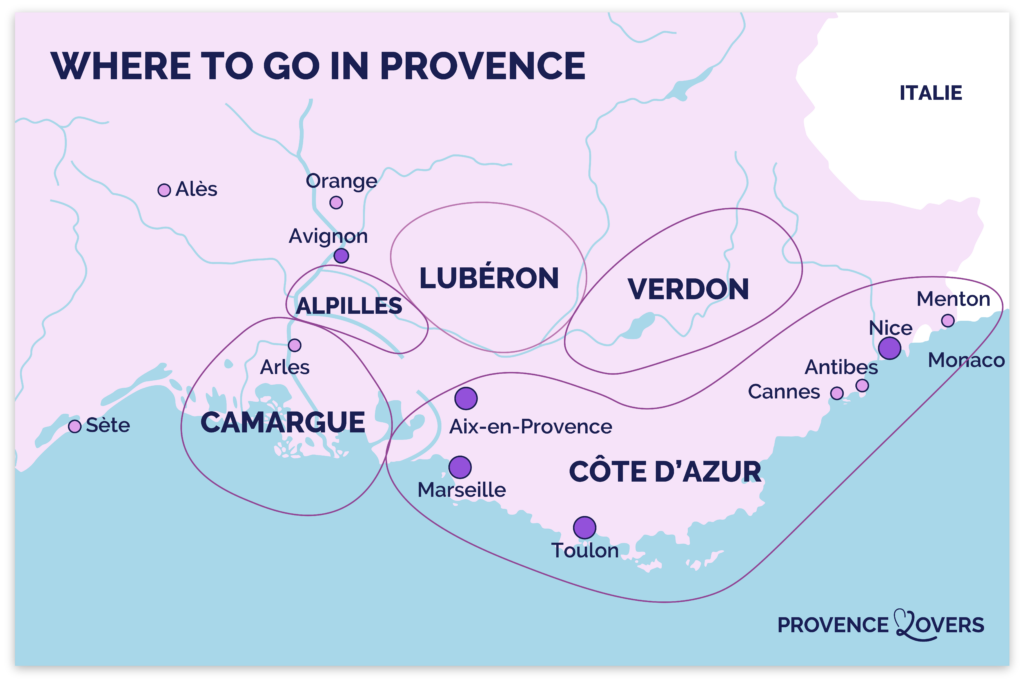
For those traveling from farther away, the Avignon TGV station remains the fastest way to reach the region, followed by the Aix-en-Provence TGV station. Marseille-Provence Airport is also just over an hour’s drive away.
Getting around
A car is by far the most convenient way to explore the Luberon. The villages are quite far apart from one another, and public transportation remains limited there. We recommend allowing a little extra time for your trips, as the Route des Crêtes is often narrow and winding, particularly around Bonnieux, Ménerbes, and on the climb up to Saignon.

Parking is generally available at the entrance to villages, rarely in the historic center, which remains pedestrian-only or has very limited vehicle traffic.
How much time should you set aside to visit the Luberon?
To see the main villages and an ochre site, plan on spending at least 3 days. If you want to visit the museums, the vineyards, and go hiking, you’ll want to plan for about a week. And if you want to take the time to explore the lesser-known villages and sample the local cuisine as well, about ten days is a more comfortable amount of time.
What can you do in the Luberon when it rains?
- Visit museums, such as the Lavender Museum or the Ochre Museum
- Exploring the Thouzon Caves
- Visit a winery for an indoor wine tasting
- Explore the villages, which retain their charm even in the rain
When is the best time to visit the Luberon?
Spring and early fall offer pleasant temperatures and fewer crowds at the sites. Summer is still the best time to see the lavender in bloom, but it’s also the busiest and hottest time of year. Winter, which is quieter, is ideal for truffle lovers and hikers.
EXPLORE the Luberon
- Top Attractions in the Luberon
- Best Villages
- Where to stay
- Gordes: Attractions – Hotels
- Roussillon
- Provençal Colorado



 nos vidéos sur Youtube
 nos photos sur Instagram
 nos actualités sur Linkedin
 formulaire de contact


