
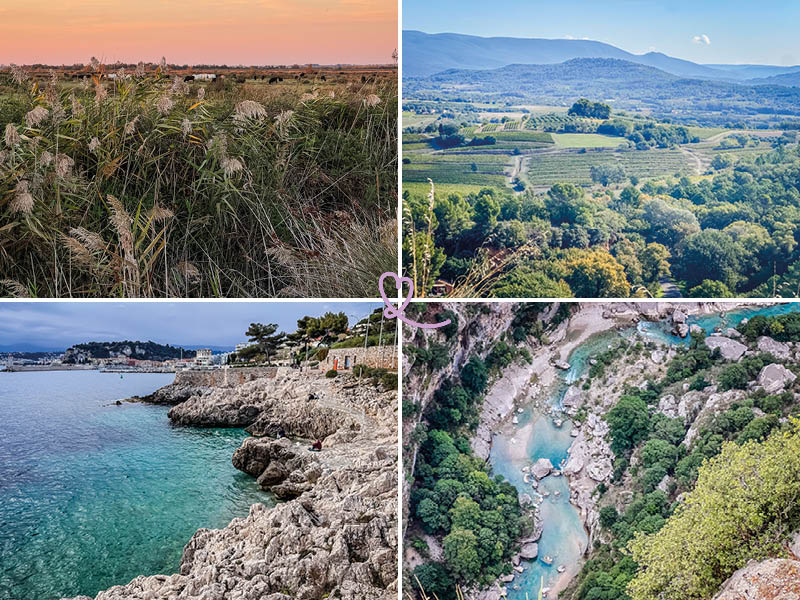
Lavender fields as far as the eye can see, hilltop villages, spectacular calanques and sun-drenched gastronomy… Provence offers a remarkable diversity of landscapes and atmospheres. But which destination should you choose for your vacation? The Lubéron and its Provencal markets, the Alpilles and its olive groves, the Côte d’Azur and its beaches, the Camargue and its wild horses, or the Verdon and its breathtaking gorges?
Here’s our complete guide to help you choose the Provencal destination that best suits your vacation desires.
This guide is completely independent, based on our experiences. We visited the region anonymously, making our own choices and paying our bills in full.
Provence’s most beautiful destinations – summary
The most beautiful regions
Provence is a region of great diversity: hilltop villages, Mediterranean coastline, iconic seaside resorts, mountainous areas, breathtaking gorges, dreamy islands… You need to set aside some time to explore all its aspects.
We’ve selected our five favorite destinations for you, the ones we think are the most varied and representative of what the region has to offer. For each, you’ll find below the must-see places, the main things to do, practical advice and our suggestions for accommodation.

Our 5 favorite destinations, which we find the most varied, are:
- The Lubéron, with its blond stone villages, colorful Provencal markets and lavender fields
- The Alpilles, with its Gallo-Roman heritage, centuries-old olive groves and unspoilt mineral landscapes
- The Côte d’Azur for its diverse coastline, rich cultural offering and Mediterranean gastronomy.
- The Camargue for its wild horizons, pink flamingos and lively pastoral traditions
- Le Verdon for its spectacular gorges, turquoise lakes and numerous outdoor activities

But there are also the great classics:
- Avignon, the City of the Popes and a UNESCO World Heritage Site, with its famous Pont d’Avignon and Palais des Papes
- Aix-en-ProvenceA city of art and history in the footsteps of the painter Cézanne, renowned for its fountains, mansions and lively Cours Mirabeau.
- MarseilleFrance’s second-largest city, gateway to the Calanques and a booming cultural scene
- The islands of Hyères – Porquerolles, Port-Cros and Ile du Levant – with their crystal-clear waters, seabed, pine forests and wild coves, accessible by ferry from the mainland.
- Mont Ventoux, the “Giant of Provence”, whose peaked peak at 1912m offers an exceptional panorama of the region, and is also known for its legendary stages in the Tour de France.
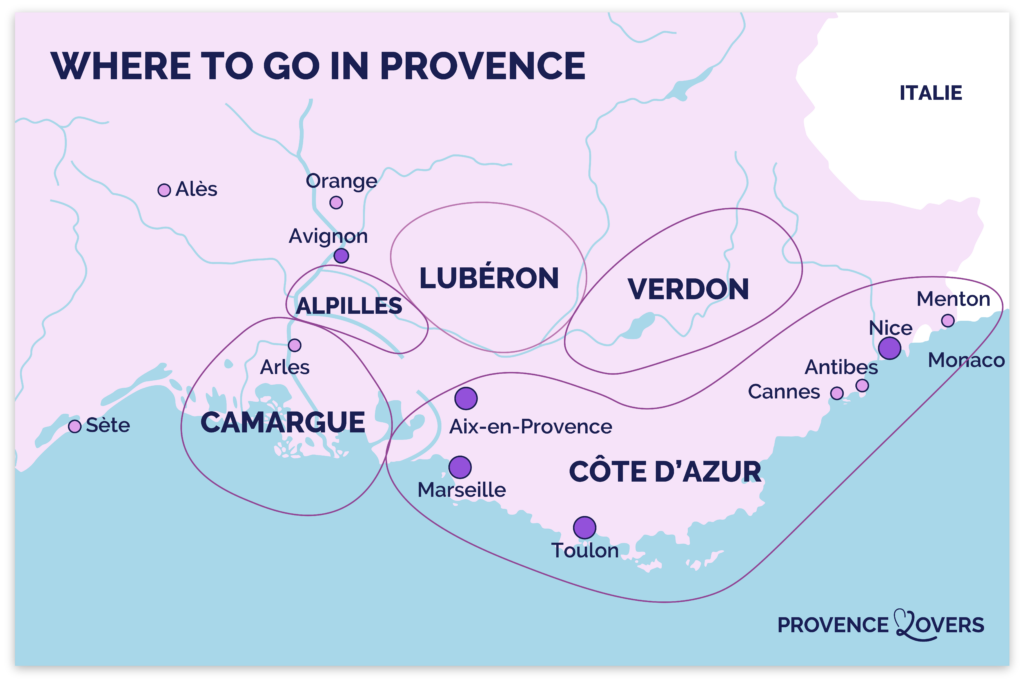
Where to go in Provence – Destination maps
These are must-see destinations in Provence! To help you find your way around, you’ll find a general overview of Provence’s destinations below.
The Luberon: hilltop villages and Provencal markets
Why we love the Luberon

Luberon embodies the very essence of authentic Provence. This hilly region between Avignon and Aix-en-Provence will seduce you with its blond stone villages clinging to the hills, colorful markets and lavender fields that set the landscape ablaze in summer. We particularly appreciate the relaxed pace of life in this region.
The villages retain their Provençal charm with their shaded little squares, ancient fountains, and narrow alleys where the scent of thyme and rosemary lingers. The region offers a perfect balance between nature and cultural heritage, without the tourist hustle and bustle of some neighboring destinations. Local producers perpetuate traditional know-how. You’ll discover wineries, century-old oil mills and artisan workshops.
Check out our selection of the best attractions in the Luberon.
WHERE TO STAY IN Provence
Our independent picks for the accommodation of your dreams:

Or, if you’ve chosen your destination, our selection of the best hotels in:

Example of a tourist attraction in the Luberon: Gordes
Perched on a rocky promontory, Gordes is one of the most beautiful villages in Provence and France. Its limestone houses are set in an amphitheatre facing the Vaucluse plateau. The cobblestone streets lead to artists’ studios and art galleries. Immerse yourself in the beauty of Provence with an organized tour that includes Gordes!
Not far from the village lies Sénanque Abbey, a jewel of 12th-century Cistercian architecture surrounded by fields of lavender that create a striking scene in June and July.

Example of an attraction in the Luberon: Roussillon
The village of Roussillon owes its fame to its ochre cliffs, with their flamboyant hues ranging from pale yellow to blood red. The village itself features colorful facades that reflect the palette of surrounding ochres.
The Sentier des Ocres (Ochre Trail) lets you discover these spectacular geological formations, the result of millions of years of erosion. We recommend visiting in the late afternoon, when the low-angle sunlight brings out the colors.Explore the Ochre Trail, Roussillon, and other villages as you let us guide you!

Example of an attraction in the Luberon: Lourmarin
This dynamic village at the southern foot of the Lubéron mountain range exudes the gentleness of the good life. Its Renaissance château, lively café terraces and Friday morning market make it a popular stopover. We have learned that the French writer Albert Camus spent his final years here. He is buried in the village cemetery. The surrounding area is ideal for hiking through vineyards and olive groves.
Ideas for organized tours that include Lourmarin here!

Example of a tourist attraction in the Luberon: Bonnieux
Clinging to the hillside overlooking the Lubéron, Bonnieux offers exceptional panoramic views over the Calavon valley. The climb up to the high church rewards the effort with a 360-degree view. We were blown away. Below, the Pont Julien, a 2,000-year-old Roman structure, bears witness to the region’s long history of human occupation.
Ideas for organized tours that include Bonnieux here!

Practical advice
We advise you to allow at least 4 to 5 days to discover the Luberon without hurrying. One week allows you to alternate cultural visits, nature walks and moments of relaxation.
The car remains indispensable, as villages are scattered and public transport is limited. Distances between the main sites vary from 15min to 45min by car. Find all our tips for renting a car in Provence here.
You can also opt for organized tours that allow you to discover the region with a guide.

In our opinion, the best period is from April to June and from September to October, when temperatures are pleasant and visitor numbers moderate. Lavender blooms from mid-June to mid-July, but this period attracts more visitors. In July and August, it’s best to visit early in the morning or late in the afternoon to avoid the heat and crowds. Winter offers a different, quieter atmosphere, although some establishments close from November to March.
OUR TPS FOR RENTING YOUR CAR IN Provence
- Compare prices on our preferred platform: DiscoverCars – one of the best rated sites.
- Choose a car that is powerful enough (the roads are steep) but compact (some passages are narrow).
- Remember to take outcomprehensive insurance (some roads are winding and narrow).
- There is a lot of demand, book it early.

Where to stay
The Luberon offers a wide range of accommodation, from charming hotels to guest houses and village rentals. We advise you to book in advance, especially in high season. Find the best establishments in Luberon here. We also enjoyed the Gordes offer!
Here’s a list of our favorite hotels:
- Hôtel Mas des Romarin, a charming hotel overlooking the village of Gordes
- Hôtel Le Jas de Gordes set in a Provencal farmhouse with peaceful surroundings, wooded gardens and swimming pool
- Hotel Mas de la Baume surrounded by greenery and calm with a superb swimming pool

The Alpilles: olive trees and Romanesque heritage
Why we love the Alpilles
The Alpilles is a regional park made up of a small limestone mountain range between Avignon and Arles. We loved the region’s exceptionally rich heritage and unspoilt landscape. Enjoy the light that inspired Van Gogh during his stay in Saint-Rémy-de-Provence. Here, Provence is rugged and untamed, dotted with centuries-old olive trees and slender cypresses.
The massif is home to villages full of character, where Provencal architecture is expressed in all its simplicity. Last but not least, local gastronomy features Vallée des Baux PDO olive oil, olives and lamb. A real treat! Compared to neighboring Lubéron, the Alpilles are less affected by mass tourism, although some sites such as Les Baux-de-Provence attract many visitors.
Check out our selection of the best attractions in the Alpilles.

Les Baux-de-Provence
Listed as one of France’s most beautiful villages, Les Baux crowns a rocky spur overlooking the valley. We enjoyed strolling through this perfectly restored medieval village, home to Renaissance mansions and Romanesque chapels. The Château des Baux, a ruined fortress perched atop the hill, offers a breathtaking view of the Alpilles and the Camargue. Join a guided tour to discover Les Baux-de-Provence in a whole new way.
Down below, the Carrières de Lumières feature monumental projections of works of art onto the walls of ancient quarries, a unique immersive experience that transported us. Beware: Baux-de-Provence is very busy all year round. We suggest you go early in the morning or late in the afternoon.

Saint-Rémy-de-Provence
In our opinion, this elegant city combines a historic heritage with a modern lifestyle. The archeological site of Glanum is a must-see. It reveals the remains of a remarkably well-preserved ancient Gallo-Roman city. Visiting Saint-Rémy also means following in the footsteps of the famous painter Van Gogh.
Nearby, the Saint-Paul-de-Mausole Monastery, where he stayed in 1889, houses the painter’s cell and displays reproductions of his works. Don’t miss Wednesday morning, when the market invades the streets of the center in an explosion of colors and scents.
Ideas for activities and organized tours in Saint-Rémy-de-Provence here!

Eygalières
This peaceful village epitomizes authentic Provence, far from the hustle and bustle of tourism. Its winding streets lead to a 12th-century Romanesque church and the remains of a medieval castle. We strolled around the square, shaded by century-old plane trees, which hosts a Friday morning market. The surrounding area offers beautiful walks through olive groves.
The Baux Valley
This part of the Alpilles massif traverses typical landscapes of thousand-year-old olive groves and white rock. Along the way, we visited a number of olive-growing estates, most of which open their doors for visits and tastings. Let yourself be tempted! Along beautiful, panoramic roads, we also enjoyed remarkable views over the region and discovered small, unspoilt hamlets.

A LITTLE MORE patience
All the photos, maps, information, good addresses to make your stay in Provence a success, will soon be gathered in a single ebook!
Practical advice
In our opinion, three to four days are enough to explore the Alpilles, taking time to stroll through the villages and do some hiking. A week allows you to take more time and combine your stay with a visit to nearby Arles or Avignon.
The car is still necessary, as towns and villages are scattered over a distance of some thirty kilometers. Journeys between the main sites generally take between 10 and 30 minutes. Find all our tips for renting a car in Provence here. You can also opt for organized tours that allow you to discover the region easily.

The ideal period is from April to June and from September to October, when the climate is pleasant and visitor numbers are reasonable. Be warned, summer can be very hot, with temperatures regularly exceeding 35°C, making mid-day visits a real pain. Winter offers a special light appreciated by photographers, although some sites reduce their opening hours.
Where to stay
In the Alpilles, the range of accommodation on offer is a blend of characterful hotels, traditional farmhouses and confidential addresses in the heart of olive-tree landscapes. As there aren’t that many establishments and they’re in high demand, we recommend you book as early as possible. Find the best accommodation in the Alpilles here. We also appreciated the offer from Saint Rémy de Provence. Here are a few recommended addresses:
- Hôtel Château des Alpilles: an elegant 19th-century residence nestled in a wooded park, offering a peaceful, refined setting.
- Hôtel Le Saint-Rémy & Spa: a contemporary hotel in the heart of the historic center, appreciated for its spa and chic, relaxed atmosphere.
- Le Petit Hôtel: an intimate address full of charm, ideal for a tranquil stay in the heart of the Alpilles.
- Hôtel Gounod: a friendly establishment in Saint-Rémy-de-Provence, perfect for enjoying the surrounding villages and countryside.

The Côte d’Azur: between sea and hinterland
Why we love the Côte d’Azur
We found that the French Riviera offers remarkable diversity, from limestone coves to legendary seaside resorts, and from hilltop villages to exotic gardens. It’s not for nothing that the Riviera has attracted many artists since the 19th century. The light is exceptional and the mild climate means you can enjoy the region all year round, with over 300 days of sunshine! Mediterranean cuisine excels here, blending Provencal and Italian influences with specialties such as socca niçoise, pissaladière and petit farcis. We enjoyed ourselves.
The Côte d’Azur has two contrasting faces. The coastline, particularly between Cannes and Nice, is very busy during the summer months, with a high level of urbanization. The hinterland, on the other hand, boasts authentic villages and remarkable natural landscapes. We recommend combining these different facets for a complete discovery of the region.
Check out our selection of the best attractions on the French Riviera.

Nice
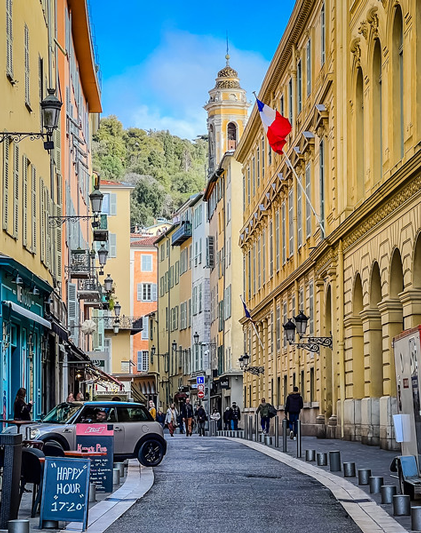
In the Côte d’Azur capital, we enjoyed the architectural heritage, dynamic cultural life and Mediterranean art of living. Take a stroll along the Promenade des Anglais, a 7km stretch of coastline along the Baie des Anges, offering breathtaking sea views. Old Nice will enchant you with its colorful narrow streets, the Cours Saleya market, and its ochre-colored facades.
We also loved the castle hill, which offers an exceptional view of the city and the bay. Finally, the many museums, including the Matisse Museum, bear witness to the city’s cultural influence.
All Nice activities and tours here!

Saint Tropez
A summer hotspot for celebrities, Saint-Tropez is renowned for its lively harbor and its famous Pampelonne Beach. We were charmed by this must-see seaside resort on the Côte d’Azur. With its colorful little streets, magnificent golden-sand beaches, and luxury resorts, you’re going to love this city!
Here you’ll find ideas for tours and activities in Saint Tropez.

Cannes
Renowned the world over for the Cannes Film Festival and its famous Promenade de la Croisette, you’ll love discovering this must-see seaside resort on France’s Côte d’Azur. A mecca for luxury and gambling, it is home to numerous prestigious hotels, restaurants, and casinos.
Between the historic Suquet district, the port, the beaches, the market and the museums, we loved this city.
Here are all the organized tours and activities in Cannes.

Monaco
An independent principality nestled between sea and mountains, Monaco combines luxury, spectacular architecture and Mediterranean panoramas. We were impressed by the Rock, the historic heart of the city with the Prince’s Palace and the old town with its narrow streets.
The Monte-Carlo district attracts visitors with its famous casino, manicured gardens and prestigious establishments. Between yacht harbors, museums and sea views, Monaco offers a unique experience on the Côte d’Azur.
Ideas for activities and guided tours in Monaco here!

The Calanques from Cassis to Marseille
Between Cassis and Marseille, the Parc National des Calanques protects a limestone massif plunging into a crystal-clear sea. We were captivated by these spectacular Mediterranean fjords. The Calanque d’En-Vau, the Calanque de Port-Pin, and the Calanque de Sugiton are among the most impressive.
Access is on foot or by boat, with car traffic restricted in summer to prevent fires.
Explore the Calanques on an organized tour and why not by boat?

Antibes and Cap d’Antibes
Antibes, located between Cannes and Nice, is famous for its beaches and the seaside resort of Juan-les-Pins. But it has much more to offer: rich heritage, museums, water sports and seaside walks. We also loved Cap d’Antibes, a peninsula famous for its coastal trail and the Garoupe Lighthouse, as well as its small beaches and luxury hotels.

Menton
The last French town before Italy, Menton benefits from a subtropical microclimate ideal for growing citrus fruit. We discovered a city of colorful facades set high above the sea. The exotic gardens, including the Jardin Serre de la Madone and the Val Rahmeh Exotic Botanical Garden, are home to some truly beautiful plant collections. Come in February for the Lemon Festival, which transforms the town into an explosion of color and creativity.
See organized tours and activities in Menton here.

Aix-en-Provence
Aix-en-Provence is an elegant city whose 17th- and 18th-century townhouses bear witness to a rich aristocratic past. We particularly enjoyed the Cours Mirabeau, an avenue lined with century-old plane trees and home to numerous cafés, bookstores, and lively outdoor seating areas.
The city is also inseparable from Paul Cézanne. You can visit the Musée Granet and the artist’s untouched studio, and follow the many sites that inspired his paintings. Such is the case with the Montagne Sainte-Victoire in the background. In addition, the morning market on Place Richelme and Place des Prêcheurs is, in our opinion, one of the best times to soak up the local atmosphere.
All tours and activities in Aix-en-Provence here.

Èze
Perched on a rocky outcrop, this medieval village offers breathtaking panoramic views of the Mediterranean. Don’t miss the Exotic Garden, set in the ruins of the castle, featuring an impressive collection of succulents in a spectacular setting. We enjoyed wandering through the village’s steep streets, vaulted passageways and artisan workshops, which give it a timeless atmosphere.
All activities and organized tours in Èze here.

Saint-Paul-de-Vence
This fortified medieval village in the hinterland of Nice has been attracting artists and art lovers since the 1920s. You’ll be seduced by its intact 16th-century ramparts encircling a maze of cobbled streets lined with art galleries and artisan workshops. We also visited the Fondation Maeght, just outside the village, which presents an exceptional collection of modern and contemporary art in an architectural setting designed by Josep Luís Sert.
Discover the best activities and excursions in Saint-Paul-de-Vence.

Practical advice
The Côte d’Azur deserves at least a week to discover both the coast and the hinterland. Ten days to two weeks will allow you to explore the site in greater depth, without having to rush. Traffic can be difficult in summer, especially along the corniche between Nice and Menton. We suggest you take the train to travel between the coastal towns, as the line along the coast offers remarkable views. See available timetables and book your train tickets now.
For the hinterland, the car remains indispensable. You can rent a car here and find all our tips for renting a car on the Côte d’Azur here.

The best time to visit the Côte d’Azur is from May to June and September to October, when temperatures are pleasant (20-25°C) and crowds moderate. July and August are very busy, with high temperatures (28-32°C), but you can still make the most of the swimming and the light! Winter remains mild (12-15°C) and sunny, ideal for discovering the region without the crowds, although swimming is cool. Beware, many establishments close between November and March in the tourist villages of the hinterland.
Where to stay
Nice
Thanks to its excellent rail and road links, the city is an ideal base from which to explore the whole of the Côte d’Azur. There’s a wide range of accommodation on offer, from small hotels to palaces. And in the evenings, the Old Nice and Port districts liven up the city with their restaurants and bars.
See the top-rated accommodations.
See our selection of hotels in Nice.

Cannes
An emblematic seaside resort, Cannes offers a wide range of accommodation, notably along the Croisette and around the center of town. The town is well-situated for exploring the Côte d’Azur, but remains quite touristy and lively. We recommend it for a beach and city break.
See the best rated accommodations
See our selection of hotels in Cannes.

Saint Tropez
The accommodation on offer is varied but often expensive, with high demand in summer. We recommend that you stay here if you want to enjoy the beaches and atmosphere of the Gulf, and that you book well in advance.
See the top-rated accommodations.
See our selection of hotels in Saint Tropez.

Antibes
This town of character between Nice and Cannes offers a good compromise between entertainment and tranquility.
See the best rated accommodations
See our selection of hotels in Antibes.

Cassis
This authentic fishing port is the ideal starting point for exploring the Calanques.
See the best rated accommodations
See our selection of hotels in Cassis.

The Camargue: wild horses and endless horizons
Why we love the Camargue
The Camargue captivated us with its unique landscapes of lagoons, salt marshes, and wild expanses where white horses and black bulls graze. This wetland between the two branches of the Rhône is a bird sanctuary of European importance, providing a refuge for colonies of pink flamingos and hundreds of species of migratory birds.
We enjoyed the timeless atmosphere of this region. Local traditions perpetuate an ancestral pastoral way of life, visible in the manades (bull and horse farms), gardians on horseback and Camargue races. Compared to other Provencal destinations, the Camargue offers a different, wilder and more contemplative experience, focused on nature and wildlife.
Check out our selection of the best attractions in the Camargue.

Arles
At the gateway to the Camargue, Arles seduced us with its rich heritage and unique atmosphere. You’ll discover remarkably well-preserved Roman monuments, such as the Arles Amphitheater and its ancient theater, both designated as UNESCO World Heritage Sites.
We also enjoyed strolling through the historic center, between lively squares and alleys steeped in history. The city is also marked by the passage of Van Gogh, whose footsteps you can follow at several emblematic sites.
Here you’ll find ideas for guided tours and activities in Arles.

Les Saintes-Maries-de-la-Mer
Capital of the Camargue region, this fortified village with its 12th-century fortress-church retains the atmosphere of a traditional Mediterranean port. We loved the authentic atmosphere of its lively streets and port. You can enjoy the long sandy beach for swimming or horseback riding along the seashore.
The village is also marked by the famous Gypsy pilgrimage, held every year on May 24 and 25, which attracts thousands of people to honor Saint Sara. The marina and bullring bear witness to Camargue life. You’ll also find plenty of restaurants where you can try tellin, a small local shellfish.
Discover activities and excursions in and around Les Saintes-Maries-de-la-Mer.

Camargue nature reserves
The Camargue is home to several protected nature reserves, allowing you to discover its landscapes in their best preserved state. We particularly enjoyed the Camargue National Nature Reserve, a vast expanse of marshes, ponds, and salt marshes where a wide variety of birds can be observed.
The Domaine de la Palissade , the Parc ornithologique du Pont de Gau and the Parc de la Capellière also offer accessible itineraries for approaching flamingos, herons and other emblematic species. In our opinion, these protected areas are one of the best ways to understand the unique ecological wealth of the Camargue.
See nature experiences and visits in the Camargue.

Aigues-Mortes
This fortified medieval town emerges from the salt marshes in a striking setting. The perfectly preserved 13th-century ramparts, built by Saint Louis, stretch for 1.6km and offer panoramic views over the Camargue and the salt marshes. The Tower of Constance, an imposing keep, served as a prison for Protestants after the revocation of the Edict of Nantes.
The salt flats of Aigues-Mortes produce fleur de sel and Camargue salt in a fascinating landscape where the mountains of white salt contrast with the pink waters of the basins. They’re almost as beautiful as the Salin-de-Giraud salt flats.
Explore Aigues-Mortes and its salt marshes with guided tours.

The wild beaches of the Camargue
We were impressed by these almost infinite stretches of sand, bordered by dunes and wild vegetation. Among the best-known, the Plage de Piémanson and the Plage de Beauduc offer a rawer, more secluded atmosphere, far from the seaside resorts. Here you can enjoy wide-open spaces, ideal for walking and contemplation, sometimes with the presence of horses or birds. These beaches are among the Camargue’s most emblematic landscapes.

Camargue races and manades
You can watch the Camargue races, a local tradition in which the raseteurs try to catch attributes attached to the bulls’ horns. These shows take place mainly from April through September in the village arenas of places such as Les Saintes-Maries-de-la-Mer, Aigues-Mortes, and Saint-Rémy-de-Provence.
We also recommend a visit to a manade, where you can learn about the breeding of Camargue bulls and horses, often with demonstrations on horseback. We believe this is one of the best ways to understand local culture and traditions.

Practical advice
Three to four days are all it takes to discover most of the Camargue, alternating birdwatching, horseback riding, cycling and village visits. A week allows you to explore the region in greater depth and take full advantage of its special atmosphere.
The car makes it easy to get around the region. You can rent a car here and find all our tips for renting a car in Provence here. Another alternative is cycling, an excellent way to explore the area around Les Saintes-Maries-de-la-Mer on flat roads. Numerous cycle routes criss-cross the region.

Mosquitoes can be very present from April to October, especially at sunrise and sunset. Take repellent and protective clothing with you. The best time for birdwatching is from April to June, and from September to October during migration. Summer can be very hot (30-35°C) and windy (the mistral blows regularly), but allows you to combine nature and swimming. Winter offers wonderful light and fewer visitors, although some sites reduce their opening hours. Spring reveals the Camargue in all its splendor with the blossoming of flowers and the return of migratory birds.
Where to stay
Les Saintes-Maries-de-la-Mer
The heart of the Camargue offers a good base from which to explore the region. The village offers a range of accommodation, from campsites to charming hotels, some of which are located in the heart of the marshes!
See the best rated accommodations
We particularly liked it:
- Hôtel Mas de la Fouque: a charming hotel in the heart of the marshes
- Mas de la Grenouillère Hotel and Equestrian Center in the heart of nature

Arles
At the gateway to the Camargue, this town steeped in history offers a cultural alternative, with its Roman and Romanesque monuments listed as UNESCO World Heritage sites. The hotel and gastronomic offer is excellent. The location makes it easy to explore the Camargue (20min from Saintes-Maries-de-la-Mer) and enjoy the city’s entertainment.
See the best rated accommodations
We particularly liked it:
- Hôtel Jules César: elegant hotel in a former convent in the heart of Arles
- La Maison d’Hôte Un nid en Camargue: a warm and intimate address, ideal for a quiet stay.
- Hotel Maison Volver: Mediterranean-style hotel in the center of Arles

Aigues-Mortes and Le Grau-du-Roi
Aigues-Mortes boasts a number of fine hotels within its walls. In the seaside resort of Grau-du-Roi, you’ll find plenty of accommodation and an atmosphere that combines beach, port and easy access to the Camargue.
See the best rated accommodations

The Verdon: spectacular gorges and turquoise lakes
Why we love the Verdon
The Verdon river cuts Europe’s deepest gorges in the limestone plateau between the Alps and the Mediterranean. We were impressed by this Provence of cliffs. In the Gorges du Verdon, you can enjoy a wide variety of outdoor activities. We especially enjoyed the hikes along the gorges and the breathtaking views.
You can also explore the canyon by kayak or pedalo, tryclimbing the limestonecliffs or simply swim in the turquoise lakes. The hinterland reveals characterful villages clinging to the hills, surrounded by lavender fields that give color to the landscape in July. Overall, the region remains less popular than other Provencal destinations, even if visitor numbers increase in July and August. Finally, we liked the climate, which is appreciably cooler in summer than on the Mediterranean coast.

The Gorges du Verdon
The Grand Canyon du Verdon stretches for 25km between the village of Castellane and Lac de Sainte-Croix, with cliffs reaching 700m in height. We were blown away by the scenic routes, the Route des Crêtes (left bank) and the Corniche Sublime (right bank), with their scenic lookouts. Le Point Sublime, the Trescaïre Lookout, and the Balcon de la Mescla are among the most spectacular.
To get as close as possible to the gorges, we recommend the Sentier Martel, a mythical 15km hike at the bottom of the canyon. It passes through rock-cut tunnels and suspended walkways. Allow 7-8 hours round trip. For sports enthusiasts, rafting, canyoning and canoeing offer a whole new way to discover the gorges.
Here you’ll find lots of things to do in the Gorges du Verdon.

Lac de Sainte-Croix
The lake stretches over 2200 hectares at the mouth of the gorge. You’ll fall under the spell of its turquoise waters and landscaped beaches. Swimming there is refreshing (18–22°C in the summer).
We also recommend renting pedalos, kayaks and electric boats, which allow you to sail up into the gorge from the lake. You can also visit the village of Sainte-Croix-du-Verdon, which overlooks the lake from its promontory. The panorama is worth it!
Here are some organized tours and activities to discover the lake.

Moustiers-Sainte-Marie
Listed as one of France’s most beautiful villages, Moustiers clings to a cliff overlooking Lac de Sainte-Croix. Don’t miss the famous star hanging from a chain between the two sides of the cliff, which marks the village with its legendary imprint. We also found the narrow streets charming.
They are home to numerous earthenware workshops perpetuating a craft tradition dating back to the 17th century. The Chapelle Notre-Dame-de-Beauvoir, accessible via a 262-step staircase, rewards the climb with an exceptional panorama of the village and lake.

The Valensole Plateau
This vast plateau between the Verdon and Durance rivers is covered with lavender fields in July. We were captivated by the purple of the landscape. The geometric rows of lavender stretching as far as the eye can see create an emblematic backdrop for Haute-Provence. Many producers open their distilleries to explain how essential oil is made.
Take a tour and find out all about lavender. The village of Valensole holds a friendly Sunday market, which we also recommend. Lavender blooms from late June to mid-July, so don’t be disappointed if you don’t see any purple outside this period.
Opt for an organized tour combining a visit to the village, lavender fields and distillery.
Practical advice
We recommend planning at least 2 to 3 days to discover the Verdon, alternating hiking, water sports and village visits. However, one day may be enough for a white-water sport activity limited to a lake or river, for example.
The car is still essential, as the sites are scattered and not well served by public transport. The roads in the gorges are winding and narrow, requiring careful driving, especially in high season when traffic can be heavy. Allow 1h30 for the Route des Crêtes and 1h for the Corniche Sublime, excluding stops at lookouts. Click here for our tips on renting a car in Provence. Opting for a tour is also a good option.

The ideal time to visit the Gorges is from May to June and from September to October, when the climate is pleasant (20-25°C) and the number of visitors moderate. July and August are very busy, especially at Lac de Sainte-Croix and on the Sentier Martel. If you want to see the lavender in flower, we recommend you come between June and July.
In summer, temperatures remain bearable (25-30°C) thanks to the altitude. Autumn offers remarkable colors in the forests. In winter, many establishments close and some roads may be covered in snow or ice.
Where to stay
The hotel offer in the Gorges du Verdon is more limited than on the Côte d’Azur or in the Lubéron, but it allows you to stay as close to nature as possible. You’ll mainly find campsites, small hotels, B&Bs and gîtes, often set in villages or in the countryside. We recommend that you make reservations in advance, especially in the summer, since accommodations are limited and fill up quickly.
The villages of Palud-sur-Verdon, Castellane or Moustiers-Sainte-Marie could be interesting bases. Accommodation in a city on the coast is also an option. Nice is the closest option.
Find the best accommodations here.
Here is our selection:
- Château de Trigance: a perched medieval castle with panoramic views, old stones and four-poster beds!
- TheHôtel & Spa des Gorges du Verdon boasts spectacular views, a gourmet restaurant and a spa.
- Hôtel le Panoramic with swimming pool, mountain atmosphere and direct access to trails.


It’s time to book!
Compare everything: companies, prices, schedules and availability.
Where to go in Provence: frequently asked questions
What destination should you choose for your first trip to Provence?
For a first taste of Provence, we recommend the Lubéron region, which boasts all the emblematic elements of the region: hilltop villages, colorful markets, lavender fields (in bloom from June to July) and local gastronomy. The region offers a good variety of experiences in a small area, making it easy to organize. Proximity to Avignon and the TGV train station is another practical advantage.

Which region is best for travelling with children?
In our opinion, the Côte d’Azur and Camargue are particularly well-suited to family vacations. The Côte d’Azur combines sandy beaches, water sports and child-friendly cultural sites. The Camargue will fascinate the youngest visitors with its white horses, pink flamingos and horseback or bicycle rides on flat terrain. Finally, both regions offer a good infrastructure for family accommodation.

Can I combine several destinations on the same trip?
Some combinations work very well. The Luberon and Alpilles are neighbors and can be explored in a week. You can also combine the Camargue with the Alpilles (30min drive). The Verdon can be part of a tour that includes the Côte d’Azur (1h30 from Nice). On the other hand, if you want to see it all in one trip, that requires at least two weeks in our opinion and involves a lot of driving.
Which destination offers the best value for money?
The Camargue and Verdon generally offer more affordable accommodation and restaurants than the Lubéron or Côte d’Azur. We found the Alpilles to be in the middle range. Note that prices everywhere rise significantly in July and August. To keep your budget in check, book in advance for stays in May-June or September-October!

PLAN YOUR TRIP TO provence
- Inspiration
Best things to do in Provence
Provence’s most beautiful towns
Most beautiful villages
Most beautiful castles
Best destinations

- Practical advice
Rent a car in Provence – in Nice – in Cannes – in Marseille – in Aix-en-Provence.
Itineraries: 5 days – 1 week – 10 days
Weekend Ideas: Best of – Romantic – Luxury – Unique

- Where to stay
Where to stay in Provence
Best luxury hotels

- The must-dos
Best things to do in Marseille
What to do in Aix-en-Provence
Best things to do in Avignon
Best things to do in Arles
Best things to do in Nice
Best things to do in Cannes
Best things to do in Antibes
Best things to do in Monaco
Best things to do in Saint-Tropez
Best things to do in Cassis
Things to Do in the Luberon
Things to Do in the Alpilles


SHE MADE THE TRIP Claire


 nos vidéos sur Youtube
 nos photos sur Instagram
 nos actualités sur Linkedin
 formulaire de contact


