
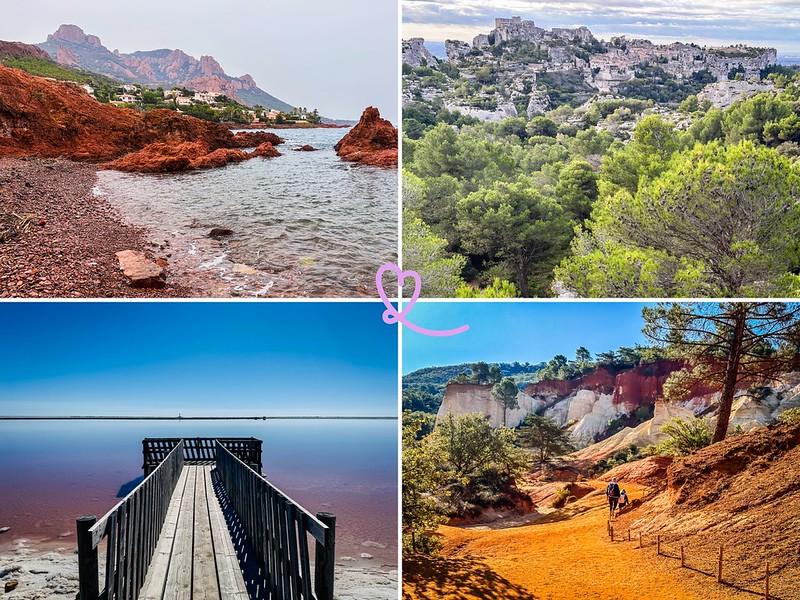
Nestled between the sea and the mountains, Provence is home to a mosaic of natural landscapes far more diverse than just the lavender fields and hilltop villages for which it is known: wild marshes, dizzying gorges, red cliffs plunging into the Mediterranean, limestone ridges, and geological wonders dating back millions of years.
Here is our selection of the most beautiful natural parks in Provence (our favorites), to help you decide where to set down your backpack and which routes to take during your stay.
This guide is completely independent, based on our experiences. We visited the region anonymously, making our own choices and paying our bills in full.
The Most Beautiful Natural Parks in Provence – Map + Summary
Map of Provence’s Natural Parks
Provence alone is home to a significant portion of the protected natural areas in southern France: regional nature parks, a national park, and designated sites stretch from the marshes of the Rhône Delta to the foothills of the Alps. Here is a map to help you find your way around the parks we’ve selected:
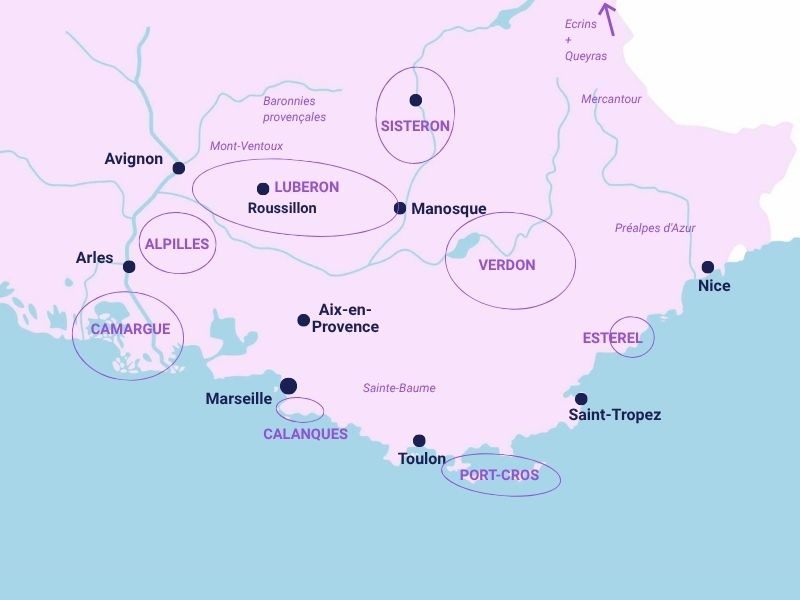
*To be honest, we created one that doesn’t officially exist, because we fell in love with this collection of surprising geological formations: the Sisteron Valley.
Must-See Parks: Our Favorites
We’ll go into detail about them later in this article, but here’s a summary of our 7 picks:
- The Alpilles, a small limestone mountain range between Avignon and Arles, known for its olive groves and the light that inspired Van Gogh
- The Camargue, the wild Rhône Delta, known for its flamingos, white horses, and endless horizons

- The Luberon, nestled between the garrigue and cedar forests, known for its villages of pale stone and its lavender fields
- The Verdon Gorge, known for its dizzying cliffs and turquoise waters
- The Calanques National Park, located between Marseille and Cassis, is known for its limestone coves plunging into crystal-clear waters

- The Sisteron Valley and its geological attractions: the Rocher de la Baume, the Pénitents des Mées, and the Mourres (officially, it’s not a natural park, but to us, it is).
- And the Esterel Mountains, whose red volcanic rocks contrast with the deep blue of the Mediterranean

The Provence-Alpes-Côte d’Azur region has a total of 9 regional nature parks. Check out the 5 that we didn’t cover in detail in the last section of this article.
OUR TPS FOR RENTING YOUR CAR IN Provence
- Compare prices on our preferred platform: DiscoverCars – one of the best rated sites.
- Choose a car that is powerful enough (the roads are steep) but compact (some passages are narrow).
- Remember to take outcomprehensive insurance (some roads are winding and narrow).
- There is a lot of demand, book it early.

1. Alpilles Natural Park

Why visit?
The Alpilles form a small range of white, bare limestone ridges that stand out sharply against the dark green of the pine trees and the silvery gray of the olive trees. This is a rugged Provence, swept by the mistral, where the garrigue releases its scents of thyme and rosemary as soon as the heat sets in.
The light there has a unique intensity: patches of brilliant white at noon, then shades of ochre and pink at sunset—the same light that fascinated Van Gogh so much that he stayed in the region for nearly a year.

The Most Beautiful Places to See in the Alpilles
- Les Baux-de-Provence, a medieval village perched atop a rocky outcrop, and its ruined castle, which overlooks the entire mountain range
- The Carrières de Lumières, former stone quarries transformed into massive art projections
- The archaeological site of Glanum, a Gallo-Roman city buried at the foot of the ridges
- The Baux Valley and its millennia-old olive groves, where several estates produce PDO olive oil
- Saint-Rémy-de-Provence, an elegant town following in Van Gogh’s footsteps, with its Wednesday morning market
- See all the best attractions in the Alpilles

Where to stay?
- In Saint-Rémy-de-Provence, for a great balance between nature and village life
See our selection of the best hotels
or go directly to View the top-rated accommodations - Around the Alpilles, to be right in the heart of the mountain range
See all the top-rated accommodations in the Alpilles

To Know
- A car is necessary; the villages are scattered over about 30 kilometers.
- Les Baux-de-Provence is very crowded year-round—it’s best to visit early in the morning or late in the day
- The mountain range is closed to hikers on certain summer days when there is a high risk of wildfire—check the prefectural decrees before setting out
- Allow 3 to 4 days to explore the Alpilles at a leisurely pace

It’s time to book!
Compare everything: companies, prices, schedules and availability.
2. Camargue Nature Reserve

Why visit?
The Camargue is a region of flat horizons and water everywhere: ponds, marshes, and salt marshes blend into one another until the boundary between land and sky becomes indistinct. It is a very special, ever-changing light that reflects off the water’s surface and makes the pink hues of the salt flats shimmer at sunset.
This vast, untamed wilderness, where humans remain unobtrusive and pastoral traditions have endured for centuries, gives the region a timeless, contemplative atmosphere that is very different from the rest of Provence.

The Most Beautiful Places to See in the Camargue
- Les Saintes-Maries-de-la-Mer, the capital of the Camargue, and its 12th-century fortress church
- The Pont de Gau Bird Sanctuary, the Domaine de la Palissade, and the Parc de la Capellière, where you can see flamingos and herons
- Aigues-Mortes, a medieval fortified town rising from the salt marshes, with its 13th-century ramparts
- The salt flats of Aigues-Mortes and Salin-de-Giraud, where the white of the salt contrasts with the pink of the basins
- The wild beaches of Piémanson and Beauduc, secluded and windy
- See all the best attractions in the Camargue

Where to stay?
- In Saintes-Maries-de-la-Mer, to be right in the heart of the delta
See all the top-rated accommodations in Saintes-Maries-de-la-Mer - In Arles, to combine ancient heritage with excursions in the delta
See our selection of hotels in Arles
Or go directly to View all top-rated accommodations - In Aigues-Mortes or Le Grau-du-Roi, for the harbor and beach atmosphere
See all the top-rated accommodations in Aigues-Mortes and Le Grau-du-Roi

To Know
- Mosquitoes can be very common from April through October, especially at sunrise and sunset—be sure to bring insect repellent and wear clothing that covers your skin
- Cycling is a great way to explore the area around Saintes-Maries-de-la-Mer on flat roads
- The best time for birdwatching is from April through June and from September through October, during the migration seasons
- Allow 2 to 4 days to see the highlights of the Camargue
3. Luberon Regional Nature Park

Why visit?
The Luberon offers a gentler side of Provence than its neighbors: rolling hills covered with garrigue, oak groves, and cedar forests, where the pale stone of the villages blends in with the color of the surrounding fields. The light there is warm and golden, especially at the end of the day when it gently caresses the facades of the houses perched on the hillside. In the summer, you can smell the scent of lavender, but you can also smell the scent of olive trees and grapevines all year round. The pace here is slow, almost suspended, far from the hustle and bustle of the coast: you can hear the chirping of cicadas, the rustling of the wind in the cypress trees, and sometimes the distant sound of a market setting up in a shaded square. This is a Provence that is both wild in its highlands and shaped by centuries of agriculture in its valleys.

The Most Beautiful Places to See in the Luberon
- Gordes, a hilltop village with its characteristic dry-stone architecture, and Sénanque Abbey at its feet
- Roussillon and its Ochre Trail, with cliffs that blaze with colors ranging from pale yellow to blood red
- the many other villages in the hills— See our selection of the most beautiful villages in the Luberon
- The many hiking trails, including those in “Colorado Provençal”
- Abbeys and priories such as Sénanques
- Archaeological sites such as the Bories
- See all the best attractions in the Luberon

Where to stay?
- Around Gordes, to be in the heart of the mountain range
See our selection of hotels in Gordes
or go directly to ” See all top-rated accommodations“ - In the Luberon in general, for more choices
See all the top-rated accommodations in the Luberon

To Know
- Lavender blooms most profusely from mid-June to mid-July, which is when demand is highest
- A car is still essential; the villages are scattered, and public transportation is limited
- The Luberon Regional Nature Park is also home to 28 sites designated as geological nature reserves, for earth science enthusiasts
- Allow 4 to 5 days to explore the Luberon at a leisurely pace

4. Verdon Gorges Natural Park

Why visit?
The Verdon River has carved the deepest gorges in Europe into the limestone plateau of Haute-Provence—a dizzying abyss where cliffs hundreds of meters high drop sheer down to a river of an almost unreal turquoise color. The sense of vastness at the edge of the lookouts is striking, as is the contrast between the dazzling white of the rock and the blue-green of the water.
The air there is cooler than elsewhere in Provence, cooled by the altitude, and is sometimes filled with the cry of a vulture soaring above the canyon. Around the gorges, the Valensole Plateau opens up to a completely different landscape: vast expanses that blaze with purple in the summer

The Most Beautiful Places to See in the Verdon Gorges
- The Route des Crêtes and the Corniche Sublime, with their lookouts over the canyon
- The Martel Trail, a legendary 15-kilometer hike deep in the canyon, winding through tunnels and across suspension bridges
- Lake Sainte-Croix and its turquoise waters, perfect for swimming, kayaking, or paddleboating
- Moustiers-Sainte-Marie, a village perched on a cliff, renowned for its pottery workshops
- The Valensole Plateau and its lavender fields, which bloom from late June through mid-July

Where to stay?
Accommodation options are more limited than on the coast, consisting mainly of campgrounds, small hotels, and vacation rentals around the villages of Moustiers-Sainte-Marie, Castellane, and La Palud-sur-Verdon.
See all the top-rated accommodations in the Gorges du Verdon

To Know
- The roads through the gorges are winding and narrow—traffic can be heavy during peak season
- The Martel Trail requires a good level of fitness—expect a 7- to 8-hour round-trip hike
- Many accommodations close in the winter, and some roads may also be snow-covered
- Plan on 2 to 3 days to explore the Verdon, alternating between hikes, water activities, and visits to villages
5. Calanques National Park

Why visit?
Between Marseille and Cassis, the white limestone plunges directly into an almost tropical turquoise-blue sea, carving out narrow, steep-sided Mediterranean fjords. It is a landscape of stark contrasts: the sun-drenched rock, the sparse scrub clinging to the slopes, and the cool, crystal-clear water at the bottom of each calanque.
You get a sense of isolation there, despite the immediate proximity of a large city, since some of the coves are accessible only on foot or by boat. The scent of pine and resin mingles with that of salt, and the silence is broken only by the lapping of the water against the rocks or the cry of a seagull.
The Most Beautiful Places to See in the Calanques
- The Calanque d’En-Vau, the most spectacular of them all, flanked by high limestone cliffs
- The Port-Pin Calanque and its small pebble beach shaded by pine trees
- The Sugiton Calanque, accessible from Marseille
- A boat trip from Cassis or Marseille to see the mountain range from the sea

Where to stay?
- Marseille, a major port city
See our selection of the best hotels in Marseille
or go directly to View the top-rated accommodations - Cassis, an authentic fishing village, is the ideal starting point for exploring the Calanques.
See our selection of the best hotels in Cassis
or go directly to View the top-rated accommodations

To Know
- Vehicle traffic is restricted in the summer on certain access roads to prevent fires
- Reaching certain calanques, such as En-Vau, on foot requires good physical fitness and proper footwear
- Some trails close when there is a high risk of wildfire, usually between June and September—check before you go
A LITTLE MORE patience
All the photos, maps, information, good addresses to make your stay in Provence a success, will soon be gathered in a single ebook!
6. Port-Cros National Park

Why visit?
Off the coast of Hyères, the islands of the Port-Cros National Park offer a glimpse of the Mediterranean as it must have been before mass tourism: crystal-clear water ranging from turquoise to deep blue, coves lined with umbrella pines and eucalyptus trees, and a silence broken only by the sound of the surf and the song of cicadas.
On Porquerolles, the light seems softer than elsewhere along the coast, filtered through the canopy of the pine groves that line the trails, while the maquis gives off the scent of myrtle and wild rosemary. With no cars, you can explore the island at a leisurely pace, on foot or by bike, in an atmosphere that feels almost like an island, halfway between Provence and the Cyclades.
Port-Cros, which is wilder and more mountainous, adds to this impression with a genuine sense of isolation, thanks to its dense forests that plunge directly into a sheltered sea where marine life thrives.

The Most Beautiful Places to See on Porquerolles
- Porquerolles Island: village, beaches, forts, and harbor
- Bike trails through vineyards and pine forests,
- The island of Port-Cros, the historic heart of the national park, is fully protected and crisscrossed by hiking trails through the forest
- Île du Levant, the wildest of the three, is partly occupied by a military base

Where to stay?
You can stay overnight on Porquerolles to enjoy the island once the day-trippers have left, or stay in Hyères or Giens, where the shuttle boats to the three islands depart from.
To Know
- You can reach Porquerolles by boat from Giens (about a 20-minute crossing), Hyères, La Tour Fondue, or Toulon
- Private cars are not allowed on the island—plan to walk or rent a bike there
- Book your crossing in advance during the summer—the ferries fill up quickly
- Access to certain trails is restricted in the summer when there is a high risk of wildfire
7. Sisteron Valley (not officially a park)

Why visit?
As you travel up the Durance Valley toward the Alpes de Haute-Provence, the landscape changes dramatically: the gentle hills of Provence give way to spectacular rock formations, sculpted by millions of years of erosion.
We decided to create our own nature park in this section, featuring three exceptional rock formations to explore!
Here, the rock takes on an almost fantastical appearance: cliffs split in two by a river, rows of pillars lined up like a frozen procession, or oddly shaped boulders perched on a plateau. This is a rougher part of Provence, with drier air, where you can already feel the influence of the nearby mountains.

The Most Beautiful Places to See
- The Rocher de la Baume in Sisteron, a limestone cliff split by the Durance River, which Napoleon crossed on his return from Elba (the Route Napoléon), overlooked by the Sisteron citadel
- The Pénitents des Mées, about a hundred 100-meter-high rock pillars lined up over two kilometers along the Durance River, which local legend describes as petrified monks
- Les Mourres de Forcalquier, a plateau dotted with limestone boulders of unusual shapes (waves, cylinders, basins), dating back about 25 million years and formed at the bottom of an ancient lake

Where to stay?
Sisteron, Forcalquier, or Mane are good starting points for exploring these three sites, which are less than a 30-minute drive from one another.
See the top-rated accommodations in Sisteron

To Know
- You can easily walk along the Pénitents des Mées from the village of Les Mées via a marked trail
- Les Mourres is located about 3 km from Forcalquier in the direction of Fontienne, with on-site parking
- One day is enough to explore the three sites, but you can also visit the surrounding villages.
8. Esterel Natural Park
Why visit?
Between Saint-Raphaël and Cannes, the Esterel Mountains contrast the deep blue of the Mediterranean with a flamboyant, mineral-rich red—the color of the volcanic rhyolite that makes up the entire mountain range. It is a landscape of stark contrasts: the reddish ridges stand out against a deep blue sky, while the dark green of the umbrella pines and cork oaks clings to the most sheltered slopes.
The morning or evening light further accentuates the rock’s glowing hue, which seems almost unreal against the turquoise waters of the coves below. It is one of the wildest regions of Provence on the French Riviera, shaped by ancient volcanic activity that ceased hundreds of millions of years ago.

The Most Beautiful Places to See in the Esterel
- Cap Roux Peak (453 m), the most iconic summit, offering a 360° panoramic view stretching from Cannes to Cap Camarat
- The Rocher Saint-Barthélemy, with a breathtaking view overlooking the sea from a height of about 200 meters
- The Pointe de l’Aiguille, near Théoule-sur-Mer, known for its small coves nestled in the red rock
- The coastal trail between Saint-Raphaël and Cannes, with its alternating coves and volcanic rocks

Where to stay?
Saint-Raphaël, Agay, and Théoule-sur-Mer offer direct access to the mountains while still being right on the coast.
See our selection of the best hotels in Saint-Raphaël
or go directly to View the top-rated accommodations

To Know
- Access to the mountain range is restricted in the summer (closures may occur on days with strong winds or drought conditions)—check before you go
- Be sure to wear sturdy shoes: some sections, such as the one at Rocher Saint-Barthélemy, are quite exposed.
- Allow about 3 to 4 hours for the loop hike from Sainte-Baume to the summit of Cap Roux
- A proposal for a 10th regional nature park, bringing together the Maures, Esterel, and Tanneron mountain ranges, is currently under consideration
HAVE FUN WITH THESE activities
- Great kayak trips in:
Saint-Tropez to the Ramatuelle reserve
FromCassis to the Calanques - Helicopter flight from Cannes
- Shuttle service along the coast between Nice and Saint-Tropez
- Bike tours: eBike in Nice – Mountain biking in the Esterel massif

Other regional nature parks in Provence worth exploring
The Provence-Alpes-Côte d’Azur region has a total of 9 regional nature parks. In addition to the five we just described, here are five others that are also worth a visit, mostly located in Haute-Provence and the Alpine hinterland:
- The Baronnies Provençales Regional Nature Park, located between the Drôme and Hautes-Alpes departments, features landscapes that are both alpine and Provençal
- Mont-Ventoux Regional Nature Park, surrounding the “Giant of Provence” and its barren summit at 1,912 meters
- Azur Pre-Alps Regional Nature Park, in the Nice hinterland, nestled among gorges and limestone plateaus
- Queyras Regional Nature Park, one of the highest-altitude nature parks in France, on the border between the Hautes-Alpes and Italy
- Sainte-Baume Regional Nature Park, a forested area between Marseille and Toulon, known for its relict forest and the Cave of Saint Mary Magdalene
- Écrins National Park, the highest mountain range entirely within France, featuring the Barre des Écrins at over 4,000 meters
- Mercantour National Park, on the Italian border, is renowned for its wildlife (ibex, chamois, wolves) and its secluded valleys, such as the Merveilles Valley.
PLAN YOUR TRIP TO provence
- Inspiration
Best things to do in Provence
Provence’s most beautiful towns
Most beautiful villages
Most beautiful castles
Best destinations

- Practical advice
Rent a car in Provence – in Nice – in Cannes – in Marseille – in Aix-en-Provence.
Itineraries: 5 days – 1 week – 10 days
Weekend Ideas: Best of – Romantic – Luxury – Unique

- Where to stay
Where to stay in Provence
Best luxury hotels

- The must-dos
Best things to do in Marseille
What to do in Aix-en-Provence
Best things to do in Avignon
Best things to do in Arles
Best things to do in Nice
Best things to do in Cannes
Best things to do in Antibes
Best things to do in Monaco
Best things to do in Saint-Tropez
Best things to do in Cassis
Things to Do in the Luberon
Things to Do in the Alpilles



 nos vidéos sur Youtube
 nos photos sur Instagram
 nos actualités sur Linkedin
 formulaire de contact


