
Are you planning a trip to Provence and wondering if the Luberon is worth including in your itinerary?
Between Avignon and Manosque, this region of limestone hills offers hilltop villages, lavender fields, old ochre quarries, dry-stone huts, a Roman bridge, Cistercian abbeys, and markets that bring a different town to life every day of the week.
Here, we’ll share the reasons why we recommend the region, as well as its limitations, so that you can make an informed decision.
This guide is completely independent, based on our experiences. We visited the region anonymously, making our own choices and paying our bills in full.
Is the Luberon worth visiting?
Yes, without hesitation. The Luberon is one of the most diverse regions in Provence within a small area: in a 30-minute drive, you go from a medieval village to a red ochre trail, then from a winery to a plateau covered in lavender. It is particularly well-suited for travelers who enjoy combining cultural heritage, nature walks, and local specialties.

On the other hand, it requires a car and a bit of planning in the summer, when the most popular sites attract large crowds.
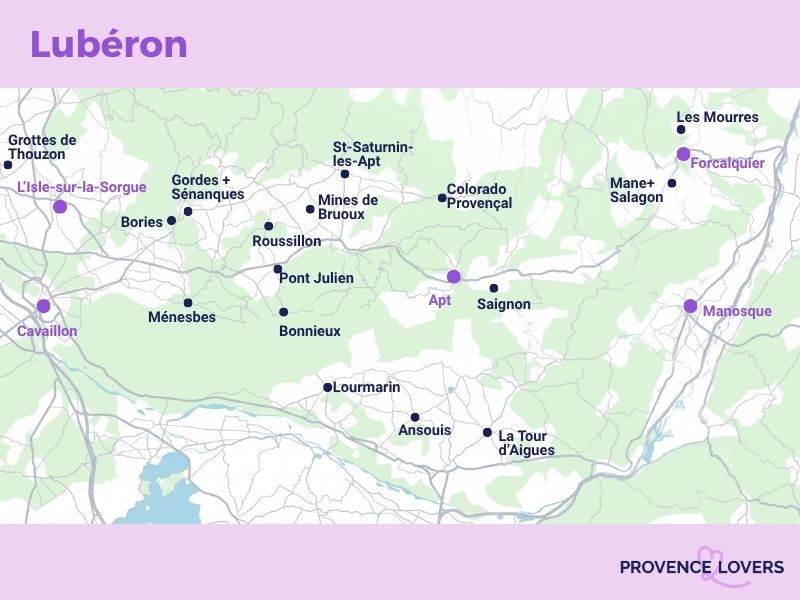
Just to clarify: when we refer to the Luberon, we are referring to the entire Luberon Regional Nature Park, established in 1977, and not just the mountain range from which it takes its name. The park comprises 77 municipalities spread across the Vaucluse and Alpes-de-Haute-Provence departments.
See our selection of the best attractions.
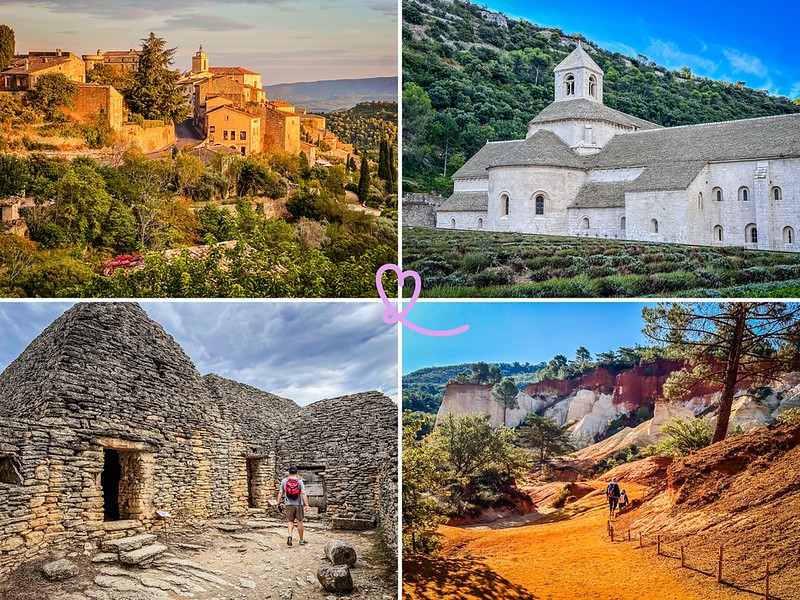
Reason 1 – For its hilltop villages, each one unique
The villages of the Luberon were built on high ground for very practical reasons: to protect themselves from conflicts during the Middle Ages, to keep watch over the plain, and to leave the fertile land for farming. The result is a cluster of limestone villages huddled around a church or a castle, connected by sloping alleyways.

We were surprised by how different they were, even though the photos make them look almost identical. We recommend exploring them early in the morning or in the late afternoon, when the light is softer and the parking lots are less crowded. See our selection of the most beautiful villages in the Luberon.
These five villages are members of the “Most Beautiful Villages of France” association. They are also the most popular, especially between June and September.

- Gordes, whose houses are perched in tiers on the side of a cliff overlooking the Calavon Valley
- Roussillon, where the facades display the full range of ochre hues, from pale yellow to deep red
- Ménerbes, sprawling across a rocky outcrop and quieter during the day
- Lourmarin, known for its Friday market and because the writer Albert Camus, who won the Nobel Prize in Literature in 1957, is buried there
- Ansouis, built around its castle
Away from the big-name destinations, other villages offer a more peaceful experience. There are fewer souvenir shops and more everyday stores, which gives you a better sense of local life.

- Saignon, perched on a rock above Apt, whose town square and fountain seem frozen in time
- Bonnieux, where 86 steps lead to the upper church and a sweeping view of the valley
- Saint-Saturnin-lès-Apt, a long, narrow village nestled among vineyards and lavender fields

WHERE TO STAY IN Lubéron
Our favorites:
In Gordes, a truly exceptional village:
Mas des Romarins Hotel – check photos and availability
Around Mane and Forcalquier:
Couvent des Minimes Hotel – check photos and availability
Around Menerbes, in the heart of the villages:
Bastine de Marie Hotel – check photos and availability

See our selection: Where to Stay in the Luberon
Reason 2 – For its ochre landscapes
Ochre is an earth pigment colored by iron oxides, which has been mined in the region since the late 18th century to produce pigments. The industry reached its peak in the early 20th century, then declined with the advent of synthetic dyes.

We consider these old farms to be one of the unique features of the Luberon, as few regions in Europe boast such landscapes. We loved walking outdoors among the orange cliffs.
- The “Provençal Colorado” in Rustrel, a landscape of cliffs and fairy chimneys in shades of yellow and red: expect a 1.5- to 3-hour hike, depending on the route
- The Ochre Trail in Roussillon: two loops—one 35 minutes and the other 50 minutes—at the foot of the village
- The Bruoux Mines in Gargas: a guided tour lasting about 1 hour through the old mining tunnels, where it stays cool even in the middle of summer

Wear closed-toe shoes and avoid light-colored clothing: ochre dust stains easily. In the summer, the trails get a lot of sun, so it’s best to head out as soon as they open. Ochre is one of Provence’s must-sees.
OUR TPS FOR RENTING YOUR CAR IN Provence
- Compare prices on our preferred platform: DiscoverCars – one of the best rated sites.
- Choose a car that is powerful enough (the roads are steep) but compact (some passages are narrow).
- Remember to take outcomprehensive insurance (some roads are winding and narrow).
- There is a lot of demand, book it early.

Reason 3 — 2,000 Years of History Visible in the Landscape
In the Luberon, history isn’t limited to museums. It can be observed directly in the field, whether it is a Roman structure or a rural dry-stone dwelling.

It isn’t the region with the most archaeological sites, but we were struck by how well-preserved some of the remains—which are over 2,000 years old—were. These sites usually don’t take long to visit, and we often combined them with another outing on the same day.
- The Village of Les Bories, near Gordes: a “borie” is a hut built of stones stacked without mortar, which served as a dwelling or agricultural shelter. The site contains about twenty of them, which were inhabited until the 19th century
- The Pont Julien, between Bonnieux and Apt, was built in the 1st century BCE on the Via Domitia, the Roman road that connected Italy to Spain. Its three arches have been closed to vehicle traffic since 2005
- The ruins of Apta Julia, the ancient Roman city on which the town of Apt was built
- The small Romanesque bridge in Mane, on the road to Forcalquier

Reason 4 — For its Romanesque abbeys and castles
Abbeys and priories…
Monastic orders took root in the region as early as the Middle Ages. Among them were the Cistercians, an order founded in Burgundy in the late 11th century, which emphasized work, prayer, and austere architecture.

We appreciated this Romanesque simplicity, characterized by bare stone and simple forms. Some sites are still inhabited by a religious community and are only partially open to visitors. Others have been converted into museums or gardens.
- Sénanque Abbey, near Gordes, was founded in 1148 and is still home to Cistercian monks: tours of the interior are by reservation only and require clothing that covers the shoulders and knees
- Saint-Hilaire Abbey, located between Ménerbes and Oppède, is more modest and much less crowded
- The Priory of Salagon, in Mane, whose ethnobotanical gardens showcase the plants once used by the region’s inhabitants

… and castles
The Luberon is not the region of France with the most castles, but the ones that remain span several eras. We found it interesting to go, in just a few kilometers, from a burned-out ruin to a Renaissance mansion.

We suggest you choose one or two based on your interests, rather than doing them all back-to-back.
- The Château de Lourmarin, built between the 15th and 16th centuries, combines medieval and Renaissance elements and hosts exhibitions
- The Château d’Ansouis, which remained in the hands of the same family from the Middle Ages until the early 21st century
- The Château de la Tour d’Aigues, which was burned down in 1792 during the French Revolution, and whose ruins now house the Museum of Earthenware
- The Château de Sauvan, in Mane, an 18th-century building nicknamed the “Little Provençal Trianon,” in reference to the pavilion built at Versailles for Louis XV


Reason 5 – For its protected natural areas and hiking trails
The Luberon has been designated a UNESCO Biosphere Reserve since 1997, a designation that recognizes the balance between nature conservation and human activities. Although the mountain range is relatively small, it is home to a variety of vegetation: holm oaks and garrigue on the southern slope, beech trees on the cooler higher elevations, and cedars planted in the 19th century above Bonnieux.

We mostly came across lizards and birds of prey there. The luckiest visitors will spot the Bonelli’s eagle or the Egyptian vulture, two rare species.
Some of our favorite spots:

- The hike up to Mourre Nègre, the highest point in the mountain range at 1,125 meters, which offers a view of the Alps on clear days
- The Cedar Forest, above Bonnieux: a shaded walk accessible to everyone
- The trails around Buoux and its fort, which is partly carved into the rock
- The GR9, a long-distance hiking trail that crosses the mountain range from east to west
- Les Mourres, north of Forcalquier, is a field of limestone rocks shaped like mushrooms or faces; admission is free: allow about 1 hour for the hike
- The Thouzon Caves, in Le Thor, discovered by chance in 1902 during quarrying work, with their stalactites and stalagmites reflected in the water

Please note: In the summer, access to forested areas is restricted due to the risk of fire. Depending on the day’s danger level, some trails may be closed. Check the map published daily by the prefecture before you leave.
Reason 6 – To explore the region from a different perspective

The Luberon is also ideal for more athletic activities. When viewed from a cliff or from the sky, the villages and fields we have just passed through take on an entirely different perspective.
- The Cavaillon via ferrata, on Saint-Jacques Hill, is a route equipped with cables and rungs, offering several levels of difficulty— check availability and make a reservation
- A sunrise hot-air balloon ride over Forcalquier, flying over the plateaus and villages— check availability and book
- Cycling, particularly on the Calavon Bike Route—a greenway built on a former railroad track that is flat and family-friendly
- Mountain biking and horseback riding, offered by several providers in the Apt and Bonnieux areas
Reason 7 – For its local specialties: wine, truffles, and fine dining
The vineyards cover a large part of the region under the Luberon AOC designation, a label that guarantees the wine’s geographical origin and production method. We mainly tasted whites and rosés, which are known for their freshness, but we also tried a few full-bodied reds.

Many wineries open their cellars for a tour followed by a tasting, often overlooking the vineyards and sometimes with a view of a hilltop village.
See the options for winery tours and tastings in the Luberon.
In winter, the region also revolves around the black truffle, which is harvested from November through March. Several estates organize “cavage” outings—that is, truffle hunting with a trained dog—followed by a tasting; see the options.

As for restaurants, we have fond memories of two places:
- The Restaurant du Couvent des Minimes in Mane, housed in a former convent, showcases products from Haute-Provence
- The Restaurant at the Grand Hôtel de Gordes, for more refined cuisine and a view of the valley
Good to know: In villages, service is generally from 12:00 p.m. to 1:30 p.m. and then from 7:30 p.m. to 9:30 p.m., rarely all day. In the summer, it’s a good idea to make a reservation. In winter, on the other hand, many restaurants close for several weeks.
Reason 8 – For its markets and crafts
Every town has its own market day, so you can find one almost every morning of the week. We love stopping by there as much for the products as for the atmosphere, because these morning events bring together locals and visitors in streets that are usually quiet.

The stalls start filling up around 8 a.m. and close around 1 p.m.: we recommend coming before 10 a.m. in the summer, when the heat and crowds are still manageable.
- Monday morning in Forcalquier, one of the largest markets in Haute-Provence
- Friday mornings in Lourmarin: lively and very crowded during the tourist season
- Saturday morning in Apt, which takes over the entire downtown area
- Sunday morning in L’Isle-sur-la-Sorgue, best known for its antique shops and flea markets

Local handicrafts are also worth checking out, far beyond the generic items sold in the most touristy villages. Among our discoveries:
- Olive oil from local mills, some of which are open to visitors during the harvest, between November and January
- The Roussillon Vinegar Shop, where you can sample flavored vinegars
- Ochre processed into pigments, soaps, or ceramics
- Mane’s Artisanal Caramels

Reason 9 – For its museums, which brighten up the landscape
The museums in the Luberon are small, but each one focuses on a theme that you can then explore in the surrounding area. We found them helpful in better understanding what we were seeing: a field of flowers, a colorful cliff, an old mill.

Most of them can be toured in about an hour and are also interesting for children. They’re also a good option on rainy days or when it’s very hot.
- The Lavender Museum in Coustellet, which explains the difference between fine lavender—grown at high altitudes—and lavandin, which is more common in the lowlands
- The Ochre Ecomuseum in Roussillon, housed in a former pigment processing plant
- The Corkscrew Museum in Ménerbes: An Amazing Collection Set Within a Wine Estate
- The Jean Giono Center in Manosque, dedicated to this 20th-century Provençal writer, who was born in the city
- The Artemisia Museum in Forcalquier, a sensory space dedicated to the scents and flavors of Haute-Provence

Reason 10 – Because it takes on different looks depending on the season
Lavender is undoubtedly the image most closely associated with the Luberon. It usually blooms from mid-June to early August, but the blooming period varies each year depending on the weather: it’s best to check the condition of the fields before heading out.

To be honest, we don’t have any photos of fields in bloom because we avoid that time of year due to our allergies. The photo above shows the rows at Sénanque Abbey… without flowers.
The most photographed fields are located:
- On the Claparèdes Plateau, between Bonnieux and Saignon
- Near Sénanque Abbey, close to Gordes
- On the Sault Plateau, a little further north and outside the park, the defining feature of this landscape
But the region is more than just those few weeks. In the spring, the orchards in the Calavon Valley are in bloom, and the trails are lovely. Fall brings the grape harvest and vineyards that turn red. Finally, winter—a quieter time—is still the season for truffles and hikes in the sunshine.
The few downsides of a trip to the Luberon
As with any destination, there are certain things you should be aware of before you leave.
Summer Attendance
In July and August, Gordes, Roussillon, and Sénanque Abbey attract many tour buses full of visitors, especially between 10 a.m. and 5 p.m. Visits are still possible, but they become less enjoyable. Just a few kilometers away, however, Saignon, Saint-Saturnin-lès-Apt, and the Abbey of Saint-Hilaire remain quiet. Coming early in the morning also makes a big difference to the experience.
Heat and Fire Hazard
Temperatures often exceed 30°C in the summer, and the ochre sites offer little shade. As mentioned above, access to the mountain ranges may also be restricted on days when the risk is high. The mistral, a cold, dry wind from the north, can finally blow for several days in a row, especially in the spring: it clears the sky but makes walks feel cooler.
The Must-Have Car

The villages are scattered, and public transportation remains scarce. The narrow, winding Route des Crêtes around Bonnieux, Ménerbes, and toward Saignon makes for longer travel times. People usually park at the entrance to villages, often in paid parking lots during the high season, since the historic centers are pedestrian-only or have very limited vehicle access.
The cost of certain villages
Gordes, Lourmarin, and Ménerbes are among the most expensive villages in Provence, both for lodging and dining. The towns of Apt, Cavaillon, and Manosque offer more affordable options, while still being less than 30 minutes from the main attractions.
Closures During the Off-Season
From November through March, some restaurants, shops, and certain attractions shorten their hours or close. This is the flip side of a much more peaceful region: just be sure to check the schedules before each visit.
Visiting the Luberon: Practical Tips
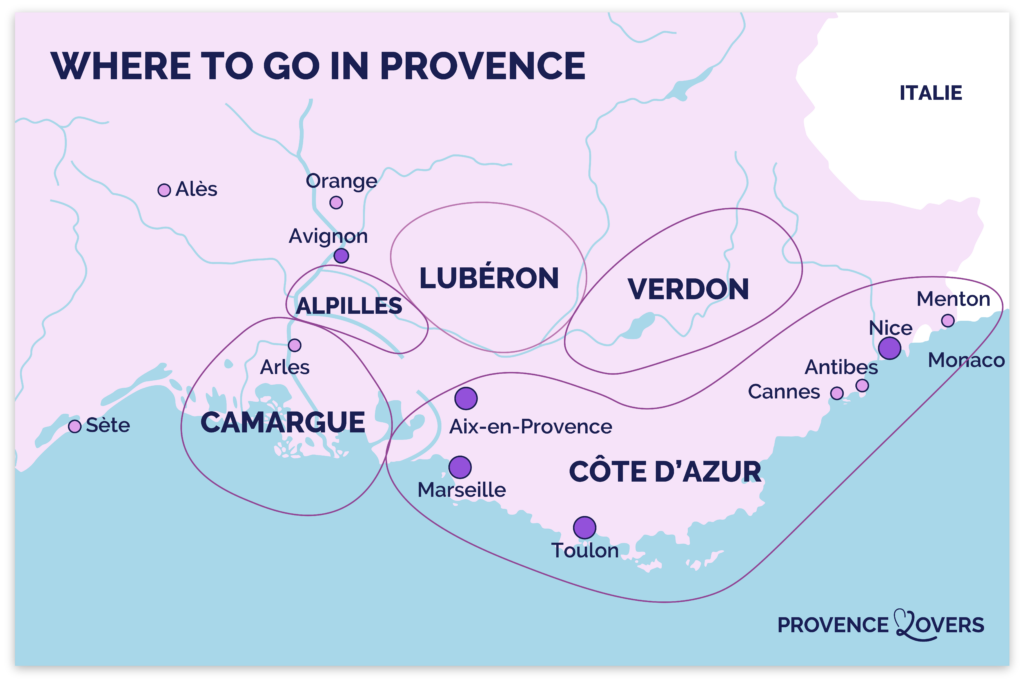
How to Get to the Luberon
The mountain range stretches about 60 kilometers, between the Durance Valley to the south and the Calavon Valley to the north.
- From Avignon: about 40 minutes by car
- From Aix-en-Provence: about 50 minutes by car
- From Marseille: about 1 hour and 15 minutes by car
For travelers coming from farther away, the Avignon TGV station remains the fastest way to get here, followed by the Aix-en-Provence TGV station. Marseille-Provence Airport is a little over an hour’s drive away. In any case, be sure to arrange for a rental car once you arrive.
Where to Stay in the Luberon
The choice of your base depends mainly on the atmosphere you’re going for:
- Apt, the historic capital of the Luberon, serves as a central hub from which to explore the entire region
- A village like Bonnieux, Lourmarin, or Gordes—for the setting—but with a higher budget
- L’Isle-sur-la-Sorgue, located outside the park but well connected to Avignon, known for its canals and waterwheels
- Manosque or Forcalquier, to explore the eastern part, in Haute-Provence

WHERE TO STAY IN Lubéron
Our favorites:
In Gordes, a truly exceptional village:
Mas des Romarins Hotel – check photos and availability
Around Mane and Forcalquier:
Couvent des Minimes Hotel – check photos and availability
Around Menerbes, in the heart of the villages:
Bastine de Marie Hotel – check photos and availability
See our selection: Where to Stay in the Luberon
How much time should I allow?
To see the main villages and an ochre site, plan on spending at least 3 days. A week gives you time to add a hike, a museum visit, and a tour of a winery. Finally, about ten days gives you time to explore the lesser-known villages and the eastern part of the park, around Forcalquier.

What is the best time to do this?
In our opinion, May, June, and September offer the best balance: pleasant temperatures for walking and a reasonable number of visitors. July is when the lavender blooms, but it’s also when temperatures and visitor numbers peak. Fall and winter are ideal for travelers seeking tranquility, the grape harvest, or truffle season—as long as they’re willing to accept that some places may be closed.
EXPLORE the Luberon
- Top Attractions in the Luberon
- Best Villages
- Where to stay
- Gordes: Attractions – Hotels
- Roussillon
- Provençal Colorado



 nos vidéos sur Youtube
 nos photos sur Instagram
 nos actualités sur Linkedin
 formulaire de contact


