
Saignon is a hilltop village in the Luberon, right in the heart of the Luberon. We really fell in love with this place: its Romanesque church, Place de la Fontaine, and the rock that overlooks the valley make it a must-see destination in Provence.
Here is our guide to the must-see spots in the village of Saignon in the Luberon, along with helpful tips for planning your visit.
This guide is completely independent, based on our experiences. We visited the region anonymously, making our own choices and paying our bills in full.
Is the village of Saignon worth a visit?
Yes, the village of Saignon is worth a visit. We found it to be one of the most charming places in the Luberon, thanks to its mix of old houses and geological formations. We absolutely fell in love with the main square and its washhouses.
It is one of the most beautiful villages in the Luberon and in Provence.

In this guide, we’ll show you the sights in the order you’ll encounter them starting from the parking lot—not starting with the most beautiful one. This gives you an idea of what your visit will be like.
1. View from the road above the parking lot

Our exploration of Saignon began with the road that climbs up to the village from the parking lot. The view from there is already breathtaking: the hilltop village appears before you, dominated by its rock, with the valley, the Monts de Vaucluse, and Mont Ventoux in the background.

We recommend that you stop here for a few moments before continuing on foot, as it’s harder to get a view of the entire village once you’re in the narrow streets. It’s also the perfect spot to take your first group photo.
OUR TPS FOR RENTING YOUR CAR IN Provence
- Compare prices on our preferred platform: DiscoverCars – one of the best rated sites.
- Choose a car that is powerful enough (the roads are steep) but compact (some passages are narrow).
- Remember to take outcomprehensive insurance (some roads are winding and narrow).
- There is a lot of demand, book it early.

2. Notre-Dame-de-Pitié Church

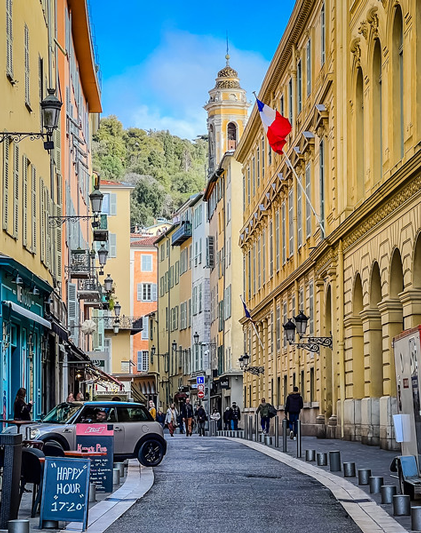
As we entered the village, we stopped in front of the Church of Notre-Dame-de-Pitié, a Romanesque church dating from the 11th and 12th centuries. It was once a stop on the pilgrimage route for travelers following the Via Domitia toward Santiago de Compostela, and it has preserved a reliquary of the Holy Cross ever since.

The building isn’t always open, but through the gate’s grille you can see a good part of the interior. This will allow you to view the nave without necessarily having to go inside.
3. Place de la Fontaine (my favorite!)

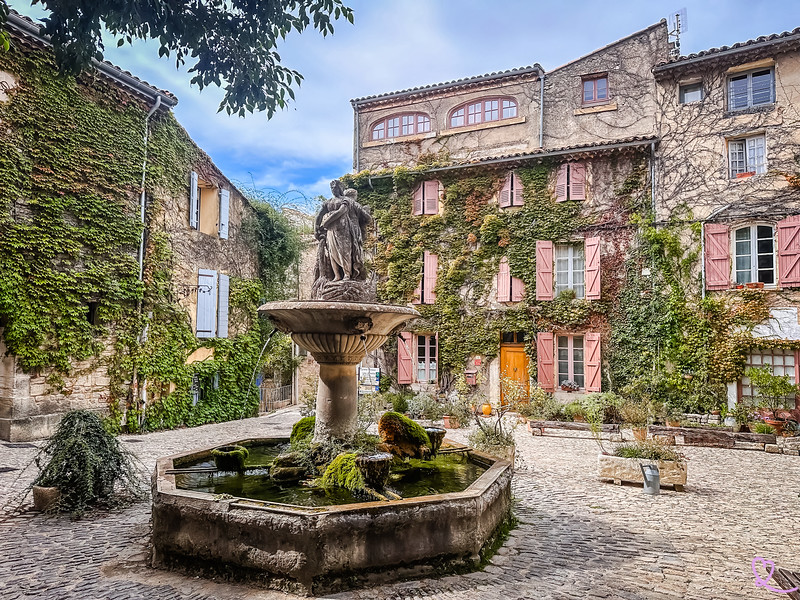
In our opinion, Place de la Fontaine is the true heart of Saignon. Its fountain, featuring a basin and a pool, is topped by two allegorical statues representing agriculture and abundance through industry, created by the Apt-based sculptor Joseph Sollier. A large ash tree shades the square, where a few bistro tables invite you to linger.

You can take a break there before continuing your tour; the area is particularly quiet outside of peak hours. We enjoyed this moment of tranquility in the center of the village, accompanied by the sound of water from the fountain and the moss and plants covering the buildings.
There are so many details to notice!
A LITTLE MORE patience
All the photos, maps, information, good addresses to make your stay in Provence a success, will soon be gathered in a single ebook!

4. Washhouse

Not far from Place de la Fontaine, the washhouses of Saignon are fed by the springs of Valsorgues. People used to come here to wash their clothes, and the water that still flows from it is used today to water the gardens. It is a simple place, but one that captures the essence of daily life in a Provençal village.
And the view of the arches is full of charm.
5. Narrow streets lined with old stone houses

We then took some time to stroll through the village’s narrow streets. The cobblestone streets, which have recently been restored in some places, wind their way between old stone houses, some of which have ornate doorways. Some of the facades date back several centuries and tell the story of the village built on its rocky outcrop.

As you walk down toward the main street, you’ll also pass the Clock Tower, built in 1584. In our opinion, this walk is one of the best ways to get a feel for the village.

WHERE TO STAY IN Lubéron
Our favorites:
In Gordes, a truly exceptional village:
Mas des Romarins Hotel – check photos and availability
Around Mane and Forcalquier:
Couvent des Minimes Hotel – check photos and availability
Around Menerbes, in the heart of the villages:
Bastine de Marie Hotel – check photos and availability

See our selection: Where to Stay in the Luberon
6. Cave Mill
Below Place de la Fontaine, on Place du Vieux Moulin, we discovered the remains of an old oil mill carved directly into the rock. This cave dwelling is typical of the housing found in Saignon, as part of the village was carved directly out of the rock itself.

The millstone, which is still visible, gives a sense of the structure’s weight and size at the time. You can view the ruins from the outside.
7. Gate of the Wind

As we continued toward the rock, we passed through the Porte du Vent, also known as the Porte de l’Auro. This stretch, located along Rue de l’Horloge, marks a stop along the way before the climb to the top of the village.

Its name evokes the breezes that often blow through this part of the village, perched high on a hill. You’ll naturally cross it as you head up toward the chapel and the castle ruins. We really enjoyed seeing how the stone walls and the natural rock intertwined.

8. Castle Chapel and Castle Ruins

For a long time, Bellevue Rock was home to a castle chapel—which has now become part of the rock itself—as well as the ruins of three medieval fortresses: Château du Rocher, Château Méjean, and Château Crugières. We were able to make out sections of the ramparts, a parapet walk, and water jugs carved into the stone.

These ruins bear witness to the village’s strategic importance in the Middle Ages, when it served as a lookout over the valley toward Apt. The tour is self-guided and does not require any special accommodations.
9. Major Rock (Caution: Vertigo)

The Bellevue Rock, commonly known simply as the village’s main rock, stands at the summit of Saignon. We climbed up there via a small trail that winds its way up from the castle chapel. It’s worth it, but it takes a little extra effort, and people who are very prone to vertigo may have trouble during the climb. I felt a little dizzy, but I was able to get on.

Its geomorphology explains its former role as a lookout point for the town of Apt, hence the presumed origin of the village’s name, which is derived from the Latin word *signum*. You’ll reach the summit quickly, despite a few somewhat steep sections.
We loved getting a closer look at the rock layers that appear to be stacked on top of one another (even though we know the geological explanation is different).

It’s time to book!
Compare everything: companies, prices, schedules and availability.
10. View of the village from the rock

Once at the top of the main rock, on one side, the view looks straight down onto the rooftops of the village and its church. We found this perspective particularly interesting for understanding the layout of Saignon, which is centered around three buildings: the castle chapel, the Clock Tower, and the church.

You’ll also be able to make out the narrow streets below and the vegetation surrounding the village. We were fascinated by the blend of nature and cultural heritage. The views were magnificent in every direction.
11. Orientation Chart

At the other end of the main rock is an orientation map that helps visitors get their bearings in the surrounding landscape. From there, the view stretches across the Calavon Valley, the town of Apt, and the Monts de Vaucluse, and on clear days can even reach as far as Mont Ventoux and the Rhône Valley.

We recommend that you take a few minutes here before heading back down, as the 360° panoramic view at the tip of the promontory can’t be found anywhere else.
Subscribe to our Newsletter
- Get away from it all with Region Lovers’ beautiful destinations!
- Once a month
- Advertising-free
Things to Do in Saignon: Other Ideas
We’ve also found a few places in Saignon beyond the must-see attractions:
- At Christine’s, the village bakery, where you can still order a bowl of café au lait made the traditional way
- Atelier Saint Louis, a traditional hat-making workshop
- Carolina Jewelry, a small boutique specializing in handmade jewelry
- Hiking around the village: for example, toward Auribeau or Le Colombier

Things to Do Around Saignon
We also took advantage of our visit to Saignon to explore the surrounding area:
- Apt: Just 4 km from Saignon, Apt is the nearest town, with its Sainte-Anne Cathedral and market.
- The Claparèdes Plateau: On the way to Buoux, this plateau is the perfect place to admire the lavender fields in the summer, whether by car or on a hike.
- Gordes and Roussillon: Saignon is ideally located for exploring other villages in the Luberon, such as Gordes and Roussillon.

How to Get to Saignon + Parking
Where is Saignon?
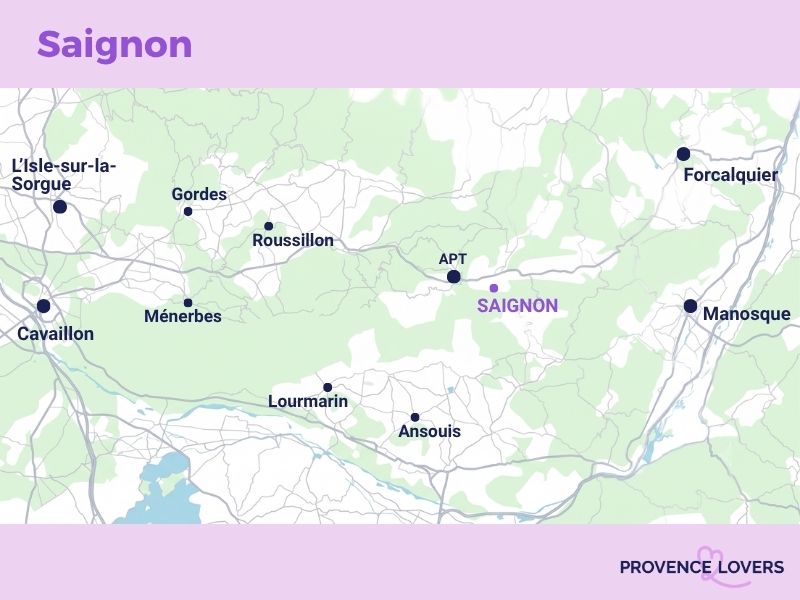
- In the Luberon, in the Vaucluse department
- From Apt: 10-minute drive
- From Manosque: 50-minute drive
- From Avignon: a 1-hour-and-10-minute drive
- From Aix-en-Provence: 1 hour and 5 minutes by car
How to get there
The easiest way to get to Saignon is by car; it takes about 10 minutes from Apt via a winding road. We don’t have any confirmed information about a direct bus route to the village; the best option is to travel to Apt and then finish the trip by car.
Parking in Saignon
There is a parking lot at the entrance to the village. We recommend that you leave your car there and continue on foot, as the streets in the city center are steep and the ground is sometimes uneven.

Helpful Tips for Visiting Saignon
How long and when?
Allow about 1 hour and 30 minutes to 2 hours to see all the village’s must-see sights and hike up to the rock.

Tour directions, map and difficulty
We started at the parking lot at the entrance to the village before heading down toward the church and then to Place de la Fontaine. We then gradually climbed toward the rock, passing by the cave mill and the Porte du Vent. The streets are sloped, and the ground is sometimes uneven, with cobblestone or rocky sections toward the top. Public restrooms are available in the village.

Visiting with children
The hike up to the rock and its castle ruins may appeal to children, who generally enjoy the slightly adventurous nature of the trail. Place de la Fontaine, with its large ash tree, is also a great place to take a break. Be careful, however, on the elevated sections near the rock; these require extra caution when traveling with young children.
Restaurants
The village has several restaurants and cafes. We haven’t had a chance to test them yet.

Visiting Saignon in Winter
In winter, the village is much quieter and is perfect for a leisurely stroll to the rock. We found the views from the orientation table to be particularly unobstructed at this time of year, with the air clearer than during the peak tourist season.
Caution: After it rains, the ground is very slippery!
EXPLORE the Luberon
- Top Attractions in the Luberon
- Best Villages
- Where to stay
- Gordes: Attractions – Hotels
- Roussillon
- Provençal Colorado



 nos vidéos sur Youtube
 nos photos sur Instagram
 nos actualités sur Linkedin
 formulaire de contact


