
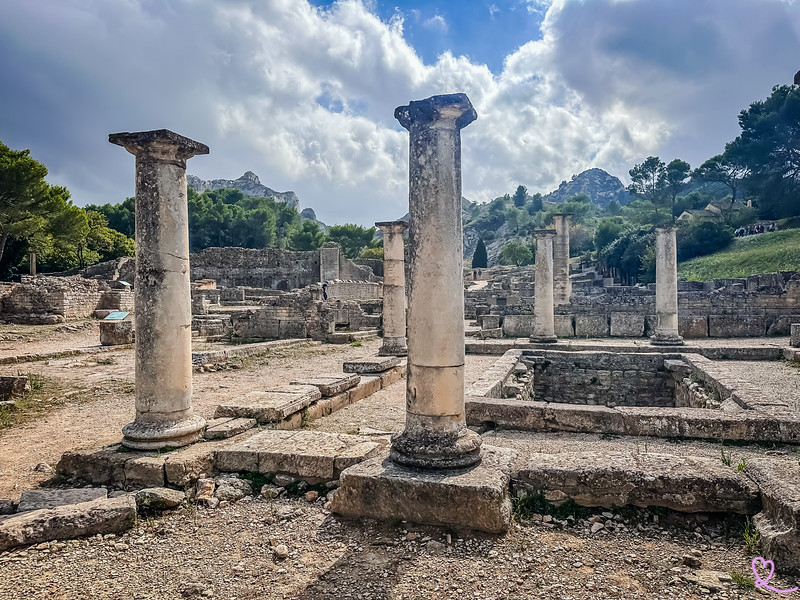
Are you a fan of ancient history? The Glanum archaeological site awaits you in Saint-Rémy-de-Provence, at the foot of the Alpilles. We were struck by the abundance of Gallic, Greek, and then Roman ruins found one after another in this small area.
In this article, you’ll find some useful tips to help you prepare for your visit and have a great time!
This guide is completely independent, based on our experiences. We visited the region anonymously, making our own choices and paying our bills in full.
Why Visit the Glanum Archaeological Site
Is Glanum worth the trip? Our opinion:
Yes, the archaeological site of Glanum is worth a visit. This site brings together Gallic, Greek, and Roman ruins in a single location, centered around a sacred spring that is still visible today. Les Antiques, the arch, and the mausoleum are among the best-preserved ancient monuments in Provence.
It’s one of the best things to do in Saint-Rémy-de-Provence.

Why is Glanum famous?
Glanum owes its fame to the arch and the mausoleum, two monuments that have remained visible through the centuries while the rest of the city disappeared beneath the alluvial deposits. This site, known as “Les Antiques,” was first mentioned as early as 1555 by Nostradamus in his *Centuries*, long before 20th-century excavations uncovered the buried ancient city.

The site, which is designated as a historic monument, has also been the subject of a leading archaeological guide published by Éditions du Patrimoine. Its reputation is also due to its location, just a few minutes’ walk from the monastery where Vincent van Gogh painted some of his most famous works.
Our favorite moments
We liked it:
- Climb up to the viewing platforms on the hill, where the view takes in the entire site and the surrounding Alpilles.
- The descent to the sacred spring, lined with arcades, also left a lasting impression on us: you can still sense the religious character of the place, which has been dedicated for centuries to Glan, the god of healing.
- the combination of history and nature, with its rock formations and beautiful trees

WHERE TO STAY IN Saint-Rémy-de-Provence
Our favorites:
- In the city:
Sous les Figuiers Hotel – check photos and availability
Mas des Carassins Hotel – Check photos and availability
- In the surrounding countryside:
Château des Alpilles Hotel – check photos and availability

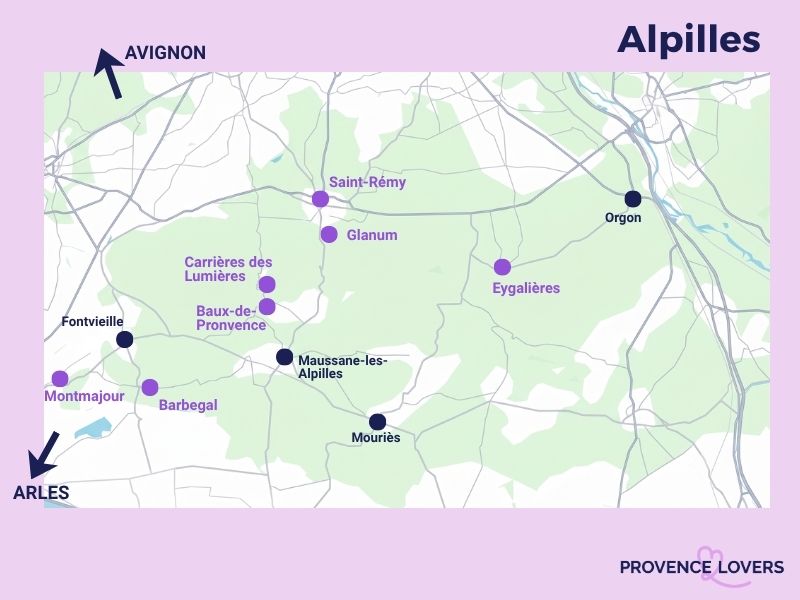
Directions: Glanum, Saint-Rémy-de-Provence
Where is Glanum located?
- South of Saint-Rémy-de-Provence, heading toward Les Baux-de-Provence
- Vincent Van Gogh Avenue
- At the foot of the Alpilles mountain range, at the entrance to a gorge leading to Mont Gaussier
- A few minutes’ walk from the Monastery of Saint-Paul-de-Mausole
How to get there?
From downtown Saint-Rémy-de-Provence, it’s about a 20-minute walk to the site.
By car, from Avignon, take the D571 and then the D5; from Arles, take the D17 to Les Baux-de-Provence and then the D5; from Salon-de-Provence, take the A7 or the N538 to Cavaillon, then the D99 and the D5.
There is also a “Site de Glanum” bus stop right next to the Mausoleum.

Parking
There is a parking lot located directly on Vincent Van Gogh Avenue, at the entrance to the site, with paid parking spaces. You can also park in downtown Saint-Rémy-de-Provence and walk to the site.

OUR TPS FOR RENTING YOUR CAR IN Provence
- Compare prices on our preferred platform: DiscoverCars – one of the best rated sites.
- Choose a car that is powerful enough (the roads are steep) but compact (some passages are narrow).
- Remember to take outcomprehensive insurance (some roads are winding and narrow).
- There is a lot of demand, book it early.

Useful tips: duration, schedules, eating…
Best time to visit
We recommend visiting in the morning, especially in the summer, since there is little shade at the site. If possible, avoid July and August during the hottest part of the day. Please note: Hours may be subject to change on certain days in July due to the Avignon Festival and the Glanum Festival.

Length of visit and main difficulties
A self-guided tour usually lasts between 1 hour and 30 minutes and 2 hours.
The site is certified by Tourisme & Handicap.
As with any archaeological site, the ground is uneven in places. The site is large and requires quite a bit of walking.

In addition, the main walkways remain accessible to people in wheelchairs and strollers, but some areas require navigating steps and cobblestones. For example, the sacred spring is accessed via a staircase. And there are several sets of stairs leading up to the lookout point.
Folding chairs are available at the entrance so you can rest on your way there.

Advice on how to visit
A visitor guide is provided at the entrance and is available in ten languages. We recommend that you follow the tour in the suggested chronological order, starting with the Hellenistic quarter, passing through the Roman monumental center, and ending at the sanctuary of the sacred spring. Feel free to take a detour to the lookout points to enjoy the panoramic view before heading back down.

Visiting with children
The website offers a game booklet that turns the visit into a real-life investigation for budding archaeologists. Your children will be able to learn about excavation techniques, how to use a trowel and a brush, and try to reconstruct the layout of a Roman house based on the objects they discover. It’s sure to make the visit fun for the whole family.

Schedules and rates
The arch and the mausoleum are located outside the archaeological site; admission is free and unrestricted.
Here is some practical information about the archaeological site.
Schedules:
- July 1 through August 28: 8:30 a.m.–6:00 p.m.
- April 1 through June 30 and August 29 through September 30: 9:30 a.m.–6:00 p.m.
- October 1 through March 31: 10 a.m.–5 p.m. (10 a.m.–4 p.m. on December 24 and 31), closed on Mondays
- Please note: Last admission to the monument is 45 minutes before closing. The site is closed on January 1, May 1, November 1 and 11, and December 21 and 25.
- Latest news on the official website here.
Rates:
- Individual price: €9
- Combined ticket for Glanum and the Hôtel de Sade: €12
- Glanum and Montmajour Combo Ticket: €14
Free of charge:
- Under 18
- Ages 18–25 (European Union nationals and non-European legal residents in France)
- A person with a disability and their companion
- Job seeker, upon presentation of a certificate issued within the last 6 months
- Valid Education Pass
- The first Sunday of January, February, March, November, and December

Guided tours
Visitors can explore the museum at their own pace, using the brochure provided at the entrance or an audio guide available in French, English, German, Spanish, and Italian for an additional €3. Guided tours are available for groups by reservation only; occasional guided tours are also organized on certain weekends, according to a schedule available on the official website.

Catering
There is a snack bar and restaurant on site that serves lunch from April through October. Outside of this time, head to downtown Saint-Rémy-de-Provence to grab a bite to eat.

A LITTLE MORE patience
All the photos, maps, information, good addresses to make your stay in Provence a success, will soon be gathered in a single ebook!
The Antiques: The Municipal Arch and the Mausoleum of the Julii
At the entrance to the site, across the road, stand the two monuments that made Glanum famous long before the city was rediscovered. Access to them is not restricted (free and available at any time).

The mausoleum, a cenotaph erected between 30 and 20 B.C., stands approximately 18 meters tall. It was built by three brothers of the Julii family in honor of their father and grandfather, as the inscription notes. We were surprised by the level of detail in the bas-reliefs adorning its base, despite the erosion of time: some of the damaged elements were restored between 2007 and 2008.

The municipal arch, which is somewhat more modest at its current height of 8 meters, once marked the entrance to the city. You’ll notice its resemblance to the Arc de Triomphe in Orange; it is a smaller version of that monument. Together, these two monuments gave their name to the “Antiques” of Saint-Rémy-de-Provence.

To plan ahead
Right at the entrance to the site, a model recreates the entire ancient city as it appeared at its height. We found this tool particularly useful for visualizing the site, since the remains on the ground sometimes make it difficult to imagine the scale of the original buildings.

Videos are also shown at this location, offering a visual reconstruction of Glanum, including its temples, forum, and thermal baths. Take a few minutes to look at them before you begin your tour: they provide valuable information for the rest of your visit.

It’s time to book!
Compare everything: companies, prices, schedules and availability.
The Hellenistic Quarter: Roman Houses, Market, and Baths

As you walk down the main street, paved with large slabs that conceal the old drainage system, you’ll pass through the residential neighborhood of Glanum. The House of the Antes, a typical Mediterranean residence built around a pond, stands next to the House of Atys and Cybele: the latter takes its name from a marble bas-relief discovered during excavations, depicting the shepherd Atys, who, according to legend, was transformed into a pine tree after breaking his vow of chastity to the goddess Cybele.

A little further on was the Hellenistic market, consisting of several shops arranged around a courtyard lined with Doric columns; the Romans later removed part of it to build a chapel dedicated to the Bona Dea.
We also spotted the large thermal baths, recognizable by their rooms heated by a hypocaust and their swimming pool fed by a fountain shaped like a theater mask. Take a moment to look at the nearby gym, which is used for exercise, before continuing on your way.

The Roman monumental complex: the forum, the basilica, and the twin temples
At the heart of the site lies the forum, built during the reign of Augustus, a period when Glanum reached its peak. Beneath this forum lies an impressive dromos well dating from the late 2nd century B.C.: a staircase with 37 steps once provided access to the water, 10 meters below the Hellenistic ground level.

The neighboring basilica, measuring 45 meters long by 24 meters wide, was the forum’s main public building, featuring 24 Tuscan columns. To the southwest stood two twin temples surrounded by a peribolos, considered the oldest of their kind in Gaul and dating from around 30 B.C.: they partially encroached upon an ancient Hellenistic bouleuterion, the assembly hall of the city’s leading citizens.

We found it fascinating to see the layers of several centuries of human occupation superimposed on one another at the same site. In front of the forum, a trapezoidal courtyard lined with colonnades also featured a monumental fountain.

The Gallic sanctuary and the sacred spring
This is where it all began: the sacred spring lies at the heart of the ancient Gallic oppidum. Its waters, which never run dry, were placed under the protection of Glan and the protective mother goddesses, the Glanic Mothers. During the Hellenistic period, a structure was built to protect it from the elements and channel the water away.

Several small temples sprang up around the spring, notably those dedicated to Valetudo, the goddess of health, and to Hercules. A Hellenistic rampart, featuring a zigzag postern gate and a carriage gate, protected the entire sanctuary.

We were pleased to note that, even after the city had been fully Romanized, this Gallic-origin cult centered on the spring persisted: the Romans, too, believed in the healing properties of its waters. The staircase leading down to the spring is still there, and you can use it during your visit.

Belvedere
A staircase leads to a scenic overlook on the hill overlooking the site. The climb takes a bit of effort, but we were rewarded with a panoramic view that takes in all the ruins of Glanum and the Alpilles mountain range.

An orientation table has been set up there to help identify the main surrounding peaks, including Mont Ventoux on a clear day. Be sure to stop here before heading back down: this viewpoint offers a panoramic view that’s hard to appreciate from ground level. This lookout point is accessible at any time during the tour and can be combined with a picnic break if you’d like to take a few minutes to rest.


History in brief
Seventeen centuries of history are evident at this site, from the first Gallic oppidum to its rediscovery in the 20th century. Here are the key dates to remember:
- 6th century B.C.: The Salyens, a Celto-Ligurian people, settled around the sacred spring dedicated to the god Glan
- 2nd century B.C.: Hellenization of the city through contact with merchants from Marseille; construction of temples, an agora, and a rampart
- 49 B.C.: The city came under Roman rule after Julius Caesar captured Marseille
- 30–20 B.C.: construction of the Mausoleum of the Julii, in honor of three brothers from that family
- 10–25 AD: Construction of the municipal arch, the city’s former entrance gate
- 1st–2nd centuries: Glanum’s heyday under Emperor Augustus; construction of the forum, the basilica, the baths, and the twin temples
- A.D. 260: The city was destroyed during the barbarian invasions; the survivors founded Saint-Rémy-de-Provence a little further north
- 1921: Archaeological excavations began under Pierre de Brun; they were continued by Henri Rolland from 1942 to 1969, and then by the CNRS and INRAP since the 1980s

Frequently asked questions
Can you see the Antiques without paying the site admission fee?
Yes, the Municipal Arch and the Mausoleum of the Julii are located across the street, outside the paid admission area, and can be viewed freely at any time.
PLAN YOUR TRIP TO provence
- Inspiration
Best things to do in Provence
Provence’s most beautiful towns
Most beautiful villages
Most beautiful castles
Best destinations

- Practical advice
Rent a car in Provence – in Nice – in Cannes – in Marseille – in Aix-en-Provence.
Itineraries: 5 days – 1 week – 10 days
Weekend Ideas: Best of – Romantic – Luxury – Unique

- Where to stay
Where to stay in Provence
Best luxury hotels

- The must-dos
Best things to do in Marseille
What to do in Aix-en-Provence
Best things to do in Avignon
Best things to do in Arles
Best things to do in Nice
Best things to do in Cannes
Best things to do in Antibes
Best things to do in Monaco
Best things to do in Saint-Tropez
Best things to do in Cassis
Things to Do in the Luberon
Things to Do in the Alpilles



 nos vidéos sur Youtube
 nos photos sur Instagram
 nos actualités sur Linkedin
 formulaire de contact


