
When to visit the Côte d’Azur?
It depends on your criteria.
Here’s our complete guide with details to help you make your decision based on:
- Weather (temperature, rain, wind, etc.),
- Crowds and prices,
- Sea temperature,
- The different zones (coast, hinterland, mountains),
- Festivals and events,
- …
This guide is completely independent, based on our experiences. We visited the region anonymously, making our own choices and paying our bills in full.
When to go to the Côte d’Azur – Summary
Best months to visit the Côte d’Azur
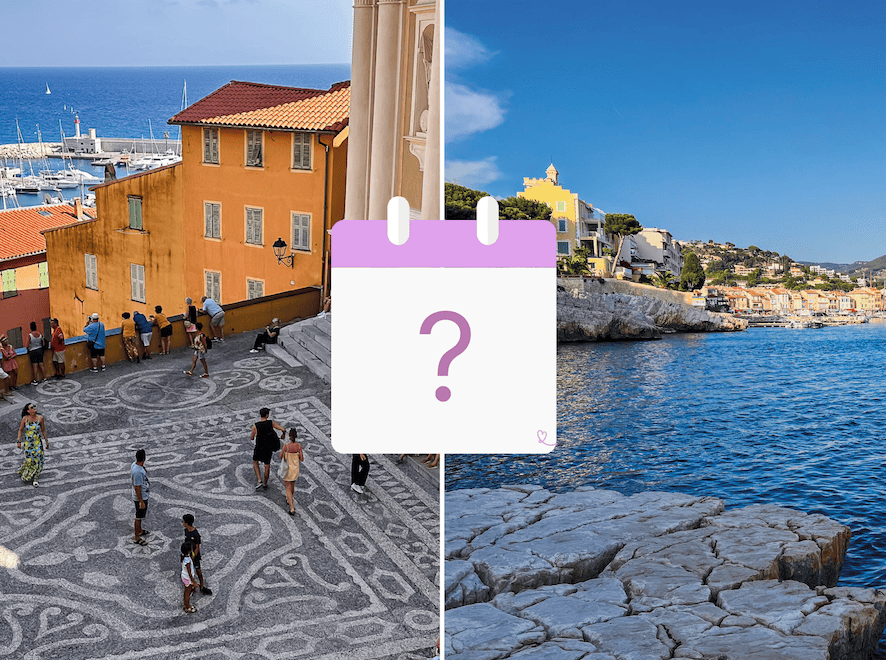
The Côte d’Azur enjoys one of the sunniest Mediterranean climates in France. Our favorite months are May-June and September-October, when temperatures are pleasant, the sea is accessible and visitor numbers remain reasonable, especially outside the school vacations.
A preference for September.

Best period for each activity
It all depends on what you’re looking for:
- Best time for the beach: June to September
- Best time for hiking and backcountry: March to June and September-October
- Best time for water sports: June to September (calm, warm sea)
- Best time for cultural visits: All year round, but preferably outside July and August.
- Best time for events: February (Nice Carnival), May (Monaco Grand Prix, Cannes Film Festival), July (fireworks, Jazz à Juan).
- Best time for lavender flowers: Mid-June to mid-July (usual flowering period, but may vary from year to year).
WHERE TO STAY IN Provence
Our independent picks for the accommodation of your dreams:
- Where to stay on the Côte d’Azur
- Where to stay in Provence (coming soon)

Or, if you’ve chosen your destination, our selection of the best hotels in:
- Nice
- Aix-en-Provence
- Marseille (coming soon)
- Avignon (coming soon)
- Arles (coming soon)
- Cannes
- Saint-Tropez
- Antibes
- Menton
- Monaco

When to visit the Côte d’Azur – Criteria
If you don’t want to read the whole article, here’s a summary based on what you’re looking for:
- Weather, temperatures, rain…
Mediterranean climate with hot summers (26-30°C) and mild winters (10-14°C). Rainfall is rare from June to August, but can be intense in autumn, sometimes in the form of Cevennes episodes. The mistral blows occasionally in all seasons, especially to the west of the region. - Swimming
The sea is swimmable from June to October. At the height of summer, the water reaches 24-26°C. In September, it stays around 22-23°C. In winter, it drops to 13-14°C. The Mediterranean can experience algae deposits on certain beaches, especially in summer after windy or hot spells. Also, from June to September, watch out for jellyfish. - Crowds and prizes
High season from mid-July to the end of August, with crowded beaches, high prices and difficult coastal traffic. Seasonal shoulders (May-June and September-October) offer a good compromise. Winter is calm, except for the festive season and the Nice Carnival in February.

OUR TPS FOR RENTING YOUR CAR IN Provence
- Compare prices on our preferred platform: DiscoverCars – one of the best rated sites.
- Choose a car that is powerful enough (the roads are steep) but compact (some passages are narrow).
- Think of thecomplete insurance (some roads are tortuous and narrow).
- There is a lot of demand, book it early.

When to go to the Côte d’Azur – Weather and conditions by zone
The coastline
From Menton to Marseille, the seaside boasts the mildest microclimate in the region:
- Summer: warm temperatures (26-35°C), virtually no rain. The sea breeze refreshes the evenings.
- Winter: generally mild temperatures (10-14°C), around 300 days of sunshine a year. A few rainy spells from November to March. However, the mistral can blow and be quite cold, so temperatures are cooler.
- Mid-season: Ideal conditions with temperatures between 18 and 24°C, few crowds and more affordable prices.

The hinterland
The hilltop villages, inland towns and gorges are more contrasted in character:
- Summer: Temperatures slightly cooler than by the sea (25-30°C depending on altitude). Ideal for hiking and exploring villages.
- Winter: Cooler (6-12°C) with possibility of frost in high-altitude villages.
- Mid-season: A particularly pleasant time of year for walking, with vegetation in full bloom in spring and autumnal colors in October.
Mountains (Alpilles, Mont Ventoux, Mercantour)
The region offers a number of natural mountain getaways within easy reach of the coast, each with its own distinct character:
- Summer: The Alpilles (28-34°C) and Mont Ventoux (15-20°C at the summit) are best visited early in the morning to avoid the heat. At higher altitudes, the Mercantour offers welcome coolness (15-22°C) and remarkable wildlife (chamois, ibex, wolves). This is the best time for hiking at altitude.
- Winter: The Alpilles are accessible all year round, even if the mistral wind can blow hard. Mont Ventoux is often snow-covered and closed to traffic from December to April. The Mercantour’s resorts (Auron, Isola 2000) are coming to life, and can be reached from Nice in less than 2 hours.
- Mid-season: The ideal period for all three massifs. The Alpilles region lights up in February with the blossoming almond trees. The Ventoux is back in the hands of hikers from May onwards. In the Mercantour, some high-altitude trails remain closed until June: find out more before planning a mountain outing.

A LITTLE MORE patience
All the photos, maps, information, good addresses to make your stay in Provence a success, will soon be gathered in a single ebook!
If you wish to be informed of the publication of our guide on Provence, subscribe:

Sea temperatures on the Côte d’Azur
The Mediterranean is gradually warming up as the months go by:
- January to March: 13-14°C
- April to May: 16-18°C
- June: 20-22°C
- July to August: 24-26°C
- September: 22-23°C
- October: 19-21°C
- November-December: 15-17°C
Unlike the Atlantic, the many beaches of the Côte d’Azur retain the heat accumulated in summer: September remains an excellent period for swimming, often more pleasant than July due to the lower number of visitors.

Length of day
Daylight hours on the Côte d’Azur through the seasons
The region enjoys exceptional sunshine, with around 300 days of sunshine a year. Seasonal variations have a direct impact on the pace of visits.
Winter (December-February)
- Shortest days: about 9h30 of light
- Sunrise: around 7.50 a.m.
- Sunset: around 5:20 p.m.
- Despite this, the sunshine was much more generous than in the rest of France.
Spring (March-May)
- Mars: around 12h of sunshine at equinox
- May: over 14 hours of daylight
- Sunrise: from 6.20 a.m.
- Sunset: after 8:30 p.m.
Summer (June-August)
- Longest days: up to 15 hours of daylight
- Summer solstice (June 21): peak sunshine
- Sunrise: around 6.10 a.m.
- Sunset: until 9:10pm
Autumn (September-November)
- September: another 13 hours of light
- November: return at about 10 a.m.
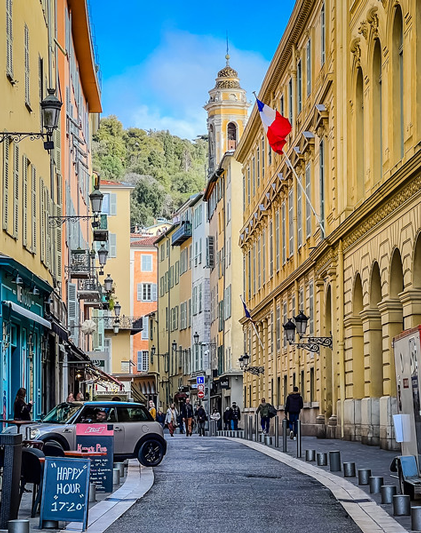
- Beautiful golden lights on the facades of Nice and Menton
- A smooth transition to winter, with the sea still accessible in September

Rain, wind, crowds…
Rain on the Côte d’Azur
The Côte d’Azur is one of the sunniest regions in mainland France. Rainfall is concentrated mainly between October and April. In autumn, Mediterranean episodes can occur: heavy rains fall in a short space of time, sometimes accompanied by thunderstorms. These phenomena are occasional but intense. Summer, from June to August, is virtually rain-free.

Wind on the Côte d’Azur
Wind is a factor not to be overlooked. The mistral, a cold, dry north-westerly wind, affects the west of the region (around Marseille, Aix-en-Provence and Cannes) more than the east (Nice, Menton). It can blow for several days in a row, sometimes strongly, and refreshes the atmosphere in all seasons.
In summer, a sea breeze settles in mid-day along the coast, making the heat more bearable. On higher ground and in the hinterland, the wind can be stronger and the temperature cooler.
Crowds on the Côte d’Azur
July and August are peak times. The beaches of Marseille, Cassis, Nice, Saint-Tropez and Antibes are saturated, the seaside roads are very busy and accommodation prices are at their highest. We advise you to book your hotel well in advance. Some restaurants are also fully booked several weeks in advance.
Weekends in May are also very busy, especially during the Monaco Grand Prix and the Cannes Film Festival. The Easter vacations also attract a large number of visitors.
Outside these periods, the region returns to a more leisurely rhythm. Winter remains generally quiet, with the exception of the end-of-year festivities and the Nice Carnival in February, which generates a large number of visitors.

Special conditions: whalebones, closures…
Best time to watch cetaceans in the Mediterranean
The north-western Mediterranean is home to one of Europe’s largest cetacean sanctuaries: the Pelagos Sanctuary, a protected area covering part of the waters between France, Italy and the Principality of Monaco. Here you can observe fin whales, sperm whales, common dolphins and bottlenose dolphins.
The most favorable period is from June to October, when weather conditions allow regular outings and the cetaceans return to surface waters to feed. Boat excursions from Nice, Villefranche-sur-Mer or Monaco offer observations accompanied by scientific teams.
Book your dolphin watching tour on the French Riviera here!
Outside this season, outings are more unpredictable due to sea conditions.

Seasonal wildlife sightings in the hinterland
The region offers remarkable natural diversity, from the Camargue to the peaks of the Mercantour, from the garrigues of the Alpilles to the forests of the Lubéron.
Spring (March-May):
- Camargue: flamingos back in numbers, herons and egrets nesting in the marshes
- Alpilles: almond and broom blossom, birdwatching (Bonelli’s eagles, reintroduced griffon vultures)
- Luberon: lavender fields still green, first sightings of Hermann’s tortoises in sunny areas
- Mercantour: marmots emerge from hibernation for the first time, alpine meadows bloom, golden eagles and Egyptian vultures return to the region

Summer (June-August):
- Camargue: peak flamingo, horse and bull activity in the marshes. Beware of the heat and mosquitoes
- Alpilles and Lubéron: active cicadas, butterflies and reptiles. Early morning hikes are recommended. Lavender flowering period (usually mid-June to mid-July)
- Mercantour: observation of ibex and chamois on the ridges, maximum wildlife activity at altitude

Autumn (September-November):
- Camargue: bird migration, spectacular concentration of waders and ducks in the ponds
- Luberon: deer bellowing in the forests (September-October), colors of the downy oaks
- Mercantour: golden larch forests, deer bellowing in the valleys
- Alpilles: grape harvest and olive harvest, calm atmosphere in the villages

Winter (December-February):
- Camargue: maximum concentration of wintering birds, low lights on the ponds, wild and calm atmosphere
- Alpilles and Lubéron: uncluttered landscapes, villages accessible without crowds, almond trees in bloom from late February onwards
- Mercantour: snow-covered landscapes, animal tracks in the snow, possible presence of wolves in the valleys

Best time to visit museums and monuments
The Côte d’Azur boasts a dense cultural network: modern and contemporary art museums in Nice (Musée Matisse, Musée National Marc Chagall), art foundations in Saint-Paul-de-Vence(Fondation Maeght), exciting museums in Marseille and Aix-en-Provence (MuCem, Musée Granet) and numerous historic sites. Most remain open all year round.
In low season, some sites reduce their opening hours or close one or two days a week, usually on Mondays or Tuesdays. We recommend checking schedules directly with the establishments before your visit, especially from October to April.

Best time to visit the gardens
The region boasts a number of remarkable gardens, some of which are ranked among the most beautiful in France. The best time to visit depends on the type of garden:
- Spring (March-May): The ideal period overall. The Jardin Ephrussi de Rothschild in Saint-Jean-Cap-Ferrat, the Jardin Japonais in Monaco and the gardens of Villa Eilenroc in Antibes are particularly beautiful in April and May, with roses and Mediterranean plants in bloom.
- Summer (June-August): The gardens remain accessible, but the heat can make visits uncomfortable in the middle of the day. Prefer late afternoon visits. Some gardens open at night in July and August
- Autumn (September-October): A good alternative to spring. The light is soft, the temperatures pleasant and the crowds much lower. The gardens of Villa Noailles in Hyères are well worth a visit at this time of year.
- Winter (November-February): Exotic gardens, such as Monaco’s Jardin Exotique, Nice’s Jardin Botanique or the Jardin d’Eze with its cacti and succulents, remain interesting thanks to their cold-hardy Mediterranean and tropical species. Classic gardens, on the other hand, are sparsely flowered


It’s time to book!
Compare everything: companies, prices, schedules and availability.
Description of seasons on the Côte d’Azur
Spring on the Côte d’Azur
Spring (March to May) is a particularly pleasant time of year. Temperatures are gradually rising, vegetation is blooming again and the beaches are starting to become crowded, but not yet saturated. It’s also the season for major events: the Cannes Film Festival and the Monaco Grand Prix in May attract an international audience. Prices are more affordable than in summer, except around these events.

Summer on the Côte d’Azur
Summer (June to September) is the peak tourist season. Temperatures are high, but the sea breeze tempers the heat at the seaside. Beaches are crowded and prices are at their highest. Evenings are lively, especially in Marseille, Nice, Cannes, Juan-les-Pins and Monaco. July is also the month of fireworks all along the coast, with the July 14th Feu in Nice and the fireworks competitions in Cannes.

Autumn on the Côte d’Azur
Autumn (September to November) is an excellent time to visit the region. The sea remains warm in September, crowds disperse and prices drop significantly. Conditions are ideal for exploring the hinterland, hiking in the Mercantour or Verdon, or visiting farmers’ markets. We particularly appreciate the light this season on the colorful facades of Nice and the inland villages. But watch out for rainy spells in October and November.

Winter on the Côte d’Azur
Winter (December to February) is mild compared to the rest of France, which has long attracted sun-seeking customers. It’s the low tourist season on the coast, with attractively priced accommodation. The days can be very sunny, perfect for strolling along the Promenade des Anglais or exploring the old centers of Nice and Menton. The Nice Carnival in February is a winter highlight that attracts large numbers of visitors for two weeks.

Major events and festivals
- February: Nice Carnival (2 weeks, floats and flower battles), Lemon Festival in Menton
- May: Cannes Film Festival, Monaco Grand Prix (Formula 1)
- June: Festival de Marseille (dance and performing arts, open-air shows throughout the city)
- July: Jazz Festival in Juan-les-Pins (Jazz à Juan, one of Europe’s oldest jazz festivals), July 14 fireworks in Nice and fireworks competitions in Cannes, Festival International d’Art Lyrique d’Aix-en-Provence (one of Europe’s most renowned opera festivals).
- July-August: Numerous classical and opera concerts and festivals (nearby Chorégies d’Orange, Nice Jazz Festival).
- September: Marsatac Festival in Marseille (electronic and alternative music)
- December: Foire aux santons in Marseille (one of the oldest in France), Christmas markets in Nice, Grasse, Vence and Aix-en-Provence

The Côte d’Azur month by month
- See our dedicated articles:
- Côte d’Azur in January
- Côte d’Azur in February
- Côte d’Azur in March
- Côte d’Azur in April
- Côte d’Azur in May
- Côte d’Azur in June
- Côte d’Azur in July
- Côte d’Azur in August
- Côte d’Azur in September
- Côte d’Azur in October
- Côte d’Azur in November
- Côte d’Azur in December
PLAN YOUR TRIP TO Provence
- Inspiration
The most beautiful landscapes in 30 photos (coming soon)
What to do in Provence
Most beautiful cities in Provence (coming soon)
Most beautiful villages
Most beautiful castles (coming soon)
Most beautiful gardens (coming soon)
Best boat tours (coming soon)
Secret places (coming soon)

- Practical advice
A successful trip to Provence (coming soon)
Rent a car in Provence – in Nice – in Cannes – in Marseille – in Aix-en-Provence.
Itineraries: 5 days – 1 week – 10 days (coming soon)
Weekend ideas: best-of – romantic – luxury – unusual (coming soon)

- Where to stay
Where to stay in Provence (coming soon)
Best luxury hotels in Provence (coming soon)

- The must-dos
What to do in Marseille
What to do in Aix-en-Provence
What to do in Avignon (coming soon)
What to do in Arles (coming soon)
Best things to do in Nice
Best things to do in Cannes
Best things to do in Antibes
Best things to do in Monaco
Best things to do in Saint-Tropez
Best things to do in Cassis


SHE MADE THE TRIP Claire