
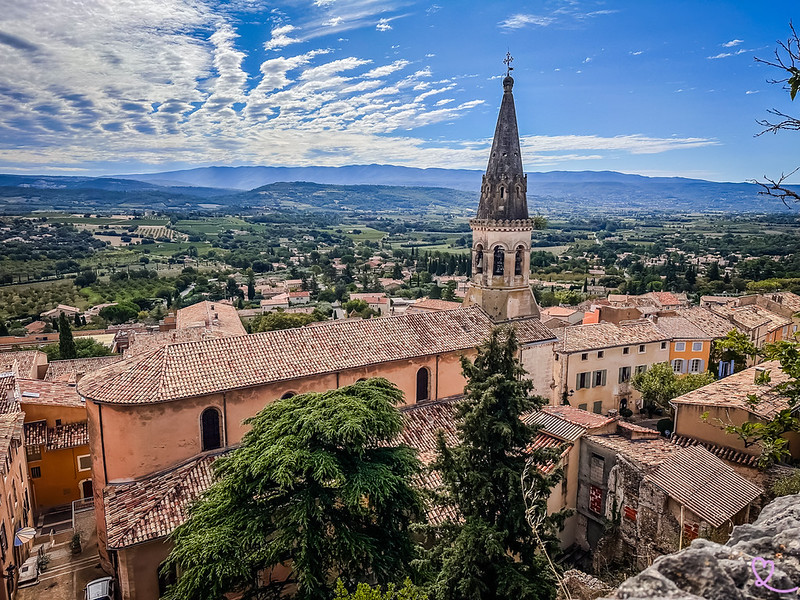
Saint-Saturnin-lès-Apt is a hilltop village in the Luberon, nestled against a rocky outcrop at the foot of the Monts de Vaucluse. We loved the ruins of its castle, its restored windmill, and the panoramic view of the Luberon from the hills.
Here is our guide to the must-see attractions in Saint-Saturnin-lès-Apt in Provence, along with helpful tips for planning your visit.
This guide is completely independent, based on our experiences. We visited the region anonymously, making our own choices and paying our bills in full.
Is the village of Saint-Saturnin-lès-Apt worth a visit?
Yes, the village of Saint-Saturnin-lès-Apt is worth a visit. We found it to be quieter than other villages in the Luberon. Between the mill, the castrum, and the 18th-century gates, the loop offered us a beautiful view of the Apt Valley.
It is one of the most beautiful villages in the Luberon and in Provence.
1. Stroll through the narrow streets of the old village

We walked through the old village with its stone houses, colorful houses, narrow alleys, and lively squares. We walked under the Passage du Pontin, a passageway built beneath the houses to save space inside the city walls. Restored in 2008, it connects Rue Blanche Gaillard, Place de la Mairie, and Rue de la République.
As you wander through the streets, you’ll come across fountains, monumental gates, and the remains of a wine vat and the first communal oven—a wood-fired oven that the lord made available to the residents in exchange for a fee.

- There is a trail marked with green dots that takes about an hour to walk through the village and the castle ruins.
- The main streets are easy to navigate, but as soon as you want to explore, the Calades are sloped and the cobblestones are uneven: comfortable shoes are recommended.

WHERE TO STAY IN Lubéron
Our favorites:
In Gordes, a truly exceptional village:
Mas des Romarins Hotel – check photos and availability
Around Mane and Forcalquier:
Couvent des Minimes Hotel – check photos and availability
Around Menerbes, in the heart of the villages:
Bastine de Marie Hotel – check photos and availability

See our selection: Where to Stay in the Luberon
2. Remains of the medieval castle

The castle of Saint-Saturnin-lès-Apt stands on a rocky outcrop overlooking the village. First mentioned as early as 960, the site was designated as a castrum—that is, a fortified village—in 1006. We walked along its ramparts, whose stones are arranged in a herringbone pattern known as “à la sarrasine.” The towers have disappeared, with the exception of the Portalet gatehouse and part of the keep. We then walked through the ruins of the ancient village, where traces of dwellings can still be made out.

- Free and open access via the trail and the cobblestone paths
- The trail climbs uphill, with rocky terrain and nearby cliff edges: be sure to wear sturdy shoes, and bring hiking poles if you have trouble.
- The place is beautiful and offers magnificent views—first of the village rooftops and then of the surrounding hills.
3. Castle Chapel

At the top of the rocky outcrop, the castle chapel overlooks the ruins of the original village. It was built in the 11th and 12th centuries on the ruins of a Roman structure and an early Christian church from the 6th century. We have learned that three bishops consecrated it in 1056, as recorded in an engraved dedication. Built in the Romanesque style, it occupied only part of the keep at that time. We found the building to be impressive, especially since it had recently been restored.

At the end of the 17th century, the White Penitents, a brotherhood of lay Catholics, ensured its preservation. They extended it to cover the entire keep and equipped it with a bell, a pulpit, and a gallery. During the plague of 1720, it served as a sickbay and a quarantine facility. Excavations conducted in 1997 uncovered a stone altar beneath the floor of the apse, dedicated to the martyr Saint Saturninus.
We were really surprised by how well-preserved it was, right in the middle of the ruins!
4. Panoramic view of the Luberon and the Monts de Vaucluse

From the castle ruins, the view stretches far into the distance. On a clear day, your gaze wanders westward for miles.
You have a superb view of the village and its rooftops in the foreground. And the surrounding hills of the Luberon. Behind you, the Vaucluse Mountains close off the horizon.

We walked along the rampart walkway next to the castle chapel to take in the different views. Amid the ruins, you’ll find an information board to help you better understand the surrounding landscape.

5. 17th-century windmills

On the rocky outcrop overlooking the village, several windmills once ground grain next to a large threshing floor. Two remain today, only one of which has retained its wings. We stopped in front of this restored mill, the starting point of our loop hike. Its conical wooden roof is movable: it allows the wings to be oriented toward the mistral, the strong north wind that blows in Provence. The second mill, which has been converted into a home, is a little further away, and we didn’t see it.

The mechanism consists of a drive shaft that drives two stone grinding wheels. The upper millstone, known as the rotating millstone, grinds the grain against the lower millstone, known as the stationary millstone, to produce flour. Adjusting the gap between the two produces a finer or coarser grind.
You can walk there from the village, and there’s also a parking lot nearby.
6. Ayguier Portal

The Ayguier Gate overlooks Bel-Air Square, with the Angle Tower of the rampart rising above it. This fortified structure was part of the 15th-century defensive wall and served as the village’s only entrance at that time. Its name is said to come from the cistern it once housed: “aigo” means “water” in Provençal. We encountered this connection to water throughout the walk.

We have learned that the village had several sets of fortifications, built as it expanded from the 12th to the 16th century. In 1363, a third line of ramparts thus enclosed the suburbs located between the church and the gate. From 1214 to 1408, Rue Droite even served as a border: one part of the village belonged to the pope, the other to the counts of Provence. During the Hundred Years’ War (1337–1453), the city walls protected the inhabitants from looting.
Walking through that door is a bit like traveling back in time!
OUR TPS FOR RENTING YOUR CAR IN Provence
- Compare prices on our preferred platform: DiscoverCars – one of the best rated sites.
- Choose a car that is powerful enough (the roads are steep) but compact (some passages are narrow).
- Remember to take outcomprehensive insurance (some roads are winding and narrow).
- There is a lot of demand, book it early.

7. Saint-Étienne Church

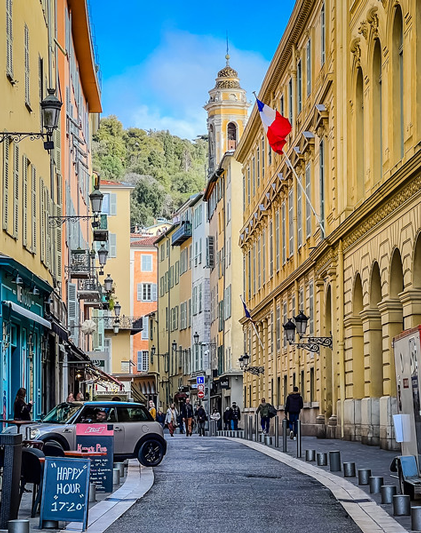
The Church of Saint-Étienne stands on the site of an 11th-century Romanesque church, which was originally a priory of Montmajour Abbey. It became a parish church in 1349, was enlarged several times, and was then demolished in the 19th century. The current, larger building was consecrated in 1862.

We liked its octagonal bell tower and the rose window that illuminates the interior above the door. On the pediment, you will see “R.F.” and “Liberty, Equality, Fraternity,” painted during the Third Republic, when the state separated its institutions from religion. We were surprised to see this detail on a church facade.
8. Follow the trail of fountains

Saint-Saturnin-lès-Apt has always sought to secure its water supply. We discovered several fountains fed by springs. The best-known one, the Matheron Fountain, is located near the church. Its carved pediment was donated in 1784 by the last Marquis of Monclar, the lord of the manor.
We focused on its Latin inscription: in it, the municipality expresses its refusal to pay the lord the water tax. Its coat of arms was chiseled away during the Revolution.
There are other fountains along the promenade. You’ll also pass by several washhouses, which offer a glimpse into daily life before the advent of running water.
A LITTLE MORE patience
All the photos, maps, information, good addresses to make your stay in Provence a success, will soon be gathered in a single ebook!
9. 18th-century decorative doors

As you wander around, be sure to take a look at the doors and sculptures. There are several of them, mainly on Rue de la République.

Located on Place de la Mairie, the Maison Commune has served as city hall ever since it was purchased by the first municipal government, elected in 1790. You’ll notice its door and pediment, created by the local sculptor Alexis Poitevin (1764–1816). Two genies flank a sheaf of wheat topped with a Phrygian cap, a symbol of the Revolution.
10. Pay your respects to the statue of Joseph Talon

At the foot of the grand staircase on Place Gambetta, a statue pays tribute to Joseph Talon, a farmer from Saint-Saturnin-lès-Apt. He is considered the pioneer, if not the inventor, of truffle cultivation—that is, the cultivation of truffles, an underground fungus that grows at the base of oak trees. We learned that he had planted acorns on land considered barren, and then kept it a secret for a long time. Created by sculptor P. Gatine, the statue was unveiled on November 9, 1986.
11. Go grocery shopping on Tuesday morning

Every Tuesday morning, all year round, the weekly market is held at Place Gambetta. It’s a small, intimate market with about ten stalls, mostly selling food. There you’ll find fruits and vegetables, deli meats, cheeses, olives, tapenade, honey, and jams from the region, some of which are organically grown. We love these village markets, which are quieter than those in the nearby big cities. And, above all, less geared toward tourists.
Other Attractions in Saint-Saturnin-lès-Apt and the Surrounding Area
We didn’t have time to see everything around the village. Here are some other ideas to combine with your visit.
- Water cisterns are tanks carved into the rock to collect rainwater. The Aiguiers Trail, which starts in the village, winds through the garrigue and offers the chance to explore several of them.
- Bories are dry-stone huts, meaning they are built without mortar. They can be found all over the Luberon, and the town has about 130 of them.

- Fields of cherry trees, olive trees, and grapevines: Around the village, the farmland is divided among cherry trees, olive trees, grapevines, and fine lavender. You’ll pass them along the roads leading to Saint-Saturnin-lès-Apt, and we also spotted them from the hills above.
How to Get to Saint-Saturnin-lès-Apt + Parking
Where is Saint-Saturnin-lès-Apt?
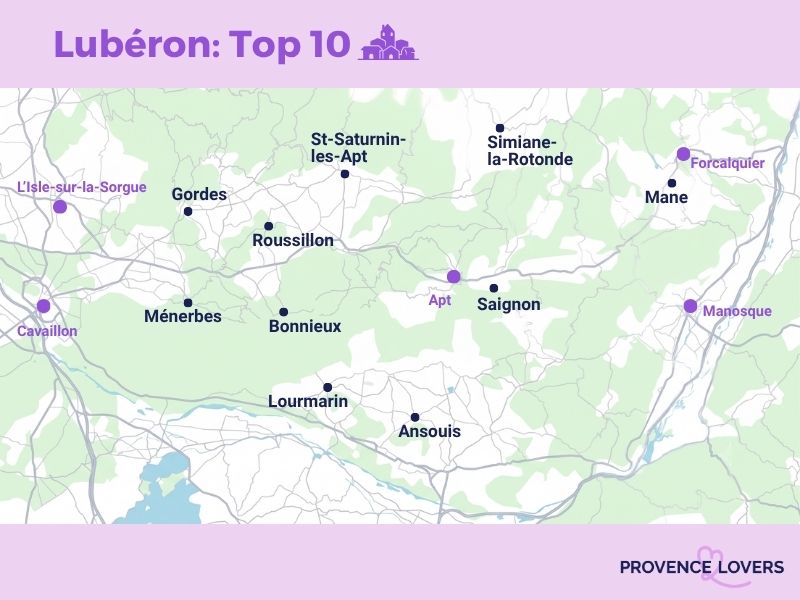
- In the heart of the Luberon Regional Nature Park, on the southern slope of the Monts de Vaucluse
- Apt to Saint-Saturnin-lès-Apt: 9 km
- From Gordes to Saint-Saturnin-lès-Apt: 19 km
- From Avignon to Saint-Saturnin-lès-Apt: 50 km
How to get there

By car, Saint-Saturnin-lès-Apt can be reached from Apt via the D900 and then the D943. We recommend this mode of transportation, which gives you more freedom to explore the villages of the Luberon.
For public transportation, buses connect the town to Apt (lines 916 and 926 [to be confirmed]). Service remains limited: check the schedule before you go.
Parking in Saint-Saturnin-lès-Apt

There are several small parking lots surrounding the village. We recommend that you park near the mill: it’s the easiest starting point for exploring the village.
You’ll also find the Cours de la Liberté parking lot (maximum 48 hours, except on Tuesday mornings), the Moulin à Huile parking area on the road to Apt, the parking area on the road to Gordes, and the municipal swimming pool parking lot, located 130 meters from the tourist information center.
During peak season, it becomes harder to find parking.

Helpful Tips for Visiting Saint-Saturnin-lès-Apt
How long and when?
Allow 1 hour and 30 minutes for the village loop if you read each step. The trail features 28 points of interest and is 2.6 km long. Come on a Tuesday morning to enjoy the market. In the summer, we prefer to leave early, before it gets too hot. There is little shade among the ruins.
Difficulty

Please note that the climb to the ruins is quite steep and the terrain is rough: be sure to wear sturdy shoes. It’s worth it for the views!
Visiting with children
The village is a great place to visit with the family, as long as you stay alert near the cliff edges. Kids will love the windmill, the mechanism of the millstones, and the ruins to explore.
Restaurants

We haven’t tried the restaurants in Saint-Saturnin-lès-Apt yet.
But on our list is:
- Le Saint Hubert Restaurant, located on Place de la Fraternité, is housed in an 18th-century inn that once served as a coaching inn, a movie theater, and a ballroom. The cuisine showcases producers from the Luberon and Ventoux regions.
Visiting Saint-Saturnin-lès-Apt in Winter
In winter, the village is quiet, and you can walk the loop without crowds. We recommend that you dress warmly for the climb up to the castle: up on the hill, the mistral can blow strongly, as evidenced by the mill’s roof, which was designed to withstand this wind. The Tuesday market and the tourist information center are open year-round.
EXPLORE the Luberon
- Top Attractions in the Luberon
- Best Villages
- Where to stay
- Gordes: Attractions – Hotels
- Roussillon
- Provençal Colorado



 nos vidéos sur Youtube
 nos photos sur Instagram
 nos actualités sur Linkedin
 formulaire de contact


