
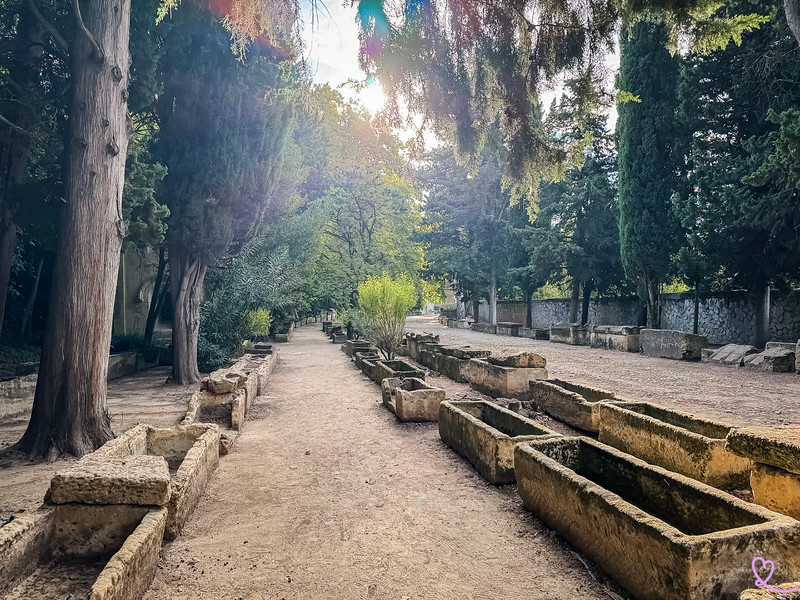
Once a Roman necropolis, which over the centuries became one of Europe’s most renowned Christian cemeteries, Alyscamps left a particularly strong impression on us with its avenue lined with sarcophagi and cypress trees. Listed as a UNESCO World Heritage Site, this site remains an essential stop for anyone seeking to understand the history of Arles.
In this article, you’ll find some useful tips to help you prepare for your visit and have a great time!
This guide is completely independent, based on our experiences. We visited the region anonymously, making our own choices and paying our bills in full.
Why visit the Alyscamps?
Are the Alyscamps worth the trip? Our opinion:
Yes, the Alyscamps are worth a visit. This ancient necropolis, whose path lined with sarcophagi and cypress trees leads to the Romanesque Church of Saint-Honorat, captivated us with its atmosphere, which is both peaceful and steeped in history. Listed as a UNESCO World Heritage Site, the site also inspired Van Gogh and Gauguin.
It’s one of the best attractions in Arles.

Why are the Alyscamps famous?
The fame of the Alyscamps dates back to the 4th century, with the martyrdom of Saint Genest, who was beheaded in 303. This fact gave the site a special aura, so much so that the faithful from all over Europe had their deceased transported there via the Rhône to be buried near the saint. We find it remarkable that a simple ancient cemetery has gained such religious significance over the centuries.

The place also owes its fame to Vincent van Gogh and Paul Gauguin, who painted several works there in 1888, a few weeks before their falling out. Van Gogh depicted tree trunks and ancient tombs in the background, while Gauguin chose to omit any reference to the sarcophagi. In fact, you’ll find these works in several major museums around the world.

WHERE TO STAY IN Arles
Our favorites: neighborhoods and hotels
Downtown Arles, close to all the attractions
Hôtel du Forum – check photos and availability
Le Cloître Hotel – Check photos and availability
Trinquenaille, on the other side of the bridge
Mireille Hotel – check photos and availability

Directions: Alyscamps, Arles
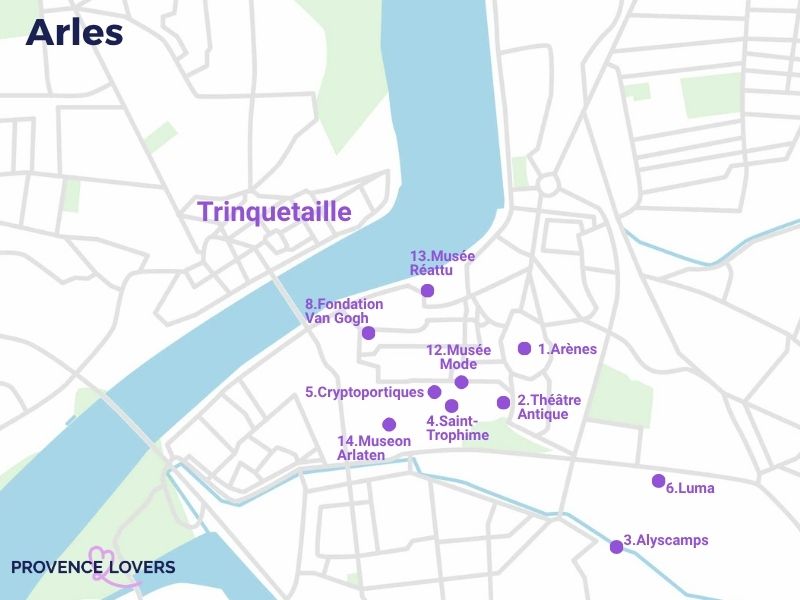
Where are the Alyscamps located?
- South of Arles’ Old Town
- Avenue des Alyscamps
- A 15-minute walk from downtown Arles
- Here is a map showing Alyscamps to the southeast:
How to get there?
From downtown Arles, it’s about a 15-minute walk to the Alyscamps. The site’s main path is accessible, with a stabilized gravel surface, making it suitable for most visitors, including those with limited mobility.
Parking
Free parking is available at the entrance to the site, making it easy to get there if you’re driving.

OUR TPS FOR RENTING YOUR CAR IN Provence
- Compare prices on our preferred platform: DiscoverCars – one of the best rated sites.
- Choose a car that is powerful enough (the roads are steep) but compact (some passages are narrow).
- Remember to take outcomprehensive insurance (some roads are winding and narrow).
- There is a lot of demand, book it early.

Useful tips: duration, schedules, eating…
Best time to visit
We recommend visiting outside the hottest part of the day—especially during the summer—so you can fully enjoy the walk under the cypress trees.
Length of visit and main difficulties
Allow between 30 minutes and 1 hour to explore the entire site. The path is accessible, and its stabilized gravel surface allows for easy movement, including for people with limited mobility.

Advice on how to visit
We recommend that you follow the main path from the entrance to Saint-Honorat Church, located at the far end of the site. This tour route allows visitors to gradually explore the sarcophagi before arriving in front of the octagonal bell tower, which frames the view.

Visiting with children
The stabilized gravel surface of the main path makes for a peaceful family stroll. The site, which is quiet and shaded by cypress trees, is perfect for a short walk and is well-suited for a visit with young children.

Schedules and rates
The Alyscamps are open during the following hours:
- November through February: 10 a.m. to 5 p.m.
- In March and October: 9 a.m. to 6 p.m.
- In April and September: 9 a.m. to 7 p.m.
- May through August: 9 a.m. to 8 p.m.
- The admission fee is €5.
- Latest news on the official website here.
Catering
The Alyscamps site does not have a restaurant on-site. You’ll find several restaurants in downtown Arles, a 15-minute walk away.
A LITTLE MORE patience
All the photos, maps, information, good addresses to make your stay in Provence a success, will soon be gathered in a single ebook!

A legendary avenue lined with sarcophagi

The Alyscamps Avenue runs along the ancient Via Aurelia, east of the Roman city of Arelate. Since ancient times, it has been customary to bury the dead outside the city walls, which explains why the necropolis was established at this specific location.

Cremations gradually gave way to burials around the 3rd century, and it was at that time that sarcophagi began to appear along the path, giving the site its current appearance.

We were struck by the number of tombs still visible today, despite the numerous instances of theft and destruction that occurred after the French Revolution. You’ll enjoy admiring the various shapes and designs of these stone sarcophagi, arranged beneath the century-old cypress trees that line the path.
The Romanesque portico of Saint-Césaire-le-Vieux and the Saint-Accurse Chapel

At the entrance to the site stands a Romanesque portico, the sole remnant of the former Church of Saint-Césaire-le-Vieux, which once belonged to the Saint-Césaire Convent, founded in the 6th century. We took the time to closely examine its carved capitals, which were adorned, in particular, with a grimacing mask that caught our full attention.

This portico is attached to the Saint-Accurse Chapel, built in 1520 as an act of atonement for the death of Accurse de la Tour, a young nobleman from Arles who was killed in a duel by Antoine de Quiqueran de Beaujeu. There, you’ll discover a lesser-known chapter in the history of the Alyscamps—a blend of local legend and religious architecture—just a few steps from the entrance to the alley.

There is another small chapel a little further along the path toward Saint-Honorat Church.

It’s time to book!
Compare everything: companies, prices, schedules and availability.
Saint-Honorat Church, a remnant of the Middle Ages

At the end of the alley stands the Church of Saint-Honorat, built in the 11th century by the monks of Saint-Victor in Marseille, and later rebuilt in the 12th century in the Provençal Romanesque style.

The original plan called for a nave with five bays, but due to a lack of funds, only the eastern bay was completed, leaving the building unfinished for eight centuries.

The crossing is topped by a dome supported by piers, above which rises a two-story octagonal bell tower, whose design draws directly on the surrounding ancient architecture. We found this silhouette particularly striking, reminiscent of the Roman sarcophagi lined up along the path.

This church is also the starting point of the Arles Way, one of the historic routes leading to Santiago de Compostela.
A place that inspired Van Gogh and Gauguin
In 1888, Vincent van Gogh and Paul Gauguin each painted several canvases at the Alyscamps during one of the final periods of their time living together in Arles, a few weeks before their final breakup. Van Gogh painted four works depicting the site, in which he portrayed the tree trunks as pillars framing the path, a carpet of orange leaves, and the Roman tombs in the background.
Gauguin, for his part, painted two canvases that almost entirely dispense with references to ancient sarcophagi. We find it fascinating that these two artists, who were based in the same place during the same period, presented such different visions of the location. In fact, you can see these works in several major museums around the world.

A necropolis designated as a UNESCO World Heritage Site
Since 1981, the Alyscamps have been listed as a UNESCO World Heritage Site as part of the Roman and Romanesque monuments of Arles. This international recognition highlights the historical significance of the site, which spans nearly two thousand years of history, from the earliest Roman tombs dating to the 4th century B.C. to its unfinished state in the Middle Ages.

What stands out most to us is the rare continuity of this place, which has remained a burial site and then a memorial for centuries, without ever losing its original purpose. The Church of Saint-Honorat, for its part, has been designated a historic monument since 1840. As you walk down the avenue, you’ll journey through several layers of Arles’ history, from ancient paganism to medieval Christianity.

History in brief
Here are the key dates that have shaped the history of the Alyscamps:
- 4th century B.C.: the first tombs along the Aurelian Way, outside the city walls of Arelate
- 303: The martyrdom of Saint Genest, who was beheaded, marking the beginning of the site’s fame
- 4th–5th centuries: Development of the Christian necropolis, where many bishops of Arles were buried
- 11th century: The monks of Saint-Victor in Marseille built the first Saint-Honorat Church
- 12th century: Reconstruction of the church in the Provençal Romanesque style, which remained unfinished (one bay out of five planned)
- 1152: Transfer of the relics of Saint Trophimus to Saint-Trophimus Cathedral in Arles
- 17th century: reorganization of the site by the Minims
- After the French Revolution: Many sarcophagi and monuments were destroyed or stolen
- 1840: Saint-Honorat Church was designated a historic monument
- 1888: Vincent van Gogh and Paul Gauguin painted several canvases at the site
- 1981: The Alyscamps were inscribed on the UNESCO World Heritage List as part of the Roman and Romanesque monuments of Arles



 nos vidéos sur Youtube
 nos photos sur Instagram
 nos actualités sur Linkedin
 formulaire de contact


