
Lacoste is a hilltop village in the Luberon region of Vaucluse, nestled against a limestone cliff facing Mont Ventoux. We loved its cobblestone streets, its fortified gates, and the ruins of the Marquis de Sade’s castle, which overlook the valley. An American art university also runs galleries and a fashion museum there.
Here is our guide to the must-see spots in the village of Lacoste in the Luberon, along with helpful tips for planning your visit.
This guide is completely independent, based on our experiences. We visited the region anonymously, making our own choices and paying our bills in full.
Is the village of Lacoste worth a visit?
Yes, the village of Lacoste is worth a visit. We enjoyed its well-preserved medieval heritage, its fortified gates, and its views of the Luberon. The American art school located here also gives it a cultural dimension we didn’t expect to find in such a small village.
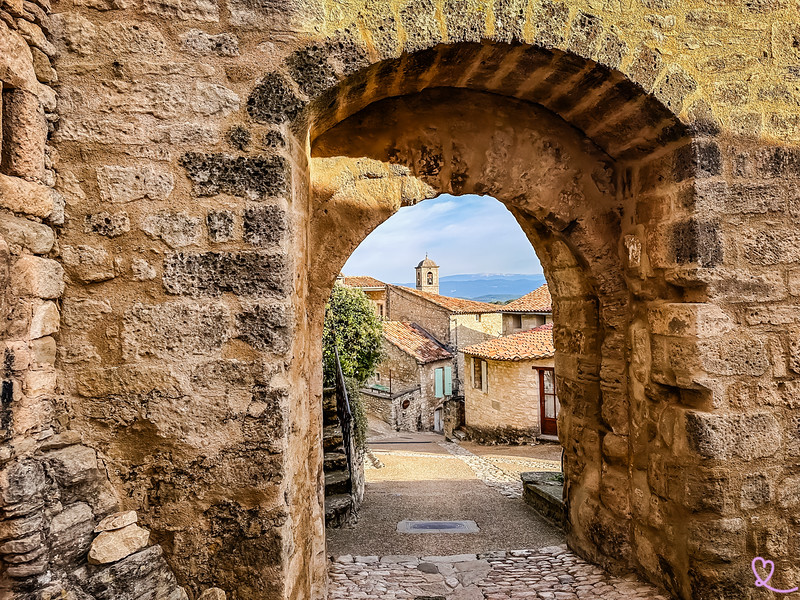
It’s one of the most beautiful villages in the Luberon!

And while it didn’t make our top 15 list of the most beautiful villages in Provence, it’s not far off!
If you don’t have a car, you can also explore Lacoste on a day-long electric bike tour through the Luberon, starting in Avignon, which includes a stop at the castle.
1. Lacoste Castle

Lacoste Castle overlooks the village from the top of the hill. It remained in the Simiane family until the 16th century, then passed to the de Sade family in 1716. The Marquis de Sade, an 18th-century writer, had it restored beginning in 1766. Fashion designer Pierre Cardin purchased it in 2001 and had it reinforced.
The castle was closed when we visited, so we weren’t able to go inside. We did, however, walk around it to admire its tall facade and its tower, which dates back to 1613. In the summer, you can tour the Marquis’s apartments, which are furnished with pieces from Pierre Cardin’s collection.

- Hours: From May through September, at least from 10 a.m. to 1 p.m. and from 2 p.m. to 6 p.m. On Sundays, only in the afternoon.
In March and September: Closed on Saturdays - Price: €5; free for children under 10 accompanied by an adult
- Tickets available at the castle entrance; no reservations required; payment by cash or credit card
- Tour of the castle (about 1 hour)
- Pierre Cardin Festival every summer in the castle’s quarries (July)
- Visit the official website for more info here.
A LITTLE MORE patience
All the photos, maps, information, good addresses to make your stay in Provence a success, will soon be gathered in a single ebook!
2. Medieval alleys in the village

The narrow streets of Lacoste wind their way up toward the castle within the 14th-century ramparts. Many are paved with “calade”: in Provence, “calade” refers to a type of paving made of stones laid on their edges, which stabilizes the ground on slopes. We loved getting lost in this network of narrow passageways, staircases, and vaulted arches.
Along the way, we also came across wayside crucifixes and old washhouses. The slope gets steeper and the ground becomes more uneven as you approach the castle. We therefore recommend that you wear sturdy shoes.

- Open Access
- Sloping alleys, varied terrain, steeper climb near the castle
- Not well suited for strollers and wheelchairs
3. Stone Houses in the Village

Lacoste owes part of its reputation to the light-colored, soft limestone quarried from its quarries. It makes up most of the village’s facades. We noticed several 16th-century homes still inspired by medieval architecture, as well as gardens laid out where houses once stood.
In the 19th century, stones from the demolished castle were actually used to build some of the houses here. Look up: you’ll see Romanesque semicircular arches marking the sites of former noble residences. We also learned that SCAD University has restored nearly 70 buildings here.

- Facades clearly visible throughout the village
- Private homes: Please respect the residents’ peace and quiet
OUR TPS FOR RENTING YOUR CAR IN Provence
- Compare prices on our preferred platform: DiscoverCars – one of the best rated sites.
- Choose a car that is powerful enough (the roads are steep) but compact (some passages are narrow).
- Remember to take outcomprehensive insurance (some roads are winding and narrow).
- There is a lot of demand, book it early.

4. Saint-Trophime Church

The Church of Saint-Trophime dates from the 12th and 13th centuries and stands outside the village walls. It houses the tombs of the lords of Simiane and is named after Saint Trophime, the first bishop of Arles. We identified its Romanesque sections at the apse and along the north wall, built of small rubble stones.

The current entrance, on the south side, has replaced the original gate since the 17th century. Inside, you can admire a restored Virgin and Child and a restored Saint Louis de Gonzague. We recommend starting your tour here, as suggested by the town.
WHERE TO STAY IN Lubéron
Our favorites:
In Gordes, a truly exceptional village:
Mas des Romarins Hotel – check photos and availability
Around Mane and Forcalquier:
Couvent des Minimes Hotel – check photos and availability
Around Menerbes, in the heart of the villages:
Bastine de Marie Hotel – check photos and availability

See our selection: Where to Stay in the Luberon
5. Garde Portal

The Garde Gate marks the entrance to the village when approaching from the church square. It dates from the 14th and 15th centuries and was likely rebuilt at the same time as the town walls, in the second half of the 16th century. It is flanked by a square tower and crowned by a decorative bretèche—a sort of small overhanging balcony.

We crossed it via the cobblestone street that climbs toward the castle. Just past that, we noticed facades that blend architectural styles from different eras. On your right, you’ll see a remodeled medieval gate.
6. The Belfry and Rue du Four

The Belfry dates from 1550 and marks the entrance to the former seigneurial estate surrounding the castle. It features a campanile—the structure housing the bell—which was added in recent times. To reach it, we walked past 16th-century facades and gardens created in place of houses that no longer exist. We then took the alley that passes under the bell tower. It leads you to the orientation map, and then to the castle. It’s also a good landmark to help you find your way around the village.

Rue du Four starts at the belfry and runs downhill toward Place de la Mairie. It owes its name to the village’s old bakery, whose building stands on the corner of the street. There, we observed several 16th-century houses that have partially retained their original interior layout.
We also took the time to look at the stone doors and window frames. At the corner of the old bakery, turn right: you’ll reach City Hall in a few minutes.
7. Panoramic views of the Luberon and Mont Ventoux

Lacoste offers beautiful panoramic views of the Luberon and Mont Ventoux, the highest peak in Provence. From the castle’s west facade, the view stretches all the way to the neighboring hilltop villages. Down in the valley, you’ll see Maison Basse, the castle’s former inn.

We also enjoyed looking at the village from the road below: its houses are terraced at the foot of the cliff. Finally, we recommend the view from Bonnieux, on the hill across the way, which offers a panoramic view of the entire silhouette of Lacoste. See the photo at the beginning of the article, taken from Bonnieux.
8. Protestant church

The Protestant church is a reminder of a unique chapter in Lacoste’s history. At the end of the 15th century, Waldensians from the high Alpine valleys repopulated the village. This Christian movement, which originated in the Middle Ages, joined the Protestant Reformation in 1532, leading to Lacoste being sacked in 1545.
The current temple dates from the 19th century and is now used as a community hall. We read with interest the sign on the facade that recounts its history. You’ll find the building 200 meters up the road.

9. The SCAD FASH Lacoste Museum (Fashion and Film)

SCAD FASH Lacoste is a museum dedicated to fashion and cinema. It is part of the Savannah College of Art and Design, an American art university that took over the school founded here by painter Bernard Pfriem in 2002. We explored its various spaces scattered throughout the village: museums, a sculpture promenade, a movie theater, and the studios on Rue des Artistes, where resident alumni welcome visitors. We were surprised by the size of this campus.

- Hours: June 15 through September 26, daily from 10 a.m. to 1 p.m. and from 2 p.m. to 6 p.m.; September 28 through October 31, Tuesday through Saturday from 10 a.m. to 1 p.m. and from 2 p.m. to 6 p.m.
- Prices: single admission ticket for €6 covering all paid areas, season pass for €10, reduced rate of €3, free for children under 12
- Free access to the Café des Artistes and the shopSCAD store
- Visit the official website for more information here.
10. The Goat Portal
The Goat Gate marks the upper entrance to the village and faces south. It dates from the 14th and 15th centuries and still retains some of its original features. In the 16th century, it was rebuilt, as evidenced by its round tower, which features embrasures (openings for firearms). We climbed up to it from the belfry, via the path that runs beneath the campanile. We found the climb quite steep, but the fortified gate makes the effort worthwhile. You can then retrace your steps to reach Rue du Four.
Sorry, it looks like we forgot to take a picture.
Other Attractions in Lacoste and the Surrounding Area
We’ve put together a few ideas to help you explore Lacoste and the surrounding area further:
The Village of Bonnieux

Perched on the hill opposite Lacoste, Bonnieux offers one of the most beautiful views of the village. It’s about a 10-minute drive [to be specified].
The Cedar Forest of the Petit Luberon
Perched on the heights of the Petit Luberon, this cedar forest is perfect for a stroll in the shade. The town of Lacoste recommends it as one of the must-see sites in the area.
How to get to Lacoste + parking
Where is Lacoste?
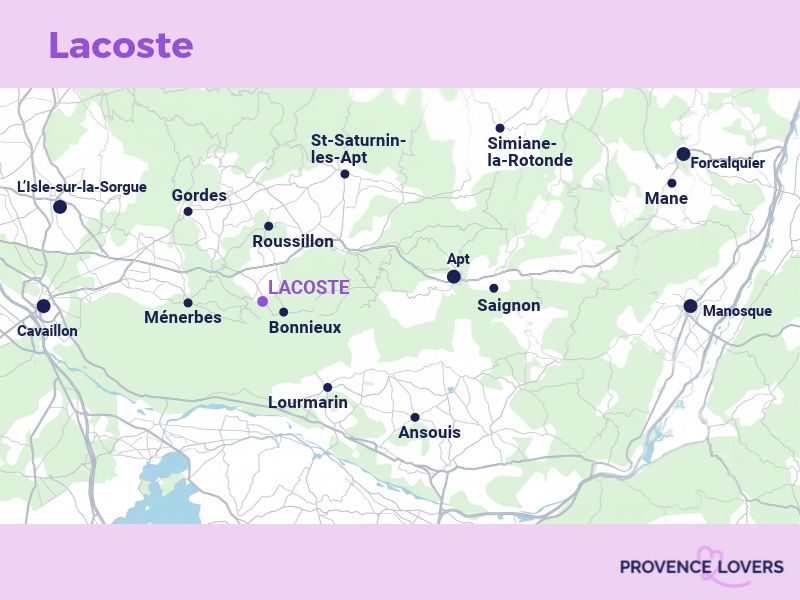
- In the Luberon, in Vaucluse (Provence), between Bonnieux and Ménerbes
- Bonnieux to Lacoste: 10-minute drive
- From Apt to Lacoste: 25-minute drive
- Avignon to Lacoste: 50-minute drive
- Aix-en-Provence to Lacoste: 1-hour drive
How to get there

In our opinion, driving is still the most convenient way to get to Lacoste and combine your visit with trips to other villages in the Luberon.
The village does not have a train station. Bus service is limited.
You can also join a guided tour. Here are our suggestions:
- Explore the Luberon by e-bike from Avignon, with a stop at Lacoste Castle
- Discover the markets and villages of the Luberon by minibus from Avignon, with a photo stop near the castle on Tuesdays
Parking in Lacoste

Parking is free in Lacoste. We found one parking lot at the bottom of the village and another at the top, near the castle. The town also lists two shaded parking lots: the landscaped parking lot, next to the cemetery, and the “restanques” parking lot, near the school. You can then explore the village on foot.

Helpful Tips for Visiting Lacoste
How long and when?
Allow 1 to 1.5 hours to walk through the village without going inside, and 2 to 2.5 hours if you visit the castle. The castle is open only in the summer, from mid-May to late August, while the SCAD spaces are open to the public from April to October. July is bustling with the Pierre Cardin Festival. We preferred early fall: the village is quieter, even though some sites have reduced their hours.

Tour directions, map and difficulty
We recommend following the route suggested by the town. Start at Saint-Trophime Church, walk up through the Portail de la Garde to the belfry, then head to the castle. Continue on to the Portail des Chèvres before heading back down via Rue du Four, the town hall, the temple, and Rue Basse. A map of the village can be downloaded from the town’s website here.
The village is quite hilly, and the terrain varies: cobblestones, flagstone paths, and rock. The climb becomes steeper as you approach the castle.

Visiting with Children
Lacoste is a great place to visit with the family—as long as you don’t mind the climbs. The fortified gates, towers, and castle will delight children, who get in free if they’re 10 or younger.
We recommend bringing a baby carrier instead of a stroller.
Restaurants
We haven’t tried the restaurants in Lacoste yet.
But on our list are: the Café des Artistes, which serves bistro-style cuisine on a veranda during the week, and the Café de France, a 19th-century establishment in the heart of the village.

Visiting Lacoste in Winter
In winter, the castle and the SCAD facilities are closed. The village remains open, and you can stroll freely through its narrow streets without the summer crowds. We think this is the perfect time to enjoy the views of the Luberon and Mont Ventoux in peace and quiet. Be sure to dress warmly: the village is sunny, but the days are cool.
EXPLORE the Luberon
- Top Attractions in the Luberon
- Best Villages
- Where to stay
- Gordes: Attractions – Hotels
- Roussillon
- Provençal Colorado



 nos vidéos sur Youtube
 nos photos sur Instagram
 nos actualités sur Linkedin
 formulaire de contact


