
Grimaud is a medieval village perched on the foothills of the Massif des Maures. We absolutely fell in love with this place—it’s one of our favorites on the French Riviera. A ruined castle, chapels, a windmill, and cobblestone streets make up a rich cultural heritage that’s best explored on foot.
Check out our ideas for things to do in Grimaud, illustrated with photos that will make you want to go there.
This guide is completely independent, based on our experiences. We visited the region anonymously, making our own choices and paying our bills in full.
Is the village of Grimaud worth a visit?
Yes, the village of Grimaud is worth a visit. We absolutely fell in love with its cobblestone streets, its shaded little squares, and its castle overlooking the Gulf of Saint-Tropez.
It is one of the most beautiful villages on the French Riviera and among the most beautiful in Provence.
1. Explore the charming alleyways around the historic center

Don’t just stick to the main streets and the walk up to the castle! We recommend that you take the time to wander through the narrow streets of this village—a real treat for lovers of historic architecture. The cobblestone streets, known as “rues en calade,” wind their way between old houses with colorful shutters and small squares shaded by bougainvillea.

We discovered charming little squares filled with plants, narrow streets with fascinating views, and details around every corner: doors, wooden ceilings, sundials…
- Allow about 1 hour and 30 minutes to walk through the entire village.
- We recommend starting at the Tourist Information Office, where a map of the village is available
- Wear comfortable shoes; the narrow streets are cobblestone and have slopes.
OUR TPS FOR RENTING YOUR CAR IN Provence
- Compare prices on our preferred platform: DiscoverCars – one of the best rated sites.
- Choose a car that is powerful enough (the roads are steep) but compact (some passages are narrow).
- Remember to take outcomprehensive insurance (some roads are winding and narrow).
- There is a lot of demand, book it early.

2. The Historic District

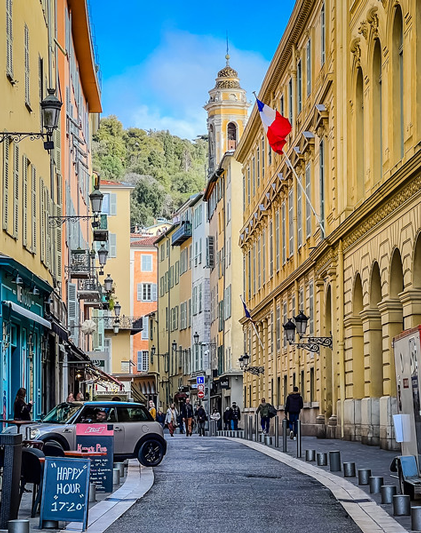
Rue des Templiers, one of the village’s earliest streets dating back to the 16th century, features a row of pointed-arch arcades that once housed merchants’ shops. We also noticed the mullioned windows on the upper floors—an architectural detail we recommend you take a moment to look up at.

In the heart of the village, the Hospice and the Water Pump offer a glimpse into daily life in days gone by. Known as “the hospital” in the 17th century, the hospice took in the poor and orphans before becoming home to the girls’ school. Right next to it, a brick hand pump covers one of the village’s two old wells, which have been known since the 11th century and were equipped in 1841 to make it easier to draw water.
3. The Castle

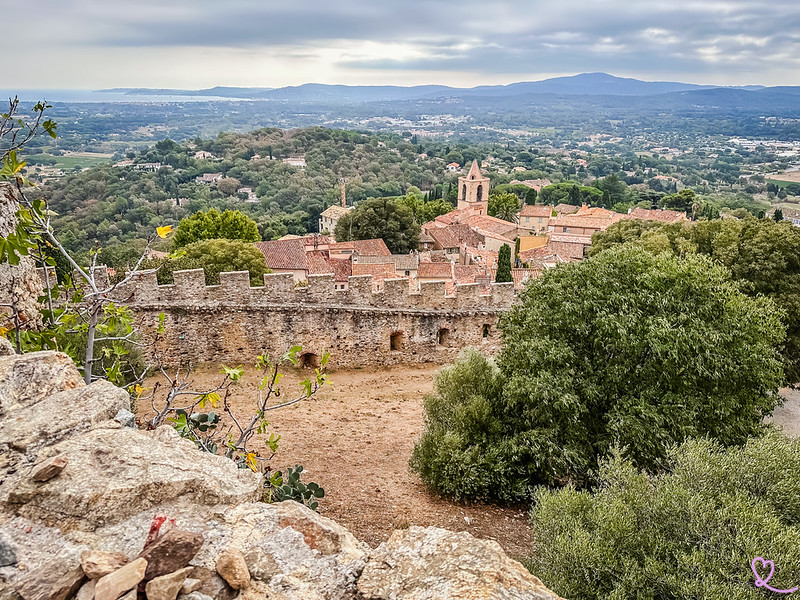
Grimaud Castle has overlooked the village since the 11th century. Rebuilt in the 15th century, it was later demolished on Richelieu’s orders during the Wars of Religion. We were able to see the preserved high walls, the arrowslits, and several original doors and windows. The site also features underground passages and cisterns, remnants of its defensive role.

From the castle’s heights, the view of the Gulf of Saint-Tropez is superb: you can take in the entire village and the plain at a glance. We recommend visiting early in the morning to enjoy the site in peace and quiet, before the tour groups arrive.
Be careful, though: the ruins are located on a hill above the castle, and part of the climb is in direct sunlight.
A LITTLE MORE patience
All the photos, maps, information, good addresses to make your stay in Provence a success, will soon be gathered in a single ebook!

4. Saint-Michel Church

Saint-Michel Church is a fine example of Provençal Romanesque architecture, built in the late 12th and early 13th centuries of granite and limestone. We appreciated the simplicity of its architecture: a single nave, rough-hewn stone walls, and a square bell tower added in the 16th century.

Inside, a fresco depicting Saint Michael, dated 1850, adorns the building. Since 2015, an organ has also been installed there and is played during the Grimaud Musical Evenings. The cemetery that once surrounded the church was moved to a location near the Saint-Roch Mill at the end of the 19th century due to a lack of space. You are welcome to visit this church, which is designated as a Historic Monument.
- Hours: Year-round, every day from 9 a.m. to 7 p.m.
- Free admission
- Visit the official website for more info here
5. The Heritage Museum

The Heritage Museum is housed in a complex of buildings that were not originally connected: a village house, a former blacksmith’s shop, and a 16th-century oil mill.
The collections trace the traditions and local history of Grimaud, encompassing rural life, crafts, and religious heritage. This way, you’ll discover many different aspects of the village in a single tour.

- Closed on Mondays and Sundays
April through October: Tuesday through Saturday from 9:00 a.m. to 12:30 p.m. and from 2:30 p.m. to 6:00 p.m.
Closed in January and on holidays.
February, March, November, December: Tuesday through Saturday from 9:00 a.m. to 12:30 p.m. and from 2:00 p.m. to 5:30 p.m. - Visit the official website for more info here
WHERE TO STAY IN Saint-Tropez
Our favorites: neighborhoods and hotels
Option 1: Downtown
Enjoy the charm and liveliness of the old town.
Hôtel Le Yaca – Check photos and availability
Hôtel Les Lauriers – Check photos and availability
Option 2: on the road to the beaches
Hotel Le Pre de la mer – Check photos and availability
Hotel Sezz – Check photos and availability

See our complete selection of the best hotels in Saint-Tropez
6. The Chapel of the Penitents

The Chapel of the Penitents, also known as Notre-Dame du Coulet, has marked one of the village’s entrances since the late 15th century. The year it was built, 1482, is engraved in Roman numerals on the door lintel. We enjoyed the tranquility of the Pénitents neighborhood, away from the hustle and bustle of downtown.

Inside, a 17th-century altarpiece and a Pietà painted in 1808 by Paul-Émile Barberi stand alongside the relics of Saint Theodore. The chapel served as the headquarters of the Congregation of the White Penitents, which was responsible for assisting the poor.
- Hours: Year-round, every day from 9 a.m. to 6 p.m.
- Free admission
- Visit the official website for more info here
- Today, you can attend classical music concerts there as part of the Soirées Musicales de Grimaud.
7. The Clock Tower

The Clock Tower is a more understated landmark, but one that is very popular with locals. Built in 1627 following a decision by the city’s consuls, it has been topped since 1648 by a wrought-iron bell tower housing a bell cast in 1476, one of the oldest in the Var.

We were surprised to learn that the current mechanism, which is still in working order today, is the work of clockmaker Paul Odobey, who also created the clock in the village of Gourdon in the Alpes-Maritimes. We recommend viewing it from Rue des Templiers, La Placette, or Rue du Baou, as these locations offer several different vantage points of this white bell tower with its ornate spire.
8. The Saint-Roch Mill

The Moulin Saint-Roch is the only windmill we were able to see in the village. We know that a mill has stood on this site since the 16th century; it was first called “Moulin de la Gardiole” before being renamed Saint-Roch in the 17th century, in reference to the nearby chapel.
We found her very charming.

Restored in the 1990s, its mechanism, wings, and roof have been restored to their original appearance, although damage sustained during a restart now prevents the mill from turning and producing flour.
From the mill’s forecourt, you can also see the castle ruins.
HAVE FUN WITH THESE activities
- Great kayak trips in:
Saint-Tropez to the Ramatuelle reserve
FromCassis to the Calanques - Helicopter flight from Cannes
- Shuttle service along the coast between Nice and Saint-Tropez
- Bike tours: eBike in Nice – Mountain biking in the Esterel massif

9. The Saint-Roch Chapel

The Saint-Roch Chapel, built in the 17th century, gave its name to the entire neighborhood, which was previously known as the Gardiole neighborhood. It is dedicated to Saint Roch, the patron saint invoked for protection against contagious diseases such as the plague.

Inside, murals depict the saint’s life: they were restored in 2021, and their artist, Andrée Gavens, was identified only thanks to an investigation conducted by a resident of La Rochelle. We recommend taking a peek through the small glass door—after turning on the outdoor light timer—to catch a glimpse of the mural covering the walls.
10. Sculptures in the City

Every year, the village of Grimaud hosts an exhibition of monumental sculptures, which can be seen from spring through fall in the narrow streets, in the small squares, and even in the exhibition hall at the Maison des Arcades. We loved the blend of contemporary art and the village’s medieval setting: the artworks are sometimes tucked away around a roundabout or in a quiet alleyway.
Visit the official website for more info here

It’s time to book!
Compare everything: companies, prices, schedules and availability.
Other Attractions in Grimaud and the Surrounding Area
We also invite you to explore the area around Grimaud, which features a lakeside town, beaches, and nature trails.
Port Grimaud
Port Grimaud, a lakeside town designed by architect François Spoerry, is nicknamed the “Little Venice of Provence.” Its canals and colorful houses have been designated as “Outstanding Contemporary Architecture.” The best way to explore it is still a boat ride along the canals.

The Beaches of Grimaud
Anse du Vieux Moulin, Cigales Beach, or Guerrevieille Beach: there are several beaches where you can swim or enjoy water sports such as tubing, flyboarding, jet skiing, or scuba diving.

The Fairy Bridge
You can reach this old aqueduct on foot from the village. The walk offers the chance to observe the flora and fauna of the Massif des Maures thanks to informational signs, with a view of the castle along the way.

How to Get to Grimaud + Parking
Where is Grimaud?
- In the Var department, at the far end of the Gulf of Saint-Tropez on the French Riviera
- From Saint-Tropez: about a 20-minute drive
- From Toulon: 1-hour drive
- From Saint-Raphaël: a 1-hour-20-minute drive
- From Nice: a 1-hour-40-minute drive
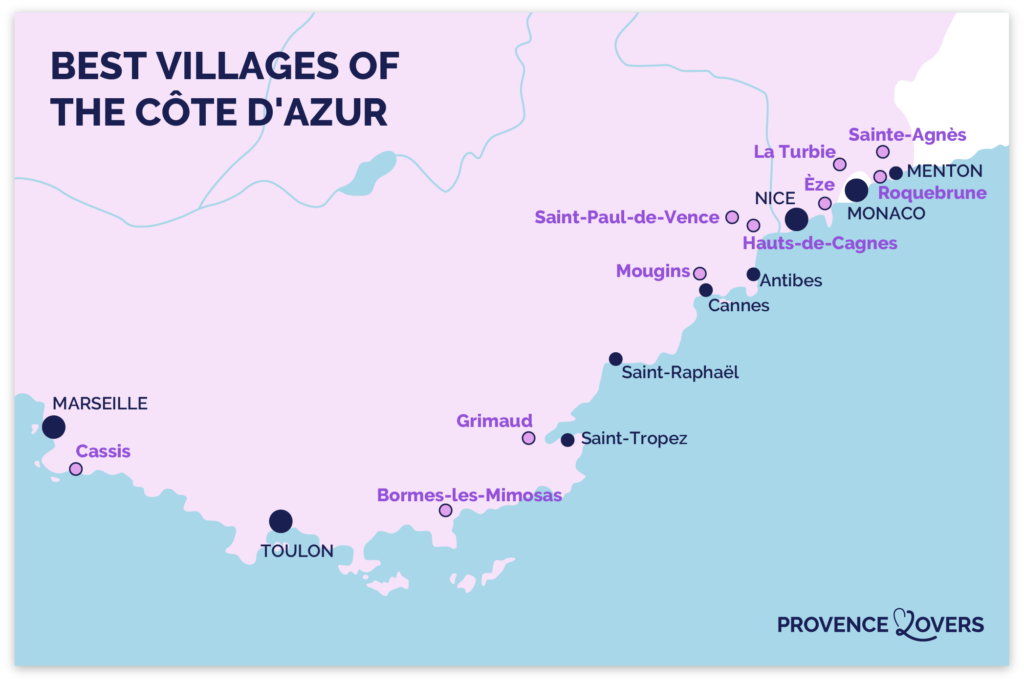
- Here is a map showing the most beautiful villages on the French Riviera, including Grimaus
How to get there
By car, Grimaud can be reached via the A8 highway (Le Muy or Sainte-Maxime exit) or via the D559 coming from the coast. For public transportation, the buses on the ZOU! network Nearby towns provide access to the village, though there is no direct connection from Toulon.
Parking in Grimaud
There are several parking lots available around the old town.
The parking lot at Les Terrasses is covered, but there are also parking spots available on the streets in the more modern part of town nearby.
Arrive early so you can park easily.

Helpful Tips for Visiting Grimaud
How long and when?
Allow about 1 hour and 30 minutes to explore the village and its landmarks, and 2 hours and 30 minutes to really see everything, including the museum.
You’ll find maps of the village and plenty of directional signs.

Tour directions, map and difficulty
There is no specific meaning.
Please note that the museum closes for lunch.
Head up toward the castle via one side of the village and come back down via another to explore as many narrow streets as possible.
The mill and the Saint-Roch Chapel are located on the outskirts; be sure to visit them before or after exploring the village.
If you’re worried about getting lost, you can also follow the historic tour route. Check with the tourist office.

Visiting with children
The village can be visited by the whole family. The Heritage Museum, exploring the monumental sculptures in the narrow streets, or the Thursday morning craft market are all sure to entertain the younger visitors. The Grimaldines Festival also features medieval activities in the summer that children enjoy.
Restaurants
We haven’t tried the restaurants in the village yet. But we found a few nice outdoor cafes on the squares in the historic district.
Visiting Grimaud in Winter
In winter, Grimaud reveals a more intimate side. The village’s narrow streets, quieter than during peak season, are perfect for a leisurely stroll among the stone houses. We especially enjoy this time of year for exploring the sights without the summer crowds.
PLAN YOUR TRIP TO THE Côte d’Azur
- Inspiration
The most beautiful landscapes in 30 photos
Best things to do on the Côte d’Azur
Most beautiful villages
Best beaches on the Côte d’Azur
Most beautiful gardens
Most beautiful islands
Secret places

- Practical advice
Successful travel on the Côte d’Azur (coming soon)
Rent a car in Provence – in Nice – in Cannes – in Marseille – in Aix-en-Provence.
Itineraries: 5 days – 1 week – 10 days
Weekend ideas: best-of – romantic – luxury – unusual

- Where to stay
Where to stay on the Côte d’Azur
Best luxury hotels on the Côte d’Azur
Hotels by the sea
Best boutique-hotels