
When you visit Antibes, you’ll undoubtedly want to take a stroll along its ramparts, on the shores of the Mediterranean. Walk along the Promenade de l’Amiral de Grasse, linking Old Antibes to Plage du Ponteil, and you’ll come across the Bastion Saint-André. Built by Vauban at the end of the 17th century, it houses the Musée d’Archéologie d’Antibes. We were delighted to visit it, learning more about the city’s origins through some remarkable objects.
Here are our practical tips for planning your visit to the Musée d’Archéologie in Antibes.
This guide is completely independent, based on our experiences. We visited the region anonymously, making our own choices and paying our bills in full.
Is a visit to the Museum of Archaeology worthwhile?
Absolutely! This museum presents objects from underwater and land excavations, which we found fascinating! The tour is chronological, and begins with an introduction to the origins of Antibes, through relics (ceramics, bowls, etc.) attesting to the presence of the Etruscans and Greeks in the area. Next, we’re transported back to Roman times.
The rest of the tour is more thematic, looking at beliefs in ancient times and the differences between rural and urban life. Having enjoyed our visit, we have listed this museum in our article on the best museums in Antibes.

WHERE TO STAY IN Antibes
Option 1: near the ramparts
Near the city walls, where you can enjoy the charm of the old town and all the restaurants.
Hotel la Villa Port – prices, pictures and availability
Near the beaches (Ponteil and Salis), with views of the ramparts and the mountains.
Hotel La Jabotte – prices, pictures and availability
In Juan-les-Pins, in the heart of the peninsula.
Hotel La Villa Cap d’Antibes – prices, pictures and availability

What you can see
The Antibes “galet”

The tour begins with an overview of the origins of the city of Antibes, focusing in particular on pottery that attests to the presence of the Etruscans and, later, the Greeks in the area. However, it was a pebble—probably made of serpentine—that caught our attention the most.
Dating from the 5th century B.C., it features the oldest inscription in Antibes and is one of the few Greek inscriptions predating the Hellenistic period to have been discovered in the colonies of Marseille!
Roman coins

We then discovered Antibes in Roman times, thanks in particular to these coins dating from 44 B.C. In bronze, they depict the head of Apollo adorned with laurels, and on the reverse, Victory crowning a trophy, through the figure of Artemis, Apollo’s twin sister. This shows that the city, recently Romanized, was still under Hellenistic influence.
Ceramics

The next section of the tour focuses on the city of Antibes during the time it was a colony of Marseille. The Mediterranean world is explored as a whole through some sixty vases and ceramic objects produced by the civilizations of the Italian Peninsula (indigenous peoples, Greeks, Etruscans, and Romans).
Our favorite piece is this impressive Attic vase—that is, one made in the Athens region in the 7th century B.C. Can you make out its designs, created using the “red-figure” technique?
Objects from underwater excavations

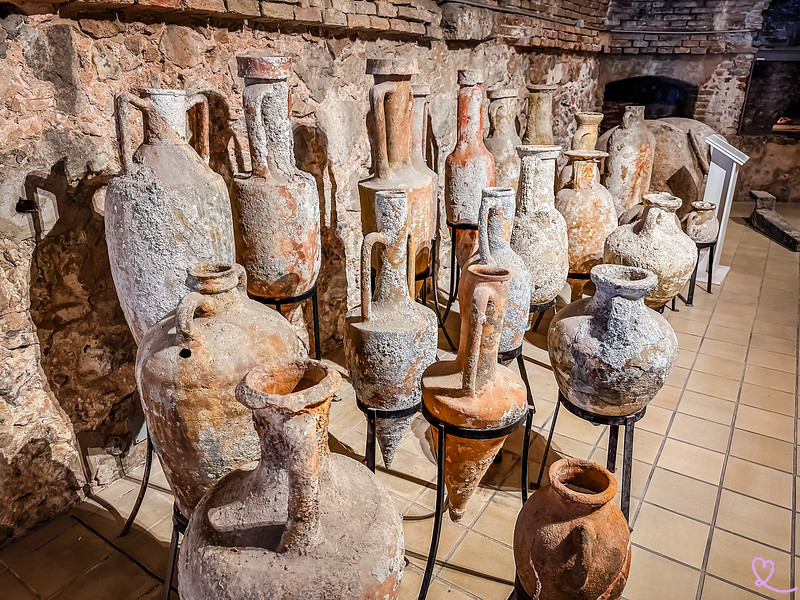
We then discovered objects from underwater excavations (amphorae…) carried out in Anse Saint-Roch and numerous shipwrecks. They attest to Antibes’ role in the development of trade ties as early as the 6th century BCE.
It’s these wooden anchors with lead jaws that have impressed us the most. We’d never seen one before, but these massive anchors (4th-5th centuries), which succeeded stone ones and preceded iron ones, were impressive!
Objects linked to ancient beliefs

Visitors are then introduced to funeral beliefs and practices in Antiquity. A number of funerary blocks are on display. We were particularly interested in this terracotta statuette from Roman times. It depicts the god who was most revered at the time: Mercury.
Can you catch a glimpse of its attributes? In his left hand, he holds a wand surrounded by intertwined snakes surmounted by 2 small wings, and a purse in his right, reminding us that he is the god of crafts and commerce.
A beautiful mosaic (late 2nd century AD)

The visit then plunges us into the rural world, with weaving machine tools and this beautiful mosaic from the late 2nd century A.D. This black and white geometric limestone pavement adorned a gallery bordering the courtyard of a presbytery, and was embellished with a fountain.
Oil lamps

Our tour ended with a section devoted to everyday objects from city life in Antiquity. In addition to the lead pipes, we were able to observe these very well-preserved oil lamps. Various types were on display. We were able to discover oil lamps with rounded spouts, but also with open channels and convex medallions.
A LITTLE MORE patience
All the photos, maps, information, good addresses to make your stay in Provence a success, will soon be gathered in a single ebook!
Access to the Musée d’Archéologie in Antibes
Where is the museum?
- City of Antibes
- The museum is located in the Vieil Antibes district, along the Promenade de l’Amiral de Grasse.
- It’s a 5-minute walk from the city center and a 10-minute walk from Plage du Ponteil.
Access by car and parking
Parking is difficult in the vicinity of the museum. We recommend parking in a pay parking lot. The Ponteil parking lot and Q-Park La Poste are a 10-minute walk away.

OUR TPS FOR RENTING YOUR CAR IN Provence
- Compare prices on our preferred platform: DiscoverCars – one of the best rated sites.
- Choose a car that is powerful enough (the roads are steep) but compact (some passages are narrow).
- Remember to take outcomprehensive insurance (some roads are winding and narrow).
- There is a lot of demand, book it early.

Public transport access
The Musée d’Archéologie is close to numerous bus routes. A 5-minute walk away, you’ll find the “Avenue Braquier” stop served by line 14, as well as the “Maizière” stop served by lines 2, 14, 30 and 31. We recommend that you consult the transport network map on the official website here.
Visiting difficulties
The tour is not particularly difficult. It is accessible to people with reduced mobility and the visually impaired thanks to adaptation tools. Only the courtyard floor in front of the entrance is slightly bumpy.
PLAN YOUR STAY IN Antibes

Practical tips for visiting the Archaeology Museum
Schedules and prices
Here are the museum opening times:
- March to October, Tuesday to Sunday: 10am – 1pm / 2pm – 5:30pm.
- November to February, Tuesday to Saturday: 10am – 1pm / 2pm – 5:30pm.
- Closed January 1, May 1, November 1, December 25.
Museum rates are as follows:
- Full price: €5
- Reduced admission: €3 (students, large families…)
- Free admission for under-18s, jobseekers…
For the full list of free and reduced-rate beneficiaries, visit the official website here.
Please note that this visit is included in the Pass’Musées d’Antibes Juan-les-Pins. For €15, it gives you free access to the Musée Picasso, the Fort Carré, the Musée Peynet et du Dessin Humoristique and the Musée d’Archéologie for 7 days. To find out more, click here.
How long
Allow 1 to 2 hours for your visit, depending on your interest in archaeology.
Best moment
We advise you to visit in the morning to minimize the number of visitors, especially during the summer months. Then why not take advantage of the Plage du Ponteil? For more ideas, read our article on what to do in Antibes.

Direction of visit
There is only one way to visit. We recommend you follow it, as it’s a chronological route.
Eating out
Numerous restaurants are located close to the museum. To find out which one to choose, read our article on the best restaurants to eat in Antibes!
PLAN YOUR TRIP TO THE Côte d’Azur
- Inspiration
The most beautiful landscapes in 30 photos
Best things to do on the Côte d’Azur
Most beautiful villages
Best beaches on the Côte d’Azur
Most beautiful gardens
Most beautiful islands
Secret places
- Practical advice
How to Make the Most of Your Trip to the French Riviera
Rent a car in Provence – in Nice – in Cannes – in Marseille – in Aix-en-Provence.
Itineraries: 5 days – 1 week – 10 days
Weekend ideas: best-of – romantic – luxury – unusual

- Where to stay
Where to stay on the Côte d’Azur
Best luxury hotels on the Côte d’Azur
Hotels by the sea
Best boutique-hotels



 nos vidéos sur Youtube
 nos photos sur Instagram
 nos actualités sur Linkedin
 formulaire de contact


