
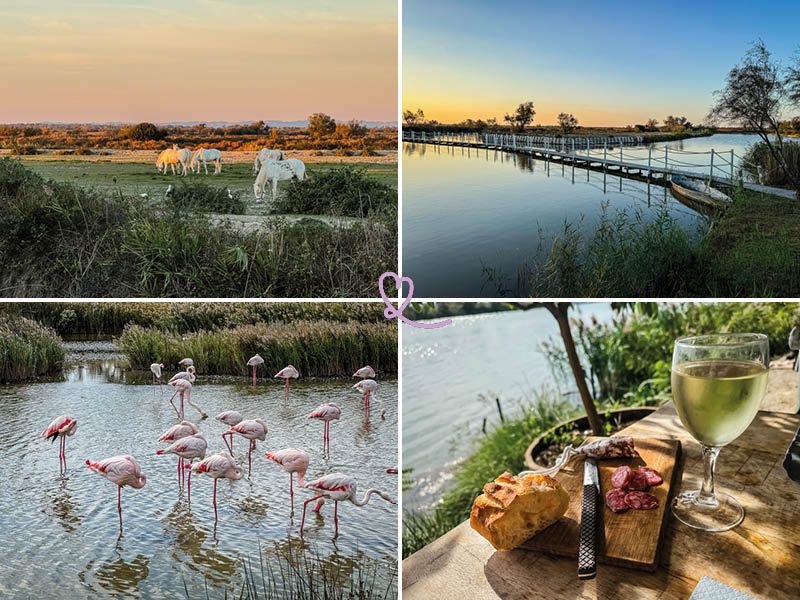
The Camargue is a region apart. Between sea, marsh and farmland, this Rhone delta creates a landscape found nowhere else in France. Pink flamingos, white horses, black bulls, rice paddies as far as the eye can see: nature dictates the pace here, and the traveler does well to adapt.
We travelled through the region, taking time to stop off at both the major tourist stops and the lesser-known corners. Here’s our selection of 13 must-see places and activities in the Camargue, to help you build a holiday to match this extraordinary territory.
This guide is completely independent, based on our experiences. We visited the region anonymously, making our own choices and paying our bills in full.
1. Explore Arles, the Camargue’s must-see Roman town

Why visit?
Arles is often referred to as the gateway to the Camargue, but the town is well worth a visit in its own right. A UNESCO World Heritage site, it is home to remarkably well-preserved Roman remains: a 1st-century amphitheater still used for bullfights and shows, an ancient theater, thermal baths and necropolises. We were struck by the density of this heritage in a town on a human scale.
Arles is also inseparable from the history of Van Gogh, who lived there in 1888-1889 and produced over 300 works. The LUMA Foundation, designed by Frank Gehry and inaugurated in 2021, adds a strong contemporary dimension to the city. We stayed there for a few days. Not to mention the Rencontres Photographiques, which liven up the town in summer and attract many visitors.

Practical advice
- Arles is best visited on foot in its historic center. Allow at least half a day, or a full day if you wish to visit several monuments and the LUMA Foundation.
- The Arles Monuments Pass gives reduced-rate access to the main ancient sites.
- If you’d like a local perspective on the city, a private guided tour is available. See prices, photos and availability.
- More information on the tourist office website here.
2. Flamingo watching at the Pont de Gau ornithological park

Why visit?
The Parc ornithologique du Pont de Gau is one of the best places in Europe to observe pink flamingos in their natural habitat. Located on the outskirts of Saintes-Maries-de-la-Mer, it extends over several dozen hectares of marshes and lagoons. We observed hundreds of flamingos just a few meters away, without any disturbance. The proximity is striking.
As well as flamingos, the park is home to over 400 species of birds, including herons, egrets, ducks, avocets and the rare kestrel. The marked trails allow you to wander around independently, at your own pace. We recommend arriving early in the morning or late in the afternoon, when the light is softer and the crowds fewer.

Practical advice
- The park is open all year round.
- Flamingos are present in all seasons, but their numbers are greatest in spring and autumn when they migrate.
- Allow between 1h30 and 3h depending on your pace.
- Binoculars are strongly recommended.
- Admission charge: €8.50
- More information on the park’s website here.
3. Stay in a traditional Camargue farmhouse

Why visit?
Sleeping in a Camargue farmhouse is a way of really getting to know the area, far beyond a simple tourist visit. These traditional farms, often surrounded by manades (horse and bull farms), offer an immersion into the daily life of the Camargue. Two addresses stand out for their authenticity and exceptional setting:
- Hôtel Mas de la Fouque: a charming hotel set in a farmhouse in the heart of nature, on the edge of a pond. The setting is remarkably tranquil, ideal for watching flamingos from the terrace. See prices, photos and availability.
- Hôtel Le Mas de Peint: an authentic farming estate, both manade and luxury hotel. The rooms are tastefully decorated, and the food is just as good as the surroundings. See prices, photos and availability.

Practical advice
- These two establishments are often fully booked in high season (April to September). Reserve well in advance.
- A car is essential to reach these remote addresses.
- Some farmhouses offer horse-riding or boat trips on the ponds: ask directly at the establishment.
OUR TPS FOR RENTING YOUR CAR IN Provence
- Compare prices on our preferred platform: DiscoverCars – one of the best rated sites.
- Choose a car that is powerful enough (the roads are steep) but compact (some passages are narrow).
- Think of thecomplete insurance (some roads are tortuous and narrow).
- There is a lot of demand, book it early.

4. Venerating the Black Madonna at Saintes-Maries-de-la-Mer

Why visit?
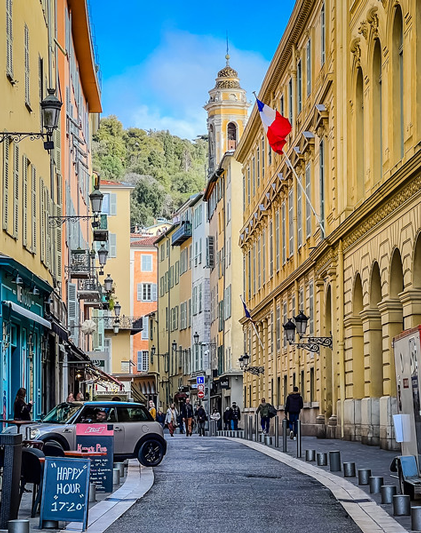
Les Saintes-Maries-de-la-Mer is the most famous village in the Camargue, and its fortified church is its spiritual heart. According to local Christian tradition, Mary Jacob and Mary Salome, Jesus’ close friends according to the Gospels, landed here after fleeing Palestine.
The church crypt houses the statue of Sara la Noire, patron saint of the Travellers, the object of a popular annual pilgrimage in May and October. We found this place particularly full of history and emotion. The climb to the roof of the church offers a 360° panoramic view of the ponds, beaches and rooftops of the village. Not to be missed.

Practical advice
- The church is open daily, and access to the crypt is free.
- Access to the roof is subject to a charge.
- Outside pilgrimage periods (May 24-25 and October weekends), the town is quieter and more pleasant to visit.
- The village is well worth a stroll, with its narrow streets, santon stores and restaurants serving Camargue specialties.
- More information on the official website here.
5. Photograph the spectacular landscapes of the Salin de Giraud

Why visit?
The Salin de Giraud is one of the most visually striking sites in the Camargue. This major salt production site boasts fascinatingly bizarre landscapes: basins of colors ranging from white to intense pink, reflections that change with the light, salt dunes that rise like small mineral hills.
Rarely have we seen such vivid colors in a natural landscape. The massive presence of pinkish micro-algae (Dunaliella salina) gives the ponds their characteristic hue, also attracting flamingos whose diet depends on them. The site is particularly photogenic at the end of the day, when the low-angled light enhances the contrasts.

Practical advice
- Access to the pool area is subject to a fee: 12€ on foot, 15€ by bike, day pass for one car 40€.
- Viewpoints have been set up to observe the basins without disturbing the industrial site.
- Provide solar protection: the site is very exposed.
- More information on the official saltworks website here.
Subscribe to our Newsletter
- Get away from it all with Region Lovers’ beautiful destinations!
- Once a month
- Advertising-free
6. Enjoy the wild beach of Piémanson

Why visit?
Piémanson beach is one of France’s last great unspoilt beaches. Several kilometers long, it stretches south of Salin-de-Giraud, at the mouth of the Grand Rhône. No parasols to rent, no restaurants, no amenities: just sand, sea and sky. We enjoyed this rare space, far from the hustle and bustle of the seaside resort.
Piémanson is also known for its free campers, who sometimes set up camp for several weeks during the summer. This type of occupation, which has been tolerated for decades, gives the site a special atmosphere. The beach is partly naturist, and is very popular in July and August.

Practical advice
- The beach is accessible by car via a track from Salin-de-Giraud.
- Access may be difficult in wet weather.
- No on-site services: bring your own water, food and sun protection.
- Parking is free but supervised in season.
- Avoid central hours in summer: heat and reverberation can be intense.
- More information on the Arles tourist office website here.
7. Beauduc expeditions

Why visit?
Beauduc is the wild end of the Camargue. This spit of land wedged between ponds and sea is accessible only by an unpaved sandy track, making it a destination for adventurers, or at least for those willing to accept a little sporting access. Here we found a solitude and raw beauty that few French coastal sites still offer.
The totally undeveloped Beauduc beach is surrounded by ponds frequented by flamingos and waders. The area is particularly popular with kitesurfers and fishing enthusiasts. Outside the high season, you can find yourself almost alone facing the sea.

Practical advice
- Access to Beauduc is via a sandy track from Salin-de-Giraud, and takes a good hour.
- An all-wheel-drive vehicle or SUV is highly recommended, especially after rain.
- The runway may be closed during nesting periods or weather events.
- No on-site service: bring everything you need.
- More information on the Arles tourist office website here.
8. Explore the Domaine de Méjanes in the heart of the Camargue

Why visit?
Domaine de Méjanes is one of the Camargue’s major agricultural estates, located on the banks of the Vaccarès, the region’s largest pond. Owned by Paul Ricard, it offers a combination of activities that allow visitors to approach the Camargue from several angles: horseback riding, mini-train rides, discovery of the manades and traditional livestock farming.
We particularly appreciated the authentic yet accessible atmosphere of this estate. The natural setting, with its ponds and reed beds, is remarkable. We also enjoyed a visit to the Paul Ricard Museum on the estate, which gave us an insight into the career of this great Camargue figure.

Practical advice
- The estate is mainly open in spring and summer.
- Horse-riding activities and the little train are subject to prior booking.
- Bring comfortable clothes and closed shoes for horseback riding.
- More information on the official website here.
9. Learn history at the Musée de la Camargue

Why visit?
To understand the Camargue beyond its landscapes, the Musée de la Camargue is an invaluable stop-off point. Housed in a former sheepfold at Mas du Pont de Rousty, it traces thenatural and human history of this area: the formation of the delta, landscape evolution, cattle and horse breeding, the life of the gardians and traditional farming practices.
We found the scenography clear and well-documented. The museum provides the keys to a more informed understanding of the region. A 3.5km discovery trail starts from the museum and extends the visit into the surrounding marshes.

Practical advice
- The museum is open all year round, with reduced opening hours in low season.
- Admission charge: €7.50
- Allow 1h30 to 2h for the visit and the outdoor trail.
- Appropriate footwear is recommended for the trail, which can be muddy after rain.
- More information on the museum’s official website here.
10. Understanding local culture at the Maison du Riz

Why visit?
Rice-growing is one of the Camargue’s emblematic agricultural activities, introduced on a massive scale after the Second World War to desalinate the land. The Maison du Riz offers an immersion into this often little-known industry: the history of rice growing in the Camargue, irrigation techniques, varieties grown, environmental issues.
This is an original approach to understanding the links between agriculture and the management of natural environments in this delta. We weren’t able to visit the museum, but we did enjoy walking through the rice fields. The store offers various varieties of Camargue rice, including the famous red and brown rices.

Practical advice
- Visits to the rice fields are organized in season, particularly during the transplanting (May-June) and harvesting (September-October) periods, which are particularly interesting for observing the changing landscape.
- Find out about availability directly from La Maison du Riz here.
11. Discover biodiversity at La Capelière Regional Nature Park

Why visit?
La Capelière is the home of the Réserve Nationale de Camargue, located on the banks of the Vaccarès. This interpretation center dedicated to the Camargue’s biodiversity is the ideal starting point for exploring the delta’s protected natural environments. Signposted paths follow the reedbeds and ponds, allowing you to observe birds, reptiles and characteristic vegetation from discreet observatories.
We saw a wide variety of birds in a very short space of time. The center’spermanent exhibition provides a clear scientific framework for the ecological challenges facing the Camargue: delta erosion, rising water levels, agricultural pressure. A place to think about as much as to observe.

Practical advice
- The center is open all year round, but with limited opening hours in low season.
- Admission charge: €7
- Outdoor trails are accessible free of charge. Binoculars recommended and on loan.
- The site is easily accessible by car from Arles (about 25 minutes).
- More information on the official website here.
A LITTLE MORE patience
All the photos, maps, information, good addresses to make your stay in Provence a success, will soon be gathered in a single ebook!
If you wish to be informed of the publication of our guide on Provence, subscribe:
12. Taste Camargue gastronomy in a traditional restaurant

Why visit?
Camargue cuisine is directly linked to the region: Camargue bull (PDO), local red rice, tellines (small shellfish collected on the beaches), gardiane (stewed bull), pond fish. We found this cuisine to be straightforward and generous, rooted in produce that can be seen in the fields and ponds a few kilometers away. Two addresses stand out for an authentic experience:
- Restaurant Le Mazet de Vaccarès: set on the edge of a pond, this restaurant offers local cuisine in an exceptional natural setting. The terrace overlooking the Vaccarès is worth the detour alone. More info here
- Restaurant La Cabane du Pêcheur Fou Chez Za: a more informal address, in the spirit of a Camargue hut, with local fish products and a friendly atmosphere. More info here

Practical advice
- Both restaurants are very popular in high season (June to September).
- Booking in advance is highly recommended, especially for Le Mazet de Vaccarès.
- Some Camargue restaurants only open in season, or only at lunchtime on weekdays: check the opening times before you go.
13. Drive to Nîmes and its emblematic ancient monuments

Why visit?
Around 30km northwest of Arles, Nîmes is a Roman city whose ancient heritage is among the best preserved in the world. The Nîmes Arena, built in the late 1st century, is still used today for shows and bullfights. The Maison Carrée, a Roman temple dating from the 1st century BC, is now home to an immersive film on the history of the city. The Tour Magne, overlooking the Jardin de la Fontaine, offers a panoramic view of the town and surrounding garrigues.
We enjoyed the contrast between the omnipresent Roman heritage and the lively contemporary life of this university town in the Gard region. Nîmes is a natural excursion from the Camargue, with an easy return by road or rail.

Practical advice
- A monument pass gives reduced-rate access to the Arena, Maison Carrée and Tour Magne.
- Allow at least half a day, or a full day to explore the gardens of the Fountain and the archaeological museum.
- The town is easily accessible from Arles by car (30min) or train.
- More information on the town’s tourist office website here.
Things to do in Camargue: other ideas
A safari from Arles
To explore the Camargue without having to drive yourself on the tracks, a guided 4WD safari from Arles is a very complete option. These private excursions allow you to venture into less accessible areas, with a guide who knows the best spots for wildlife observation. We recommend this option for visitors who have only one day and want to see as much as possible. Check prices, photos and availability and make a reservation.

A gastronomic getaway
The Camargue and its immediate surroundings boast two very fine restaurants, for those who wish to combine discovery of the region with exceptional gastronomy:
- Restaurant L’Oustau de Baumanière: in Les Baux-de-Provence, some forty kilometers from Arles, this multi-starred restaurant is one of the great references of Provencal gastronomy. The setting, in the Alpilles, is breathtakingly beautiful. More info here
- Restaurant La Chassagnette: a Michelin-starred restaurant in the heart of the Camargue, just outside Arles, whose cuisine is built around the estate’s organic vegetable garden. A committed address in a remarkable natural setting. More info here

Things to do with children
- The Camargue is a family destination, provided you choose your activities carefully.
- The Pont de Gau ornithological park, with its flamingos visible at close quarters, easily captures the attention of younger visitors.
- The Arènes d’Arles, with its seasonal entertainment program, is also of interest to children with an interest in history.
- The Fondation Luma in Arles is another option to consider, as contemporary art is full of surprises likely to stimulate creativity at any age.

Things to do when it rains
- Rain is rare in the Camargue, especially in summer, but can occur in spring and autumn.
- In this case, the Musée de la Camargue and the Maison du Riz are good options.
- The LUMA Foundation and the museums of Arles (Musée de l’Arles Antique, in particular) offer several hours of visits.
- Bad weather days are also a good time to linger in a traditional restaurant and try the gardiane de taureau or tellines.

Excursions around the Camargue
The Alpilles and the village of Les Baux-de-Provence
Some thirty kilometers northeast of Arles, the Alpilles form a limestone massif of characteristic whiteness, riddled with olive groves and garrigues. The village of Les Baux-de-Provence clings spectacularly to it: its medieval ruins dominate the plain from a vertiginous ridge. We found the contrast between this mineral landscape and the Camargue marshes striking – the two destinations naturally complement each other in the same holiday.

Montmajour Abbey
Just 5km from Arles, Montmajour Abbey is a stopover often overlooked by visitors in a hurry. Yet this monastic complex, built between the 10th and 18th centuries on a rock that once dominated the marshes, is well worth a visit. The Romanesque church, cloister and keep tower form a coherent architectural whole. Van Gogh made several representations, adding an extra dimension to the visit for fans of the painter. Find out more here.

Martigues
Nicknamed the “Venice of Provence”, Martigues is a town on the banks of a lake, whose “quartier de l’île”, with its canals and colorful boats, has attracted painters since the 19th century. This is a pleasant excursion from the Camargue, about 45min drive southeast of Arles, to the Bouches-du-Rhône. The stroll along the canals of the Ferrières district, with its colorful facades and fishing boats, is the main attraction.

Is the Camargue worth a visit?
Yes, without reservation, but only if you approach the region with the right expectations. The Camargue is not a destination for groomed beaches, nor is it a natural theme park. It’s a lively, sometimes rugged territory, where the light changes by the hour and the wildlife is patiently observed.

We were lucky enough to be able to explore enside the peak tourist season (July-August), we were able to enjoy a calmer atmosphere and sometimes more intense landscapes. In our opinion, spring, with its nesting and flowering season, and autumn, with its migrations, are the two best times to discover the delta.
Useful tips for visiting the Camargue
Where is the Camargue?
- The Camargue is a delta formed by the two arms of the Rhône, located in the south of France between the departments of Bouches-du-Rhône and Gard.
- It is bounded to the north by Arles, to the west by the Petit Rhône, to the east by the Grand Rhône, and to the south by the Mediterranean.
- The main access town is Arles, around 35km from Nîmes, 90km from Marseille and 120km from Montpellier.

How to get there?
- By train, Arles station can be reached from Marseille (about 50min), Avignon (20min) and Nîmes (30min).
- By car, the A7 (Autoroute du Soleil) takes you to Arles from Lyon (3h) or Marseille (1h).
- By plane, the nearest airports are Marseille-Provence (1h drive) and Nîmes-Alès (40min).
- From Arles, there is no regular public transport to the deep Camargue: a car is essential for exploring the delta.

Parking
- In Arles, several pay parking lots are available in the city center, including Place Lamartine and Boulevard des Lices. In high season, we recommend parking on the outskirts of the town and walking to the center (10 to 15 minutes).
- In the rest of the Camargue, parking is generally free and unrestricted.
- At Les Saintes-Maries-de-la-Mer, paid parking is available at the entrance to the village in summer.

Getting around
- The car is the essential means of transport for exploring the Camargue beyond Arles and Saintes-Maries-de-la-Mer. The delta’s roads are often narrow and without dense tourist signage: bring a GPS and download maps offline.
- Cycling is also an option for the areas closest to the villages, but distances between sites are considerable (30 to 50km between Arles and the southern beaches). Bicycle rental companies are available in Arles and Les Saintes-Maries-de-la-Mer.

Where to eat
- Arles is home to the majority of restaurants, ranging from city-center brasseries to gourmet eateries.
- At Les Saintes-Maries-de-la-Mer, the restaurant scene focuses on seafood and Camargue cuisine.
- In the delta, restaurants are rare and often only open in season: avoid relying on a passing restaurant for lunch, especially outside the summer months.
- Take along some provisions if you’re planning a day of exploration in remote areas.

Visiting in winter
- The Camargue in winter is a radically different territory: fewer tourists, softer light, and wildlife that is often more visible. Flamingos are present all year round (the Camargue is one of the few nesting areas in Europe). Many ducks and migratory birds winter in the ponds.
- On the other hand, many restaurants, accommodations and tourist sites close between November and March. It’s a good idea to check the openings before planning your stay.
- The mistral, a cold, powerful wind, can blow hard in winter: bring warm clothing and windbreakers.

PLAN YOUR TRIP TO Provence
- Inspiration
The most beautiful landscapes in 30 photos (coming soon)
What to do in Provence
Most beautiful cities in Provence (coming soon)
Most beautiful villages
Most beautiful castles (coming soon)
Most beautiful gardens (coming soon)
Best boat tours (coming soon)
Secret places (coming soon)

- Practical advice
A successful trip to Provence (coming soon)
Rent a car in Provence – in Nice – in Cannes – in Marseille – in Aix-en-Provence.
Itineraries: 5 days – 1 week – 10 days (coming soon)
Weekend ideas: best-of – romantic – luxury – unusual (coming soon)

- Where to stay
Where to stay in Provence (coming soon)
Best luxury hotels in Provence (coming soon)

- The must-dos
What to do in Marseille
What to do in Aix-en-Provence
What to do in Avignon (coming soon)
What to do in Arles (coming soon)
Best things to do in Nice
Best things to do in Cannes
Best things to do in Antibes
Best things to do in Monaco
Best things to do in Saint-Tropez
Best things to do in Cassis