
Perched on its rocky spur in the heart of the Alpilles mountains, the Château des Baux-de-Provence is much more than just a ruin: it’s a stone giant that defies time and the mistral wind. We surveyed this immense site, where medieval history blends with breathtaking panoramas. Get ready for total immersion in the life of the lords of Provence, between watchtowers and troglodytic houses.
Follow the guide, we’ll take you up there! This article contains tips and photos to help you prepare for your visit to the Château des Baux-de-Provence.

This guide is completely independent, based on our experiences. We visited the region anonymously, making our own choices and paying our bills in full.
Why visit Château des Baux-de-Provence
Is the castle worth it? Our opinion:
Absolutely! It’s not every day you get to walk in the footsteps of such a vast semi-troglodytic fortress. Beyond the stones, it’s the atmosphere that captured us: the wind blowing through the ruins, the breathtaking view of the Val d’Enfer and the olive groves, and that feeling of raw power that emanates from the keep. It’s a visit that leaves a lasting impression, as much for the rugged beauty of the landscape as for the ingenuity of the builders of yesteryear.
It’s one of the must-sees in Les Baux de Provence and one of the best châteaux in Provence (our selection to come).

Why is Château des Baux-de-Provence famous?
The castle is legendary for many reasons. Its semi-troglodytic architecture is impressive: many of the buildings are dug directly into the rock. It was once the stronghold of the Seigneurs des Baux, rebellious warriors who defied the Kings of France. The site is also known for its life-size replicas of siege machines such as trebuchets and bricoles. Finally, it was here that bauxite was discovered, the mineral that gave the village its name.

Our favorite moment
You’ll find the details of our visit later, but for us, the best part of this tour are the 360° panoramas! Once you’ve reached the top of the plateau, you can see the whole of Provence. You’ll discover the Val d’Enfer, vineyards, olive groves and, on a clear day, the Mediterranean in the distance. If you’re a photography enthusiast, you won’t be disappointed by the many angles

BEFORE OUR TIPS + PHOTOS
HERE ARE OUR GOOD PLACES IN Provence

Our favorite car rental platform: DiscoverCars

Our guide to planning your road trip: eBook

Our must-see tour: the abbey of Mont-Saint-Michel – reserve your time

Our unforgettable outdoor activity: Via Ferrata in Suisse Normande

Our favorite places to stay:
Honfleur – see the best rated accommodations
Bayeux – see the best rated accommodations
Cabourg – see the best rated accommodations
History in brief
Château des Baux-de-Provence has lived through an eventful history over the centuries:
- Neolithic & Antiquity: First human occupations and exploitation of stone quarries.
- Middle Ages: The powerful des Baux family built the fortress (13th century). The site became a stronghold of rebellions.
- Renaissance: A period of splendor under Baron de Montmorency, when the château was embellished.
- 1632: Richelieu, on the orders of Louis XIII, laid siege to the town and razed the ramparts. The site loses its military vocation.
- 1642: The seigneury is donated to the Grimaldi family (Princes of Monaco), a symbolic link that continues today.
- 20th century: tourist and cultural renaissance driven by artists and André Malraux.
How to get there: Château des Baux-de-Provence, Provence
Where is the castle?
Château des Baux-de-Provence is a 5-minute walk from the entrance to the pedestrian village.
- In the Alpilles massif
- 35min drive from Arles
- 1 hour from Avignon

How to get there?
A car is undoubtedly the best way to reach Les Baux-de-Provence. Access is easy from the A7 freeway.
Les Baux-de-Provence is also served by bus route 707, which you can catch from the bus stations of several towns (Avignon, Arles, Nîmes).
OUR TPS FOR RENTING YOUR CAR IN Provence
- Compare prices on our preferred platform: DiscoverCars – one of the best rated sites.
- Choose a car that is powerful enough (the roads are steep) but compact (some passages are narrow).
- Think of thecomplete insurance (some roads are tortuous and narrow).
- There is a lot of demand, book it early.
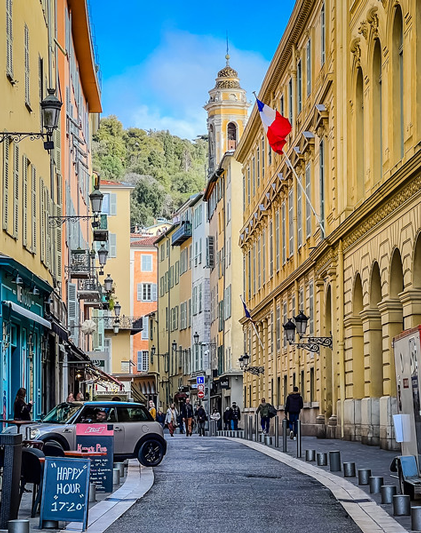

Parking
Several municipal parking lots are available at the bottom of the village. Allow 6€ to 7€ for the day. Once parked, you’ll have to walk up the picturesque streets to the castle. It’s a 10-15 minute walk uphill from the parking lot to the castle entrance.
Useful tips: duration, schedules, eating…
Best time to visit
Spring or autumn are ideal for avoiding the heat of the Provencal summer. We particularly appreciated the light at the end of the day, the famous “golden hour”, which beautifully gilded the white stones of the château. It’s the perfect moment for photographers! If you’re coming in summer, it’s best to visit early in the morning or late in the afternoon, to take advantage of milder temperatures.

Length of visit and main difficulties
Allow at least 1.5 hours for a complete lap without running. The site is very exposed to the wind: if the Mistral is blowing, hang on and avoid flying hats! We advise you to wear good shoes, as the ground is made up of rough rock, uneven steps and steep slopes.
Note that the Château des Baux-de-Provence can only be reached by walking through the village of Les Baux, along cobbled streets. The site provides a quadrix for people with reduced mobility (subject to conditions).

Advice on how to visit
You’ll start your visit with the Jardin Quiqueran. We loved strolling through this medieval-inspired garden: it’s a breath of fresh air in the castle’s mineral world. We recommend you start by exploring the military elements (Tour Sarrasine, Trou aux lièvres, Donjon) before discovering the remains of the lower part (troglodytic houses, cistern) before finishing with the panoramic views from the summit.

A LITTLE MORE patience
All the photos, maps, information, good addresses to make your stay in Provence a success, will soon be gathered in a single ebook!
If you wish to be informed of the publication of our guide on Provence, subscribe:

Visiting with children
Children love to run around the ruins and watch the catapults!
You can also opt for an escape game with them. In teams of 2 to 6, investigate the Mystery of Alix, the last Lady of Les Baux de Provence.
From April to September, medieval events are organized, with demonstrations of trebuchet and bricole firing. For more information on the program, visit the official website here.

Schedules and rates
Château des Baux-de-Provence is open all year round, every day, mainly from 9am to 6pm.
Prices are as follows:
- Full adult price: €10
- Reduced rate: €8 available for students
- Escape Game option: €5 / person in addition to château ticket
To consult the latest rates and the complete list of reduced-rate beneficiaries, go to the official website here.

Guided tours
There are no guided tours, but you’ll find interpretive panels along the way, useful for learning more about the castle’s history.
Content can be flashed directly from QR codes!

Catering
We didn’t spot any catering facilities during our visit. You’ll find plenty of options for dining out in the village below and discovering Provencal cuisine…
A formidable military architecture
As soon as you arrive, you’ll be captivated by the military architecture that reveals all its defensive power. The dreaded Tour Sarrasine, facing south to break the violent winds, bears witness to the ingenuity of medieval builders. We were particularly fascinated by the famous Trou aux lièvres. This sloping passage, a veritable death trap, enabled defenders to stun attackers from an overhanging terrace. Imagine the terror of invaders advancing through this corridor of death!

The Keep, although much eroded by the centuries, remains the centerpiece of the fortified complex. The rock has been cut 20m high to make it impassable. We recommend that you take the time to observe the different construction techniques used: the marriage between cut stone and natural rock is striking. You’ll understand why this fortress was considered impregnable in the Middle Ages.

Remarkable vestiges of troglodyte life
The exploration begins with a fascinating insight into the ingenious daily lives of medieval inhabitants. Don’t miss the troglodytic houses of Baume de Roucas, literally carved into the rock face. We were impressed by the level of detail: you can still see the fireplaces and shelves carved directly into the stone! This rock architecture bears witness to a remarkable adaptation to the environment. Right next door, the Maison du Four (kiln house) preserves some fine Renaissance features that contrast with the ruggedness of the troglodyte dwellings.

The huge Citerne reminds us that water was more precious here than gold. We were able to measure the ingenuity deployed to collect and store every drop of water in this arid environment. Look up at the Pigeonnier: the sight of the thousands of niches (“boulins”) carved into the cliff left us speechless. It’s a detail that suddenly makes daily life in the Middle Ages very real, reminding you of the importance of these birds for food and communication at the time.

Incredible views of Provence
This is undoubtedly the highlight of the show. Once at the top of the plateau, near the monument to Charloun Rieu or at the foot of the Donjon, the world opens up 360°. You’re literally on the roof of Provence, and we were overwhelmed by the immensity of the landscape. To the north and west, the view plunges into the Val d’Enfer, with its tormented shapes that would have inspired Dante to write his Divine Comedy, and extends over the Baux valley. It’s a sublime patchwork of geometric vineyards and silvery olive groves that produce some of the finest olive oil in the world.

We recommend that you take the time to immerse yourself in this typically Provencal landscape. To the south, on a clear day, the view extends as far as the Camargue, the town of Arles, and you can even make out the sparkling Mediterranean in the distance. It’s the ideal place to understand why this site was strategically impregnable: you’ll see the enemy coming from miles away. Take your time here, sit back on the rocks and let the raw beauty of Provence stretch out at your feet.

Subscribe to our Newsletter
- Get away from it all with Region Lovers’ beautiful destinations!
- Once a month
- Advertising-free

Frequently asked questions
What can you do in a day in Les Baux-de-Provence?
For an ideal day out in Les Baux-de-Provence, we recommend arriving early, climbing up to the famous Château des Baux to explore its troglodytic remains and enjoy breathtaking panoramic views over the olive valley to the sea. After a Provencal lunch on the terrace, take a refreshing dip in the Carrières de Lumières for a spectacular artistic immersion projected onto 14-meter-high walls.

Can you see the war machines in action at the Château des Baux-de-Provence?
Yes! From April to September, medieval events are organized on a regular basis. You’ll be able to watch impressive demonstrations of trebuchet and tinker shooting. We’ve found that this is often the children’s (and the grown-ups’!) favorite moment. The power of these reconstituted siege machines gives a striking idea of the violence of medieval combat.
For more information on the program, visit the official website here.

PLAN YOUR TRIP TO provence
Our articles are coming!
- Most beautiful cities in Provence (coming soon)
- Most beautiful beaches of Provence (coming soon)
- Most beautiful villages of Provence (to come)
- Most beautiful destinations in Provence (coming soon)